

 Find a book


Title
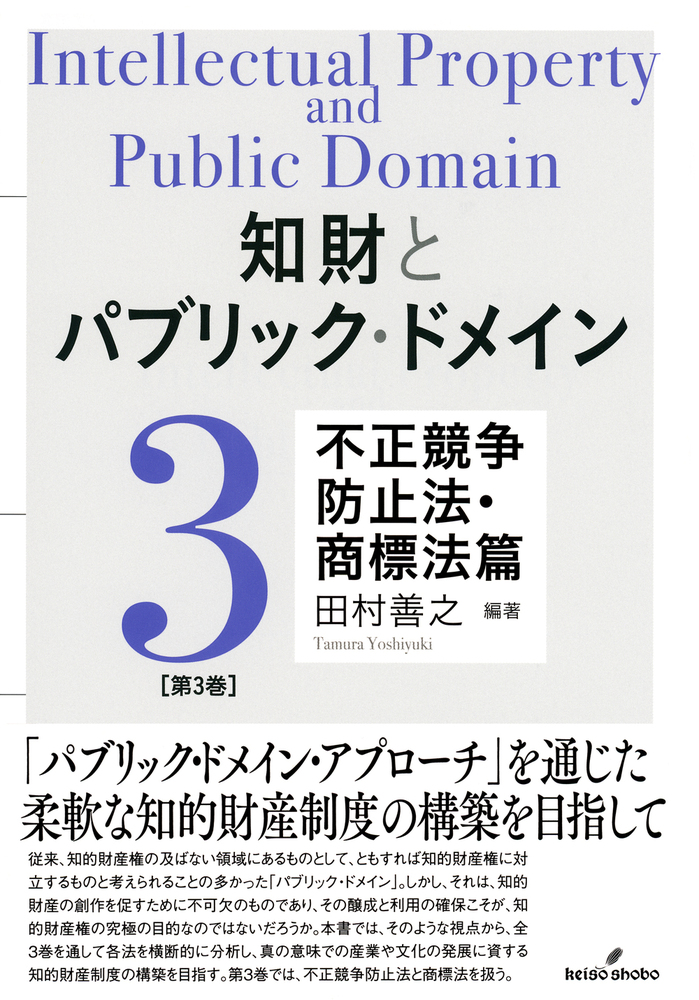
Intellectual Property and Public Domain Chizai To Public Domain 3: Fuseikyousou Boushi Ho / Shouhyou Ho Hen (Unfair Competition Law & Trademark Law)
Size
336 pages, A5 format
Language
Japanese
Released
February, 2023
ISBN
978-4-326-40416-2
Published by
Keiso Shobo
Book Info
See Book Availability at Library
Chizai To Public Domain 3: Fuseikyousou Boushi Ho / Shouhyou Ho Hen
Japanese Page
 eBook
eBook
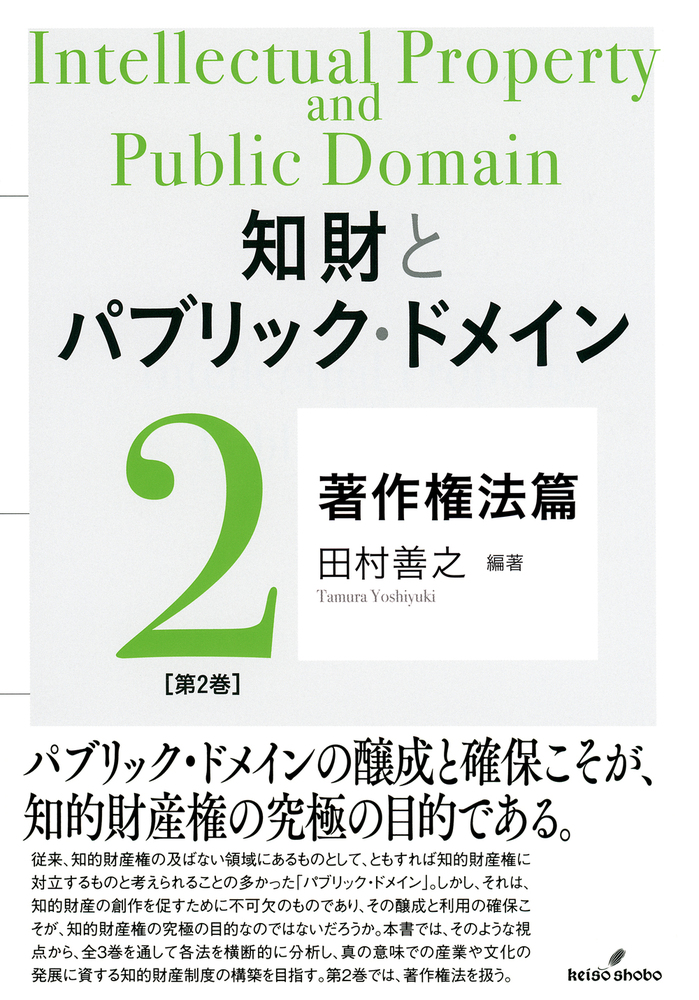
This book, the second in a three-volume series titled "Intellectual Property and the Public Domain," deals with trademark law and the Unfair Competition Prevention Act.
It is the result of the Grant-in-Aid for Scientific Research (S) "A Cross-sectional Study of Various Intellectual Property Laws from the Perspective of Cultivating and Securing the Public Domain" (2018-2022).
Conventionally, the "public domain" has often been thought of, consciously or unconsciously, as an area beyond the reach of intellectual property rights, and as being in opposition to intellectual property rights. However, if the purpose of establishing the intellectual property rights system is to promote the development of industry and culture by encouraging the creation of intellectual property, then intellectual property rights ultimately have the purpose of cultivating a public domain that is accessible to all.
However, the impetus for this research came from a literature review pointing out that while traditional intellectual property law has focused on intellectual creations and the concept of creators, the public domain has only been passively defined as something that is not subject to intellectual property rights, and has rarely received any attention. Indeed, if the purpose of intellectual property law is the development of industry and culture, then encouraging the creation of intellectual works and protecting them is a means to achieve this. Industrial and cultural development, in turn, should be achieved by enriching the public domain and ensuring its use. If this is the case, then fostering a public domain must be understood as the ultimate purpose of intellectual property law.
For example, in the fields of trademark law and unfair competition prevention law, there is often discussion that protection should be granted to property value. Recently, when the 2018 Unfair Competition Prevention Act was revised to regulate the misuse of restricted data, there was also a legislative argument that, since big data has value, a new right to protect big data should be established. In contrast, this study, based on the mindset of fostering a public domain, does not take an argument that property rights are the default, but rather takes a cautious stance toward expanding protection unless value is not only demonstrated but also a positive reason for doing so is presented. Therefore, with regard to big data, we advocate a behavioral regulation approach that focuses on regulating only illegal behavior, rather than an objective approach that focuses on protecting objects.
(Written by TAMURA Yoshiyuki, Professor, Graduate Schools for Law and Politics / 2025)