

 Find a book



Title
Shiranakatta de wa sumasarenai keieigaku no hanashi (Ignorance of management theory is no excuse)
Size
224 pages, A5 format
Language
Japanese
Released
June, 2026
ISBN
978-4-471-21064-9
Published by
Takahashi Shoten
Book Info
See Book Availability at Library
Japanese Page
This book is published by Takahashi Shoten, the publisher of “Takahashi’s Planners,” which I myself use. To be honest, I had no idea that Takahashi Shoten published general-interest books (I assumed they only published planners), so when editor Kota Nakatani visited my research lab, I was initially skeptical. However, after talking with him for a while, I began to grasp the kind of book we were aiming for. At that time, I mentioned several management-related topics offhand as potential material during our casual conversation. These topics were mainly based on drafts of essays I had previously written and left scattered here and there. Consequently, Chapter 1, “A Talk About Management,” compiles those stories in the form of a dialogue between the editor (who, within the book’s narrative, is portrayed as a 34-year-old section chief at a manufacturing company) and me. Indeed, the entire book is written in dialogue format. Furthermore, the questions and comments within these dialogues have been rewritten from the perspective of my editor, Mr. Nakatani. This was my first experience with this style of book writing—to borrow a term from the music industry, one might call it a “Nakatani-produced” work. It made me feel as though I had become an artist myself.
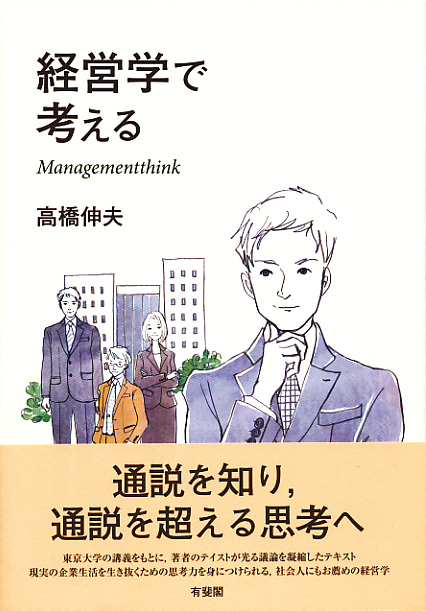
Chapters 2 through 4 of this book—“On Decision-Making,” “On Organizations,” and “On Motivation”—correspond respectively to Chapters 4 through 6 of my earlier book, Managementthink (Yuhikaku): “Reasons for Decision-Making,” “Reasons for Cooperation,” and “Reasons for Working.” Readers who prefer in-depth discussions may find that book better suited to their needs. However, this book is far easier to understand. To be honest, I never imagined that Mr. Nakatani would take such immediate interest in theoretical topics like game theory and the Prisoner’s Dilemma. He bombarded me with questions, and I did my best to answer them, so the content should be easy to understand even for beginners. This was a valuable learning experience for me as well: I came to realize that even “middle-aged guys” (my apologies!) can take genuine interest in such topics, and that explaining them this way helps foster understanding. In that sense, this book demonstrates just how socially significant even the driest academic research can be.
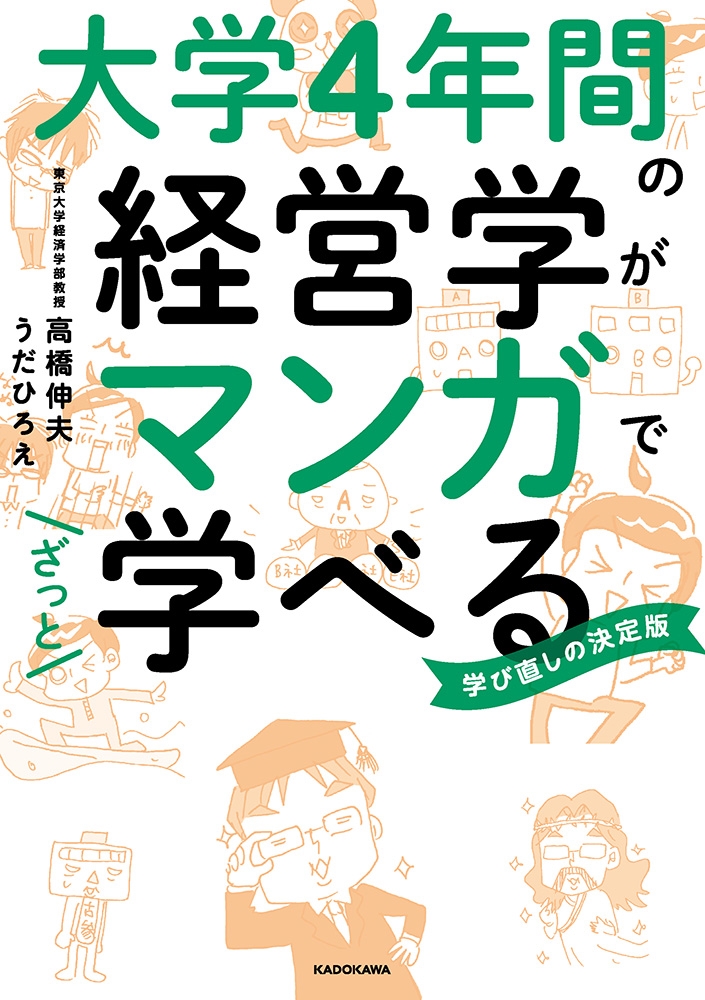
Following Mr. Nakatani’s instructions, I also wrote several additional drafts—such as “Questions from the Professor” and their corresponding “Answers.” When I saw the finished book, I was impressed, thinking, “Ah, so this is how it turns out.” In that sense, this book differs from those I have previously been involved with, not only in how it was made but also in what it aims to achieve. For me, it represents an entirely new genre. In a sense, I can proudly call it “a book written for the general public.” Incidentally, our dialogue is set in a specific café near Ueno Station—a small detail—and readers might enjoy speculating, “I wonder where that is?” The book is sprinkled with many illustrations of me—upon seeing them, my wife laughed, saying, “That looks just like you!” Overall, this is a book that can be enjoyed in many different ways.
(Written by TAKAHASHI Nobuo, Professor Emeritus, Graduate School of Economics / 2026)