

 Find a book


Title
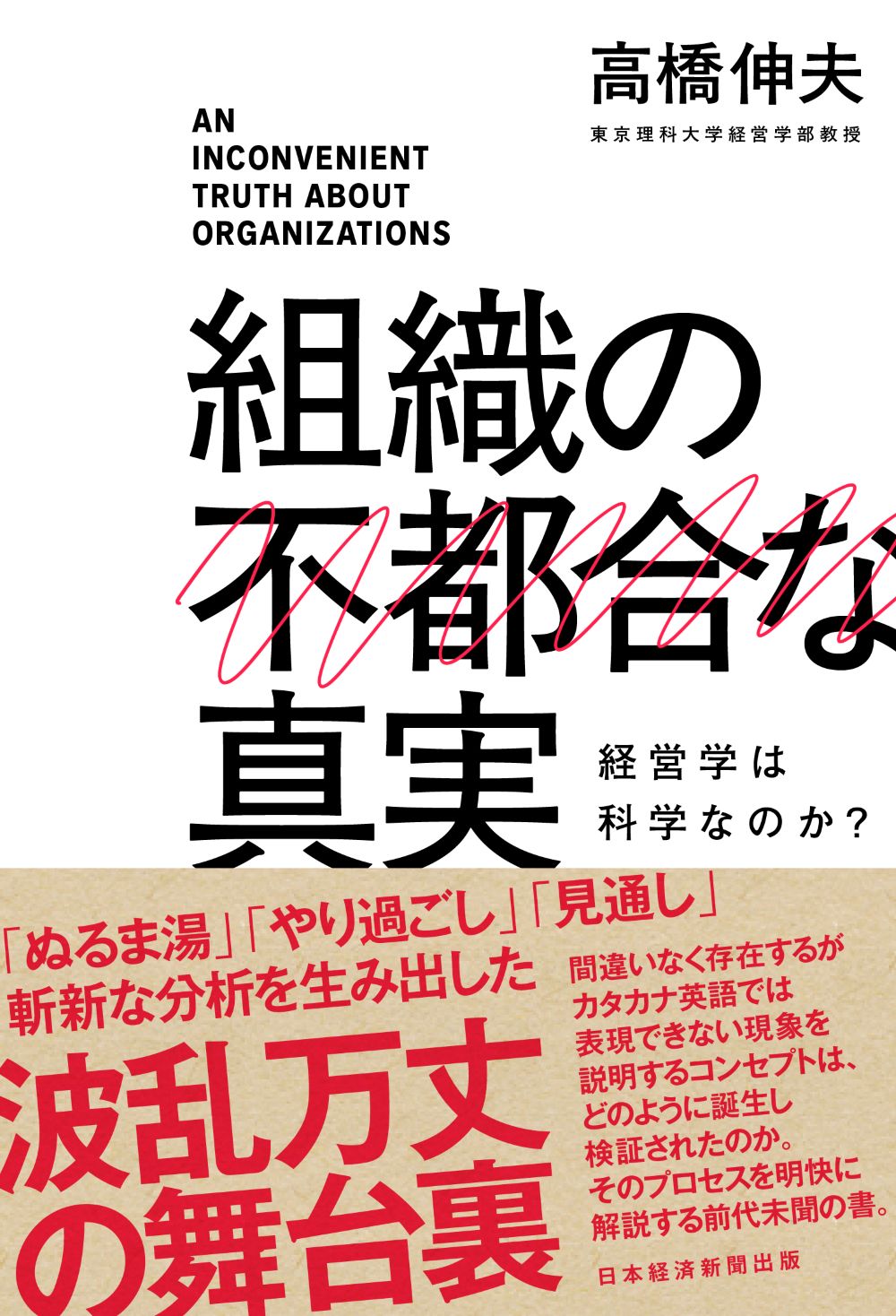
Soshiki no futsugō na shinjitsu (An inconvenient truth about organizations - Is it science?)
Size
348 pages, 127x188mm
Language
Japanese
Released
March 30, 2026
ISBN
9784296125142
Published by
Nikkei Business Publications, Inc.
Book Info
See Book Availability at Library
Japanese Page
This book is based on the author’s final lecture, “Management Studies in the Yamato Language,” delivered upon his retirement from the Faculty of Economics at the University of Tokyo, where he served for 30 years. Partly for this reason, it adopts a style reminiscent of an autobiography or a history of research; however, this stylistic choice was made to soften the tone and ensure readers find the book engaging and accessible. In terms of content, as the subtitle suggests, this book raises the question of whether contemporary management studies can truly be considered a science. This is not merely a criticism. As the author wrote in both the “Preface” and “Afterword,” his research is based on the belief that “science does not exist where there is no thrill of being contradicted by data.” This is a question based on the findings of that research.
For example, in 1989, the author proposed the “Effective Temperature Hypothesis” in an academic journal, which posits that the “nurumayu (lukewarm) feeling” within organizations can be explained by the difference between an individual’s “body temperature” as an organizational man and the workplace’s “system temperature” (i.e., the temperature of the water). For over 30 years since then, the author has collected and analyzed survey data from tens of thousands of people. Thus far, the data continues to support the Effective Temperature Hypothesis. While many people criticize the “lukewarm feeling” phenomenon out of hand without giving it much thought, it has been scientifically demonstrated that this is not necessarily a bad thing—rather, it is a sign of organizational health.
On the other hand, regarding the recently popular concept of self-determination, the author formulated the “Self-Determination Hypothesis”—which posits that “the higher the sense of self-determination, the higher the job satisfaction”—and began investigating it as early as 1990. Initially, this hypothesis also appeared to be supported by data from cross-sectional surveys. However, it was later refuted by data from a comprehensive survey conducted once a year from fiscal years 2004 to 2015—a total of 12 times—covering all 1,200-plus full-time employees at Company X. Company X underwent a large-scale organizational restructuring midway through the study, which caused significant fluctuations in the data; as a result, it became clear that the consistently observed correlation between the degree of self-determination and the job satisfaction ratio was, in fact, a spurious correlation. There was no causal relationship between the two.
The author also sounds the alarm regarding the overuse of computer simulations that lack support from survey data. What first got the author interested in computer simulations was an encounter with the “garbage can model.” The author became curious to investigate whether the organizational phenomena assumed in simulation models were actually occurring. It took me five years from the time I first learned of the garbage can model in 1982 until I came up with the idea of using the term “yarisugosu” in Japanese. It wasn’t until 1991 that I was able to conduct a survey using a questionnaire that included the item “Even when instructions are given, they sometimes fade away while I yarisugosu,” after overcoming resistance from those on the front lines. Despite such strong resistance, 66% of respondents answered “yes,” and I published the findings in an academic journal in 1992. It truly took ten years. At the time, “yarisugosu” only had the meanings “(1) to let something coming from behind pass in front of you” and “(2) to go beyond a limit,” so I started using it, assuming that Japanese people would understand it as an extension of meaning (1). This is the advantage of using Japanese terms when speaking to Japanese people. Now, the Kojien, the leading Japanese dictionary, has added the following meaning: “to let a situation run its course and to avoid getting involved with troublesome matters,” which best describes the “yarisugosu” phenomenon I am referring to. I am delighted that it has gained acceptance both as a phenomenon and as a Japanese term.
(Written by TAKAHASHI Nobuo, Professor Emeritus, Graduate School of Economics / 2026)