

 Find a book


Title
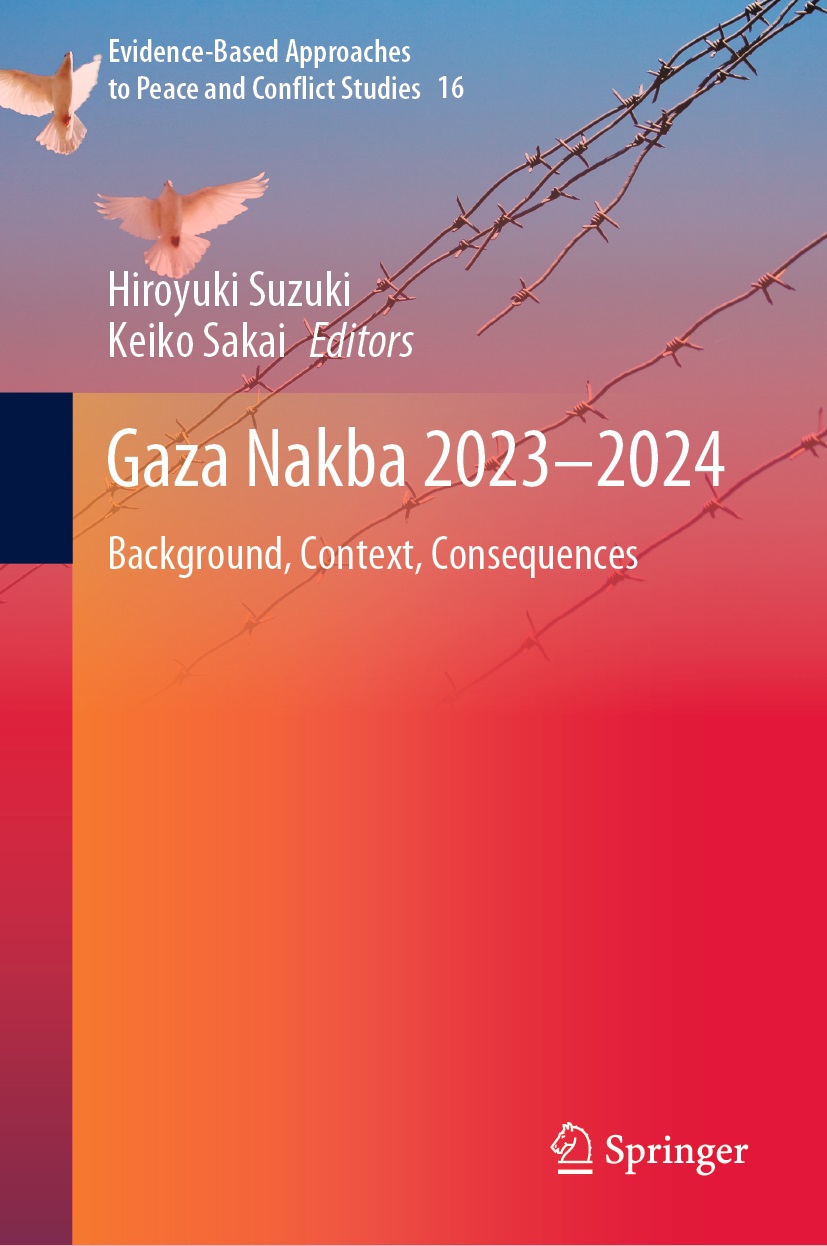
Evidence-based approaches to peace and conflict studies; volume 16 Gaza Nakba 2023–2024 Background, Context, Consequences
Size
242 pages
Language
English
Released
January 16, 2025
ISBN
978-981-97-4867-9
Published by
Springer Singapore
Book Info
See Book Availability at Library
Japanese Page
 eBook
eBook
This book was published as part of Springer's “Evidence-Based Approaches to Peace and Conflict Studies” series. Compiled in response to the escalating tensions in Gaza, it is an English-language volume authored primarily by scholars based in Japan.
Most of the content of this book is based on a public symposium addressing the Gaza situation held at the Komaba Campus of the University of Tokyo on November 16, 2023. At the same venue, just one and a half months earlier, another public lecture was held to reflect on the 50th anniversary of the oil shock. In 1973, when Japan faced energy security challenges and began pursuing its Middle Eastern diplomacy, the Palestinian question became central. Chief Cabinet Secretary Susumu Nikaido of the Kakuei Tanaka Cabinet issued a statement declaring that the Japanese government supported a just resolution of the Palestinian question and the Palestinian people's right to self-determination. He concluded by stating, “Depending on how the situation develops in the future, we may have no choice but to reconsider our policy toward Israel.” A delegation led by Deputy Prime Minister Takeo Miki, who later became Prime Minister, was dispatched to the Middle East. They traveled to Egypt and Saudi Arabia to explain the Japanese government's stance on Palestinian issues. This diplomatic effort, which had been triggered by the Yom Kippur War, was undertaken with the oil shock in mind. Japanese diplomacy toward the Middle East proceeded independently of U.S. policy in the region until the Gulf Crisis erupted in 1990, when the Japanese Self-Defense Forces were deployed overseas for the first time on a large scale under the banner of international contributions.
Fifty years after the oil crisis, the war in Gaza has sharply challenged not only the Japanese government but also Japanese society regarding how to confront the Palestinian question. Scholars are required to reflect on their stances. The publication of this book was also once in jeopardy. This stemmed from the fact that the publisher was cautious about passages that were critical of Israel. While such confusion is unfortunately rare in Japan, there was concern that questioning Israeli policies could be criticized as an anti-Semitic discourse. Through this editing process, I inadvertently witnessed how the English discourse space was constrained by associations with past anti-Semitism. As a person involved in editing this book, I am deeply interested in how it will be evaluated as it moves beyond Japan's discourse space into the English-speaking world. A comparison of this book with other English publications on the Gaza situation is also recommended.
(Written by SUZUKI Hiroyuki, Project Associate Professor, Graduate School of Arts and Sciences / 2025)
Table of Contents
Introduction: Nakba(s) That Killed All the Norms
Keiko Sakai
Where Will Separation Lead? The Humanitarian Crisis in Gaza and Future Prospects
Hiroyuki Suzuki
Israel’s Ongoing Annexation of East Jerusalem: Oppressing Palestinian National Sentiments Before and After October 7
Kensuke Yamamoto
Culture and Resistance in Palestine: Rap Music from Gaza
Kaoru Yamamoto
In the Shadow of Israel’s Prosperity: The Illiberal History of the Liberal International Order
Taro Tsurumi
How Public Opinion in Israel Shifted: Insights from Post-Cross-Border Attack Opinion Polls
Hiroshi Yasui
From Oil Weapon to Mediation Diplomacy: An Examination of the Gulf States’ Responses to the Gaza War
Koji Horinuki
The Myth of Vertical Integration in Regional Conflict: Iran and the “Axis of Resistance”
Yasuyuki Matsunaga
Gaza War 2023–2024 and Reactions from Neighboring Countries: Egypt, Jordan, Lebanon, and Syria
Rawia Altaweel
The Gaza War from the Perspective of International Law
Ai Kihara-Hunt
Japan’s Foreign Policy Regarding the Arab-Israeli Conflict and the Palestinian Question from the Perspective of Three Factors
Ryoji Tateyama
Epilogue: Unsolved Settler Colonialism and Devastation of Global Norm
Keiko Sakai
Related Info
Juno Kawakami, responsible editor for the book Gaza Nakba 2023–2024: Background, Context, Consequences (https://link.springer.com/book/10.1007/978-981-97-4868-6) interviewed the volume editors, Hiroyuki Suzuki and Keiko Sakai, about topics related to their book. (Springer Nature August 28, 2025)
https://communities.springernature.com/posts/gaza-nakba-2023-2024-background-context-consequences
Symposium:
The Impending Humanitarian Crisis in Gaza (16th November 2023) (JSPS Kakenhi “Protest on the Street, and Reconsider the Nation: from the view points of space, violence and resonance” (21H04387, PI: Keiko Sakai), Japan Association for Middle East Studies (JAMES), The University of Tokyo Centre for Middle Eastern Studies (UTCMES) November 16, 2023)
https://park.itc.u-tokyo.ac.jp/UTCMES/2023/11/02/symposium/?lang=en