

 Find a book


Title
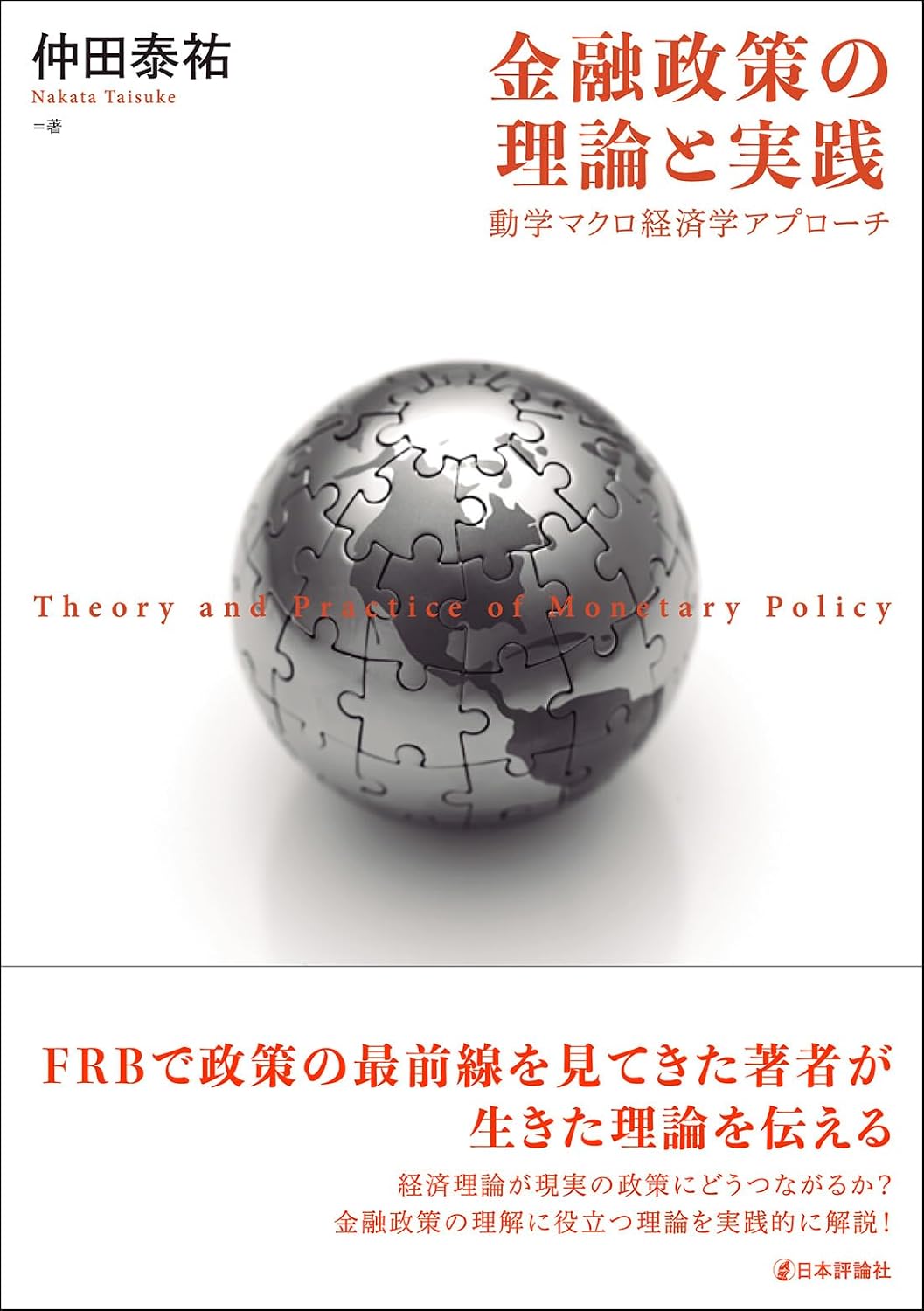
Kin-yu Seisaku No Riron to Jissen (Monetary Policy in Theory and Practice - A Dynamic Macroeconomic Approach)
Size
260 pages, A5 format
Language
Japanese
Released
February, 2026
ISBN
978-4-535-54129-0
Published by
Nippon Hyoron sha co., Ltd.
Book Info
See Book Availability at Library
Japanese Page
 eBook
Monetary policy is attracting considerable attention.
In Japan, the COVID-19 crisis brought an end to more than three decades of low inflation and low interest rates. At the time of writing, inflation remains above the Bank of Japan’s 2 percent target, and considerable attention is focused on how far—and at what pace—the Bank will raise its policy rate. Developments at the Bank of Japan, which is responsible for monetary policy and price stability, are featured in the news almost daily.
For readers seeking a more systematic understanding of monetary policy, this book provides a practical introduction to a range of theories based on dynamic macroeconomic models. These models have become standard tools in monetary policy analysis among policymakers and researchers and have exerted a major influence on the ideas and philosophies underlying actual monetary policy. Throughout the book, the theories are presented in close connection with the realities of policymaking.
From 2012 to 2020, the author served on the macroeconomic modeling team at the Federal Reserve Board, the central governing body of the U.S. Federal Reserve System, where he conducted a wide range of academic and policy-oriented analyses of monetary policy. This experience provided a close view of how theoretical analysis contributes to actual monetary policy decisions and how it has shaped the ideas and philosophies governing the conduct of monetary policy. Drawing on that experience, the book not only introduces theories based on macroeconomic models but also explains how those theories relate to Federal Reserve policy.
The book is organized as follows.
Chapter 1 introduces the New Keynesian model, a dynamic macroeconomic model that appears repeatedly throughout the book. It then examines the model’s steady state and presents several simple simulations.
Chapters 2 through 5 focus primarily on theories that were particularly useful in addressing a question the Federal Reserve had to confront continuously during the seven-year period in which the federal funds rate was constrained by its effective lower bound, from December 2008 to December 2015: How long should interest rates remain at zero?
Chapters 6 and 7 examine the policy challenges of the period from January 2016 to March 2020, when the policy rate was positive but remained low. They also discuss the Federal Reserve’s review of its monetary policy strategy, which began in 2019, the adoption of average inflation targeting in August 2020 as a result of that review, and the theories that played an important role in these developments.
Chapters 8 and 9 introduce two theories essential to understanding the Federal Reserve’s monetary policy response to the post-pandemic surge in inflation: the theory of cost-push shocks and the theory of inflation bias.
Finally, the concluding chapter considers what kinds of theoretical research are especially valuable for the conduct of monetary policy, the directions in which such research should develop, and the issues that policymakers should keep in mind when applying model-based analysis to policy decisions.
Dynamic macroeconomic models are used extensively in economic analysis at the Federal Reserve. This book therefore aims not only to explain the macroeconomic models commonly used in monetary policy analysis and the theories underpinning Federal Reserve policy, but also to provide a detailed account of how model-based analysis is actually used in the policymaking process. It also presents several specific examples of publicly available model-based analyses.
Mathematical models can inform policy decisions in many areas beyond monetary policy. The Federal Reserve’s practical use of such models may therefore also offer useful lessons for considering how mathematical modeling can be applied in other areas of public policy.
(Written by NAKATA Taisuke, Professor, Graduate School of Public Policy, Graduate School of Economics / 2026)