

 Find a book


Title
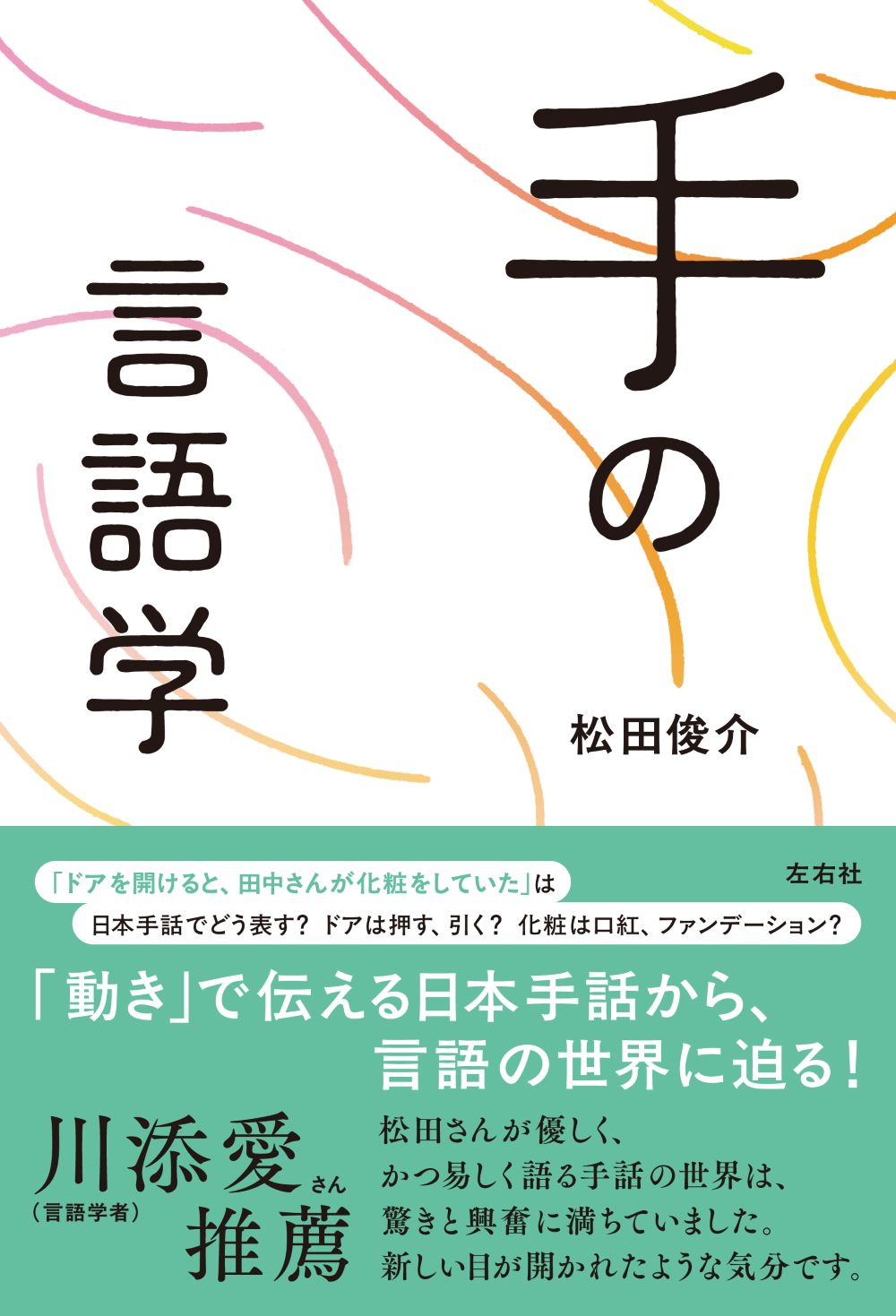
Te no Gengogaku (The Linguistics of the Hand)
Size
260 pages, 127x188mm, softcover
Language
Japanese
Released
March 31, 2026
ISBN
978-4-86528-511-6
Published by
Sayusha
Book Info
See Book Availability at Library
Japanese Page
In March 2026, I published Te no Gengogaku (The Linguistics of the Hand), a book for general readers about Japanese Sign Language (JSL). It is, quite simply, a collection of things that I personally find fascinating about JSL. In many ways, it's a book driven by my own curiosity, so I wasn't sure how readers would respond to it. Thankfully, the book has received a much warmer response than I ever expected.
When I think about why that might be, two possible reasons come to mind.
(1) It is a book about both Japanese Sign Language and Japanese
Throughout the book, I introduce interesting features of JSL by comparing it with Japanese. As a result, readers not only learn about JSL but also gain a fresh perspective on their own language.
Take the Japanese verb akeru ("to open"), for example. It can be used for many different kinds of things: hikidashi o akeru ("open a drawer"), kāten o akeru ("open the curtains"), mado o akeru ("open a window"), and so on. Of course, opening a drawer and opening curtains involve very different actions. In Japanese, however, we can simply ignore that difference and use the same word, akeru, for both. JSL, by contrast, does not have a single sign that can be used this broadly. Instead, the sign changes depending on how something is opened.
Looking at JSL in this way also reveals something about Japanese. You suddenly realize that Japanese simply doesn't care very much about how something is opened—it uses the same verb regardless. Discovering something new about the language may have been one of the reasons why readers enjoyed the book.
(2) It invites readers into linguistics through everyday experiences
I also tried to draw my examples from everyday life whenever possible. For example, one chapter starts with a menu item from a Chinese restaurant near the University of Tokyo and uses it as a starting point for exploring newly created signs in JSL.
The subject matter of linguistics is language itself—something we encounter every day. Linguistic questions are all around us, waiting to be noticed. I like to think that readers responded to the book because they felt these questions were not distant academic puzzles but part of their own everyday lives.
***
A review of the book was published in the Asahi Shimbun by Tetsuya Furuta, a professor in the Department of Ethics at the University of Tokyo. One sentence that particularly stayed with me was: “The author’s sheer joy in exploring Japanese Sign Language comes through loud and clear.” And he is absolutely right—I really do love exploring JSL.
It has been almost ten years since I first encountered JSL, and not once have I wanted to stop studying it. I imagine that JSL will remain a part of my life for many years to come. If this book can help readers experience even a little of the joy of exploring language, I would be truly delighted.
(Written by MATSUDA Shunsuke, Assistant Professor, Graduate School of Humanities and Sociology / 2026)