

 Find a book



Title
Democracy in Japan The Logic of One-Party Dominance
Size
202 pages, hardcover
Language
English
Released
March, 2026
ISBN
9798855806052 (hardcover)
9798855806069 (paperback)
Published by
State University of New York Press
Book Info
See Book Availability at Library
Japanese Page
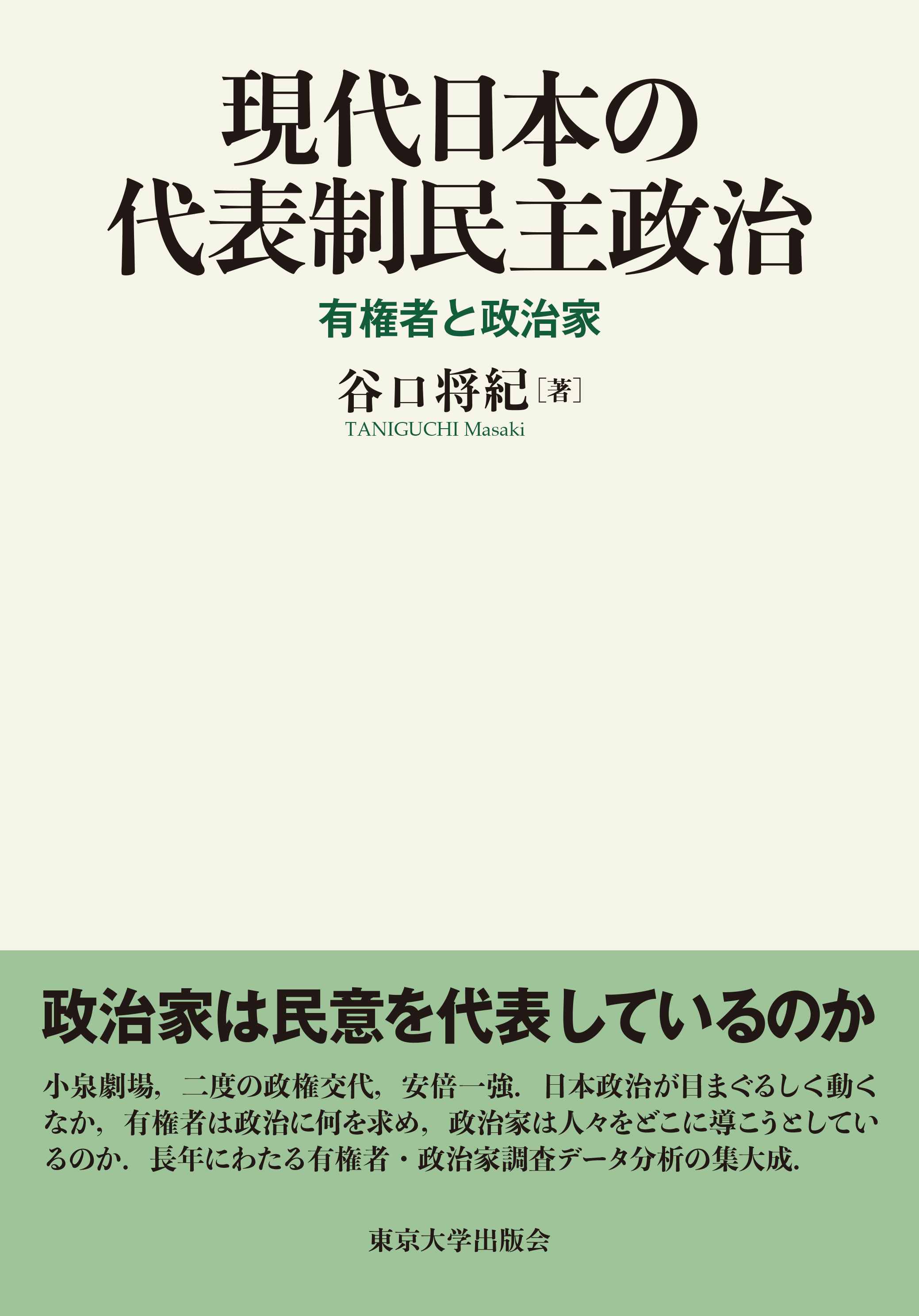
This volume represents the culmination of the UTokyo-Asahi Survey (UTAS), a long-term empirical research project in which the author has served as a principal investigator since its inception in 2003. The survey has continuously collected data from Japanese voters, members of the National Diet, and electoral candidates. Drawing on this unique body of evidence, this book offers an empirical analysis of the relationship between Japan's party politics and voters’ and politicians’ preferences. In particular, it compares the policy preferences of individual politicians, including every prime minister elected during the survey period, with those of voters on a common ideological scale. Thus, it provides a new perspective on political changes in Japan. By examining not only electoral outcomes and party competition but also the evolving attitudes of voters and political elites that underpin them, this book presents a more comprehensive understanding of contemporary Japanese politics.
The book makes two principal contributions to literature. The first is methodological. Surveys of politicians have traditionally yielded low response rates, raising concerns about their representativeness and reliability. However, through close collaboration with Asahi Shimbun's election coverage, UTAS has consistently achieved valid response rates exceeding 90 percent among electoral candidates. Moreover, by incorporating many identical questions in both voter and politician surveys, a dataset was created to enable direct comparisons between the political attitudes of citizens and political elites. To the best of my knowledge, this survey design is unparalleled internationally. I hope that the resulting dataset will likely prove valuable not only for scholars of Japanese politics but also, more broadly, for researchers of comparative politics.
The second contribution concerns what these data reveal about the nature of contemporary one-party dominance in Japan. Since 2012, the Liberal Democratic Party (LDP) has moved significantly to the right on foreign and security policies while maintaining a prolonged hold on power. The analyses presented in this book do not suggest that this outcome resulted from a corresponding conservative shift among Japanese voters. Rather, they show that the LDP retained its long-term advantage in party identification even during the Democratic Party of Japan (DPJ) administration and restored its advantage in economic valence, simultaneously. Together, these factors compensated for the ideological distance between the party and the electorate and enabled it to sustain its electoral support. These findings suggest that Japanese voters do not choose parties based solely on ideology; evaluations of governing competence and economic management play equally important roles. These results offer new empirical insights into the dynamics of party competition in Japan.
The UTAS has now been conducted for nearly a quarter of a century. Using survey data collected from voters and politicians, this book documents a period of profound political change in Japan, including two alternations of government. The accumulation of these data will contribute, however modestly, to deepening scholarly debates on Japanese politics and advancing future empirical research.
(Written by TANIGUCHI Masaki, Professor, Graduate Schools for Law and Politics / 2026)
Table of Contents
1. Disruption and Revival of the Dominant Party
2. Ideological Issues
3. Economic Issues
4. Policy Diversity within the Party
5. Policy Position of the Executive Branch
6. Allowing Agency Slack
7. Opposition Parties under One-Party Dominance
Conclusion
Appendix: The UTokyo-Asahi Survey