


 Find a book


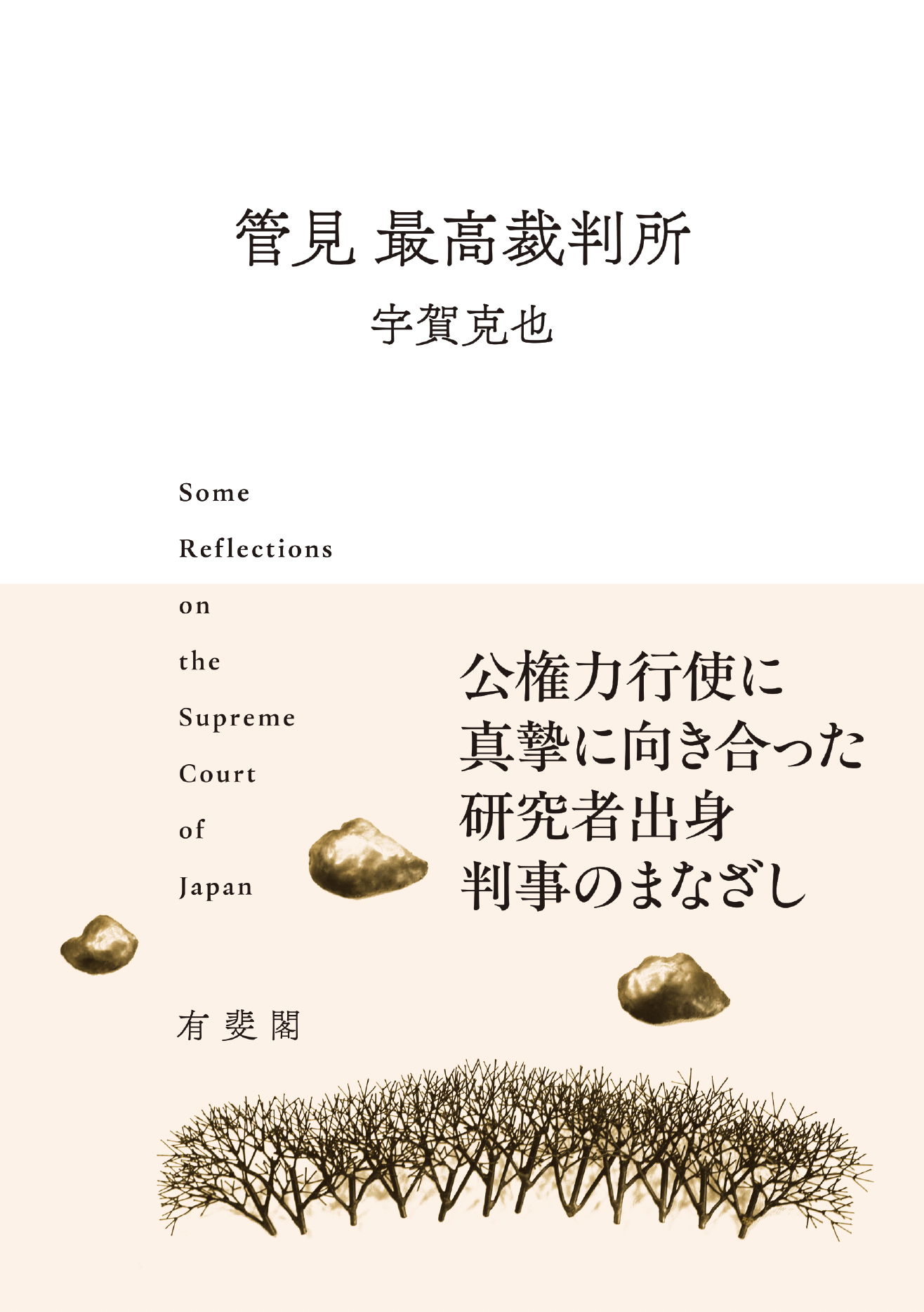
Title
Kanken Saikousaibansho (Some Reflections on the Supreme Court of Japan)
Size
390 pages, A5 format, hardcover
Language
Japanese
Released
May 29, 2026
ISBN
9784641126718
Published by
Yuhikaku Publishing Co., Ltd.
Book Info
See Book Availability at Library
Japanese Page
 eBook
This book is a memoir based on the author’s experience serving as a Supreme Court justice. Having spent 38 years at the University of Tokyo’s Faculty of Law engaged in research and education in administrative law, the author experienced considerable culture shock when he transitioned to the entirely different world of judicial practice after turning sixty. However, precisely because of his background as a long-time researcher, he frequently questioned practices that career judges—who had worked in the judicial system since their youth—took for granted. In this book, he proposes specific measures for improvement. For example, regarding decisions to dismiss appeals, the Third Small Chamber, to which the author belonged, had a practice whereby, if opinions were divided on whether to dismiss an appeal, the names of the judges who favored acceptance were listed, and the decision was recorded as a unanimous dismissal excluding those judges; it was not permitted to state the reasons for favoring acceptance. However, in this book, the author argues that if even a single judge opposes dismissal, the appeal should be accepted to allow that judge to write a separate opinion, as this aligns with the original intent of the system. Furthermore, regarding cases to be deliberated by the Supreme Court, it is customary for a Supreme Court Research Officer to prepare a report in advance that summarizes the facts of the case, identifies the issues in dispute, and reviews trends in case law and legal scholarship, as well as setting forth the assigned Research Officer’s own opinion and proposed course of action; however, This book argues that this practice risks giving the assigned research officer’s opinion too much influence. Therefore, it proposes that commentaries on relevant precedents—such as first-instance and appellate court judgments—as well as expert opinions submitted regarding the case be attached to the research officer’s report to ensure that justices read them and are exposed to views differing from those of the assigned research officer. Furthermore, the research officer’s report should be limited to presenting multiple possible interpretations and should not include the research officer’s personal opinions or proposed course of action. Furthermore, it has been proposed that, while all Supreme Court justices are currently selected from career judges, scholars and attorneys should be included among Supreme Court research officers to promote diversity in discussions within the Research Office. Furthermore, at the Supreme Court, all cases are first assigned to a small panel; if there is a suspicion of unconstitutionality or a need to discuss a change in precedent, the case is referred to the full court. However, in a five-member small panel, the case will not be heard by the full court unless a majority of three members vote in favor of referral. This book refers to this as the “small chamber barrier.” Since whether a case can be referred to the Grand Chamber may depend on the random assignment of the case to a particular small chamber, the book also proposes a system reform that would allow referral to the Grand Chamber if even a single judge requests it.
In Part 2 of this book, the author provides an overview of the facts, the ruling, and the author’s separate opinion for each judgment and decision on which he wrote a separate opinion, along with his own commentary.
(Written by UGA Katsuya, Professor Emeritus, Graduate Schools for Law and Politics / 2026)
Related Info
Supreme Court of Japan Associate Justice at the Hawaii Supreme Court (Hawaii State Judiciary June 2, 2022)
https://www.courts.state.hi.us/news_and_reports/2022/06/supreme-court-of-japan-associate-justice-at-the-hawaii-supreme-court
Asian-Pacific Law & Policy Journal: Jurisprudence of Justice Katsuya Uga of the Supreme Court of Japan (University of Hawaiʻi at Mānoa May 23, 2022)
https://manoa.hawaii.edu/aplpj/2022/05/23/jurisprudence-of-justice-katsuya-uga-of-the-supreme-court-of-japan-by-chiako-fukushima/
Japan top court rules gender alteration ban for parent of underage child constitutional (The Mainichi Dec 3, 2021)
https://mainichi.jp/english/articles/20211203/p2a/00m/0na/035000c
Top court holds gender cannot be changed while raising a minor (The Asahi Shimbun Dec 2, 2021)
https://www.asahi.com/ajw/articles/14493640