


 Find a book


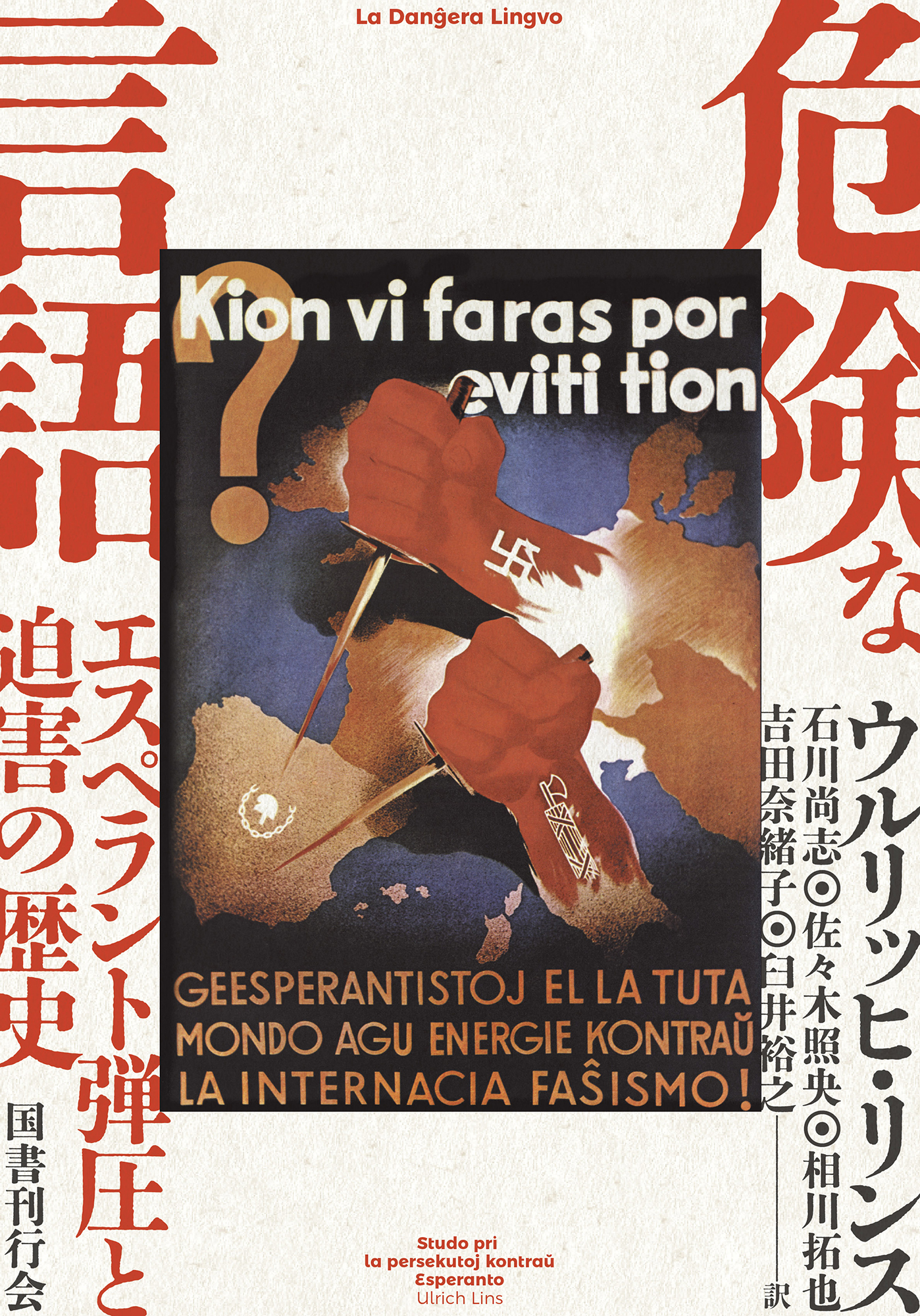
Title
Kiken na gengo (The Dangerous Language - A History of Persecution against Esperanto)
Size
496 pages
Language
Japanese
Released
September 17, 2025
ISBN
978-4-336-07790-5
Published by
Kokushokankokai Inc.
Book Info
See Book Availability at Library
Japanese Page
This book is a complete translation of Ulrich Lins, La danĝera lingvo: Studo pri la persekutoj kontraŭ Esperanto, Rotterdam: Universala Esperanto-Asocio, 2016. As its subtitle indicates, this historical work documents the suppression and persecution in various parts of the world against Esperanto—the language invented as a remedy for international communication in the late 19th century, alongside the culture and ideas cultivated and practised within the community of Esperanto users as they navigated these hardships.
The author, Ulrich Lins, is a German historian who mastered Esperanto at a young age. He played a central role in the organised movement centred on the World Esperanto Association (Universala Esperanto-Asocio) and has published numerous studies in Esperanto. With Japanese studies being one of his fields, he also has deep connections with Japan.
The origins of this book can be traced back to a series published in an Esperanto magazine issued in Kyoto (1971–1973). The expanded and supplemented version of the series was translated into Japanese by Kurisu Kei, a scholar of Czech literature, and published as an Iwanami Shinsho volume in 1975. It has since been referenced as one of the most valuable works of Esperanto studies available in Japanese.
Esperanto is an international language that was first published in Warsaw in 1887 by Ludoviko Zamenhof, a Jewish ophthalmologist. Under the dual circumstances of the Russian Empire’s rule and the anti-Semitism prevalent across Europe, Zamenhof designed Esperanto as a means of overcoming the barriers that divide humanity.
Amidst the advancing internationalisation, particularly in Western Europe at the turn of the 19th and 20th centuries, the well-designed language of Esperanto gained users worldwide. It served as a vehicle for Zamenhof’s idealism internal to the language, and, at times, ideologies such as communism and anarchism across linguistic barriers. The Esperanto movement, a cultural endeavour aimed at promoting Esperanto and sustained by Esperanto speakers worldwide, was a foundation supporting these developments, and it continues to maintain its vitality to the present day.
This book is divided into three sections. Part One describes the development of Esperanto in Europe, from its birth to the period around the First World War, and serves as a prehistory for the main narrative. The core of the discussion lies in Parts Two and Three. The former deals with the situation in Germany after the First World War (particularly during the National Socialist period). The latter narrates the history of the Esperanto movement in the Soviet Union.
What immediately strikes the reader, is the fierce hostility and suspicion directed by the authorities towards the Esperanto movement — a largely modest activity involving mostly anonymous citizens — and the sheer brutality of the persecution based on such sentiments. The author carefully examined vast archives, including official documents from National Socialist Germany and the Soviet Union, to illuminate the beliefs and motivations of the authorities behind these repressions. The book’s well-structured arguments are complemented by over 1400 footnotes throughout, demonstrating the thoroughness of the author’s years of archival research.
Equally compelling and deeply moving is the portrayal of human solidarity, among the Esperanto speakers, within these extreme circumstances. Even after the organised movement collapsed, Esperanto speakers risked their lives to shelter their persecuted friends, secretly studied Esperanto in concentration camps, and attempted to discreetly report the reality of the terror regime through international correspondence.
As the author emphasises in his conclusion, this must surely have been an expression of the energy and positivity essential to the practice of Esperanto learners: a voluntary endeavour to transcend the boundaries of nationality and ethnicity, seeking to establish equal and friendly relations with other people. This energy and positivity are reflected in the book’s narrative. The footnotes reveal numerous accounts based on interviews with survivors of persecution and suppression. The author’s own long-standing practical use of Esperanto, alongside his cross-border activities and cultivation of relationships with diverse people, is evident in the writing itself.
While one might feel that Esperanto movement history, the theme of this book, is somewhat peripheral, its content should appeal to a broad readership. Discussions touching on broader themes such as the various ideological challenges of peace movements, and the relationships between language and power, nationalism, and racism, appear throughout the book. One could also view this work as a history of popular culture within totalitarian societies, or as a history of international communication centred on 20th-century Europe. I hope that this fundamental text in Esperanto studies, like the previous Iwanami Shinsho edition, will serve as a reference for many readers.
(Written by AIKAWA Takuya, Assistant Professor, Graduate School of Arts and Sciences / 2026)