

 Find a book


Title
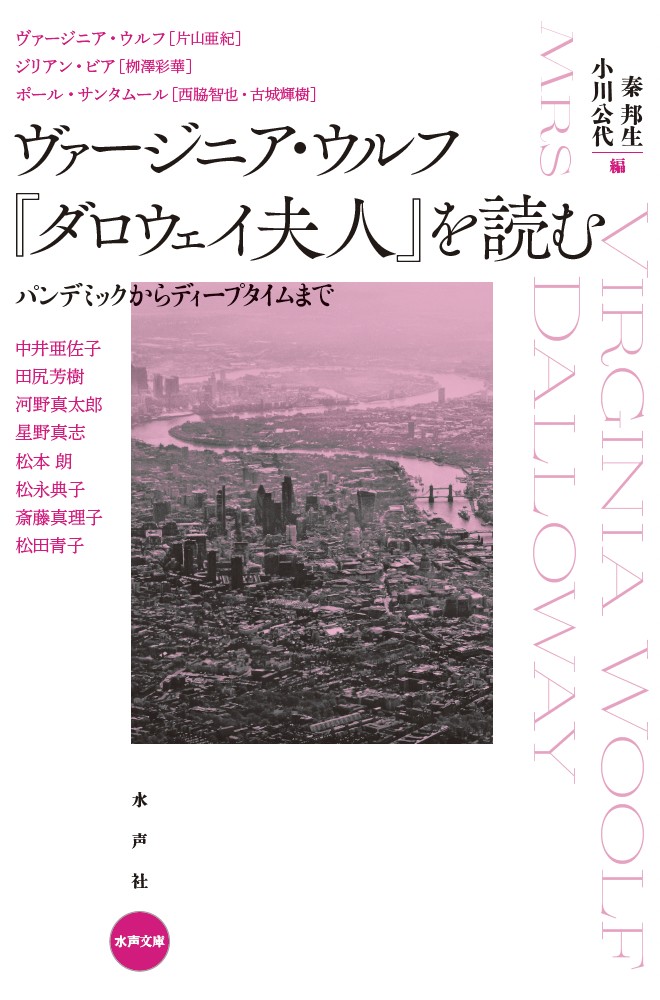
Suisei Bunko Virginia Woolf’s Dalloway Fuzin wo Yomu (Reading Virginia Woolf’s Mrs Dalloway - From Pandemic to Deep Time)
Size
336 pages, 127x188m, hardcover
Language
Japanese
Released
September, 2025
ISBN
978-4-8010-0882-3
Published by
Suisesha
Book Info
See Book Availability at Library
Japanese Page
This volume is a collection of scholarly essays compiled to commemorate the centenary of the publication of Virginia Woolf’s magnum opus, Mrs. Dalloway. While Woolf has garnered significant contemporary attention as a pioneering feminist and a pacifist thinker and critic, it was this novel, published on May 14, 1925, that solidified her reputation as a preeminent modernist author.
The narrative unfolds in London on a single Wednesday morning in June 1923, centering on the enigmatic intersection of the lives and deaths of Clarissa Dalloway, an upper-class socialite, and Septimus Warren Smith, a shell-shocked veteran of the First World War. Renowned for its “stream of consciousness” technique—a narrative form focusing on the interiority of its characters—and a complex structure that traverses past memories and present life, the novel remains a definitive masterpiece of British Modernism, read and cherished across the globe.
Rather than merely celebrating the novel’s status as a classic that has stood the test of time, this collection is designed to explore the significance of “rereading” the work from multifaceted modern perspectives. In the “Foreword” (Kimiyo Ogawa) and “Introduction” (Kunio Shin), the editors of this collection argue for the urgency of reading this novel today, in light of the collective experience of the early 2020s pandemic and the ongoing global conflicts.
The first half of the book features chapters exploring diverse themes: the act of reading itself (Asako Nakai), reflections on the “contingency of existence” (Yoshiki Tajiri), representations of clothing and fashion (Kimiyo Ogawa), and the relationship between war and environmental destruction (Kunio Shin). The second half examines the legacy and evolution of Woolf’s literature from contemporary vantage points, including its resonance with contemporary cinema and French literature (Shintaro Kono), urban representation in contemporary Anglophone literature (Masashi Hoshino), the history of Woolf’s reception in Japan (Hogara Matsumoto), and the challenges facing modern feminism (Noriko Matsunaga).
In addition to these analytical essays, the volume includes two insightful interviews conducted by Kimiyo Ogawa. Mariko Saito, a renowned translator of Korean literature, discusses the reception of Woolf in the Korean-speaking world, while contemporary Japanese author Aoko Matsuda offers moving reflections on the "courage" and the sense of a “common life” she has derived from Woolf’s writing.
A distinctive feature of this collection is the inclusion of translated scholarly works alongside original Japanese essays. Articles based on lectures by Gillian Beer and Paul Saint-Amour—two of the world's leading scholars of modernism—invite readers into the profound depths of the novel through contemporary lenses such as the sensation of “evanescence” and the concept of “deep time” (translated by Sayaka Yanagisawa, Tomoya Nishiwaki and Teruki Kojo). The volume also provides an opportunity to engage directly with Woolf’s own voice through new translations of her short story, “The Man Who Loved His Kind” (trans. Aki Katayama), and her seminal essay, “Modern Fiction” (trans. Kunio Shin). For those wishing to pursue further study, a comprehensive bibliography of Japanese and English resources is provided at the end of the book.
While a traditional university seminar often involves the slow and meticulous close reading of a single textbook, this volume aims to capture the thrill of that “deep reading” experience in book form. We invite young students eager to explore English fiction more deeply, as well as general readers with an interest in Woolf and the modern novel, to take this journey with us.
(Written by SHIN Kunio, Professor, Graduate School of Arts and Sciences / 2026)
Table of Contents
Introduction: Mrs. Dalloway One Hundred Years On — Kunio Shin
Modern Fiction — Virginia Woolf (Trans. Kunio Shin)
“For there she was”: Love and Presence in Mrs. Dalloway — Gillian Beer (Trans. Sayaka Yanagisawa)
“This Moment of June”: A Century from Dalloway’s Day — Paul Saint-Amour (Trans. Tomoya Nishiwaki and Teruki Kojo)
The Spacetime of Reading: Reading the Readers of Mrs. Dalloway — Asako Nakai
Mrs. Dalloway and the Contingency of Existence: On the Mystery of the “Old Lady Opposite” — Yoshiki Tajiri
Clothing as Mask: Mrs. Dalloway and Orlando through the Lens of Fashion — Kimiyo Ogawa
Virginia Woolf’s “Magic Garden”: The Life and Death of Trees in Mrs. Dalloway — Kunio Shin
Another Time and This Life: Reading Mrs. Dalloway alongside EEAAO and The Hours — Shintaro Kono
The City and Modernism: Echoes of Mrs. Dalloway in Contemporary Anglophone Literature — Masashi Hoshino
Transnational Book History: The Reception of Woolf by William Empson, Yuriko Miyamoto, and Chika Sagawa — Hogara Matsumoto
Continuing to Read Mrs. Dalloway in Japanese Universities: Difference, Intersectionality, and Race in Feminism — Noriko Matsunaga
[Interview] Virginia Woolf and Korean Literature — Mariko Saito (Interviewer: Kimiyo Ogawa)
[Interview] On Virginia Woolf and the Literature of Aoko Matsuda — Aoko Matsuda (Interviewer: Kimiyo Ogawa)
[Fiction] The Man Who Loved His Kind — Virginia Woolf (Trans. Aki Katayama)
Guide to Further Reading (Afterword) — Kunio Shin