

 Find a book


Title
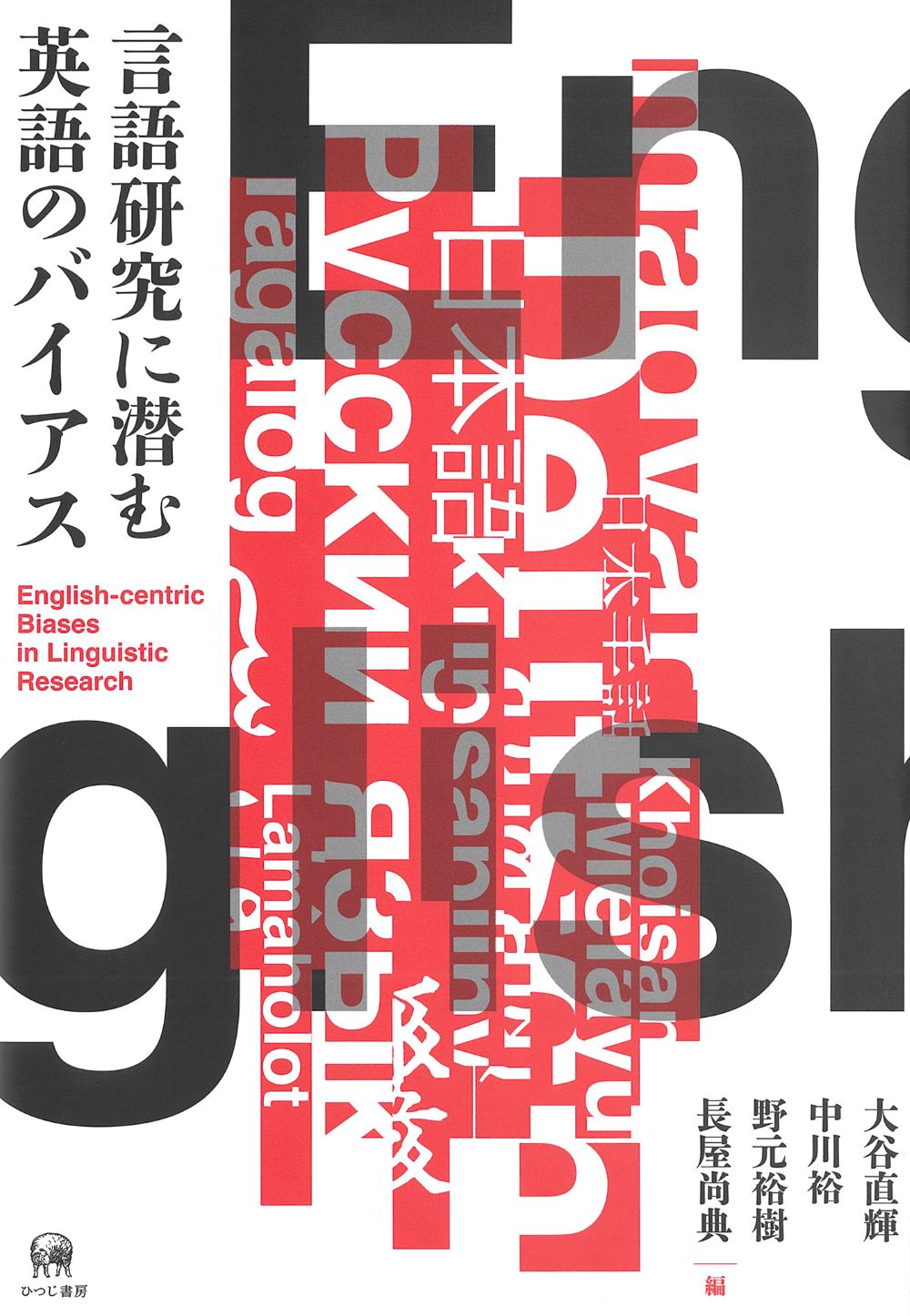
Gengo Kenkyuu ni Hisomu Eigo no Bias (English-centric Biases in Linguistic Research)
Size
356 pages, A5 format, hardcover
Language
Japanese
Released
October, 2025
ISBN
978-4-8234-1296-7
Published by
Hituzi Syobo
Book Info
See Book Availability at Library
Japanese Page
English occupies a privileged position among the world's languages. Its speakers and the communities that use it exert overwhelming influence across many spheres of contemporary life, including politics, economics, science and technology, and culture, with far-reaching consequences for communities whose primary language is not English.
This influence of English is clearly visible in universities and academic life. Students study English as a foreign language and learn from textbooks and research articles written in English. Faculty members are expected to publish in English, present at international conferences in English, and in some cases even teach classes in English to Japanese-speaking students.
The use of English as a “lingua franca” of academia has both advantages and disadvantages. On the one hand, it facilitates the sharing of research findings and communication among scholars across the globe. On the other hand, it leads to a disproportionate emphasis on research produced in English and places a substantial burden on scholars who are not native speakers of English, requiring them to acquire a high level of proficiency in the language.
Linguistics, the focus of this book, is no exception. Linguistics is a discipline that scientifically analyzes human language. In principle, as it deals with human language, its methods should be applicable equally to English, Japanese, or any other language.
In practice, however, this is often not the case. It is not merely that a large number of studies are published in English; English is also frequently chosen as the primary object of analysis. In some instances, findings about English are generalized to human language as a whole. Indeed, linguistic theories such as Chomsky’s generative grammar and Labov’s variationist sociolinguistics, both developed and disseminated primarily through English, have had a profound influence worldwide.
Entitled English-centric Biases in Linguistic Research, this volume raises critical questions about this state of affairs. What kinds of biases does the centrality of English introduce into linguistic research? How do these biases shape the analysis of individual languages? Specialists in English as well as specialists in languages other than English come together in this book to address these issues.
The book is divided into three parts. Part I, “Rethinking the Yardsticks of Linguistic Analysis through English,” presents five papers that examine the influence of English on linguistic research from the perspective of English itself. Part II, “The Impact of English on the Study of Individual Languages,” includes nine papers that explore how English affects the analysis of specific languages such as German and Russian. Part III, “The Influence of Powerful Languages on the Study of Less Powerful Languages,” considers the impact that major languages other than English, such as Chinese, have on the study of other languages.
While some familiarity with linguistics is helpful, the book is written to be accessible to readers without specialized training, including undergraduate students, and is warmly recommended to anyone with an interest in language and linguistics.
(Written by NAGAYA Naonori, Associate Professor, Graduate School of Humanities and Sociology / 2026)