

 Find a book


Title
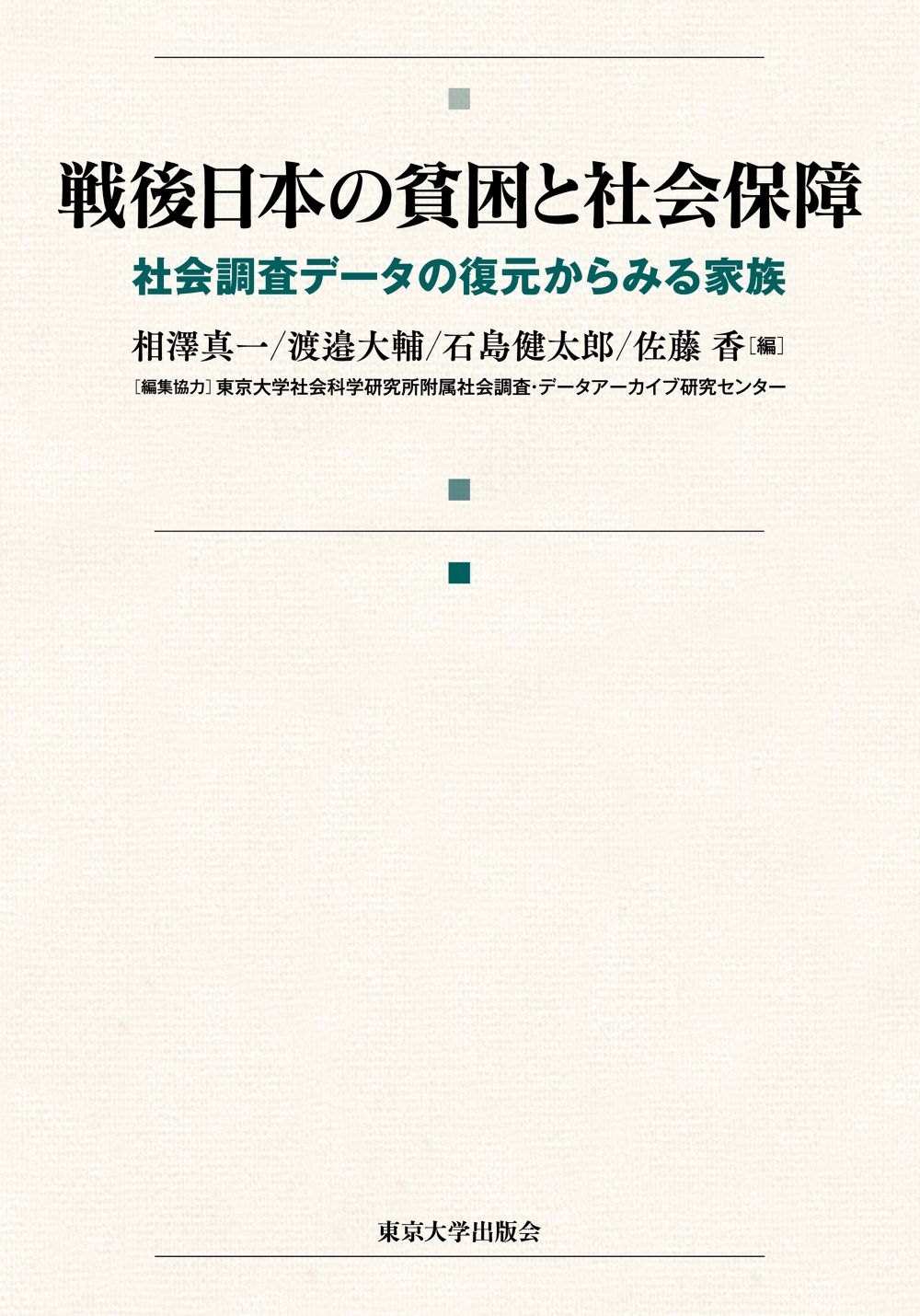
Sengo Nihon no Hinkon to Shakai Hosho (Poverty and Social Security in Postwar Japan: Households Viewed Through the Reconstruction of Social Survey Data)
Size
324 pages, A5 format
Language
Japanese
Released
December 01, 2024
ISBN
978-4-13-051149-0
Published by
University of Tokyo Press
Book Info
See Book Availability at Library
Japanese Page
 eBook
eBook
The summer of 2025 marked the 80th anniversary of the end of World War II. On this occasion, Japanese television channels, newspapers, and magazines were filled with programs and special features about the war and its aftermath. For today’s youth, the hardships of postwar Japan may be difficult to imagine as a lived reality. Under the occupation by the Allied General Headquarters (GHQ), severe food shortage was a pressing challenge across the nation. Poverty was not an abstract concept, but a daily, shared experience for nearly everyone. By analyzing historical survey data from the 1950s and 60s, this book takes us back to that difficult era.
The outbreak of the Korean War in 1950 sparked a modest economic recovery and, in 1951, the San Francisco Peace Treaty restored Japan’s sovereignty. At this juncture, the Japanese government introduced a range of social security and welfare policies to tackle widespread poverty. In Kanagawa Prefecture, the local government conducted numerous surveys to examine how these new policies were used and their effects. Beyond Kanagawa, scholars in fields such as economics and public health also began conducting research on poverty.
By the 1960s, Japan was experiencing its economic miracle. With an annual growth of approximately seven percent sustained for nearly a decade, the gross national product doubled. As prosperity spread, researchers began asking new questions: Who succeeded in escaping poverty and how? What lifestyles were people developing in this new era? Where did the need for social support persist?
The “Postwar Labor Survey Materials” preserved from this period offer a wealth of insights. Although the original paper questionnaires were carefully archived at the Institute of Social Science, they have inevitably deteriorated over time. The authors photographed these fragile records and reconstructed them as digital datasets compatible with contemporary statistical software, making it possible to revisit the past with new analytical tools.
This research belongs to the field of historical sociology, a subfield of sociology. Traditionally, historical sociology has relied heavily on written documents. This book, however, centers on quantitative data analysis. In this sense, it contributes to “quantitative historical sociology,” a relatively new approach that emerged in the mid-1990s. Two major changes have made such work possible. First, the establishment of data archives, such as the Social Science Japan Data Archive (SSJDA) at the University of Tokyo, enabled access to past survey data. Second, the recognition of secondary analysis of survey data as a valuable form of research has greatly increased in the academic community.
Another distinctive feature of this book is its interdisciplinary character. Alongside sociologists, contributors include scholars in social welfare, while the process of reconstructing and analyzing the old surveys also drew on economics, history, and statistics. The appendix describes how new technological environments made such interdisciplinary collaboration possible, a subject that will be especially valuable for readers interested in research methods and practices.
(Written by SATO Kaoru, Professor Emeritus, Institute of Social Science / 2025)