

 Find a book


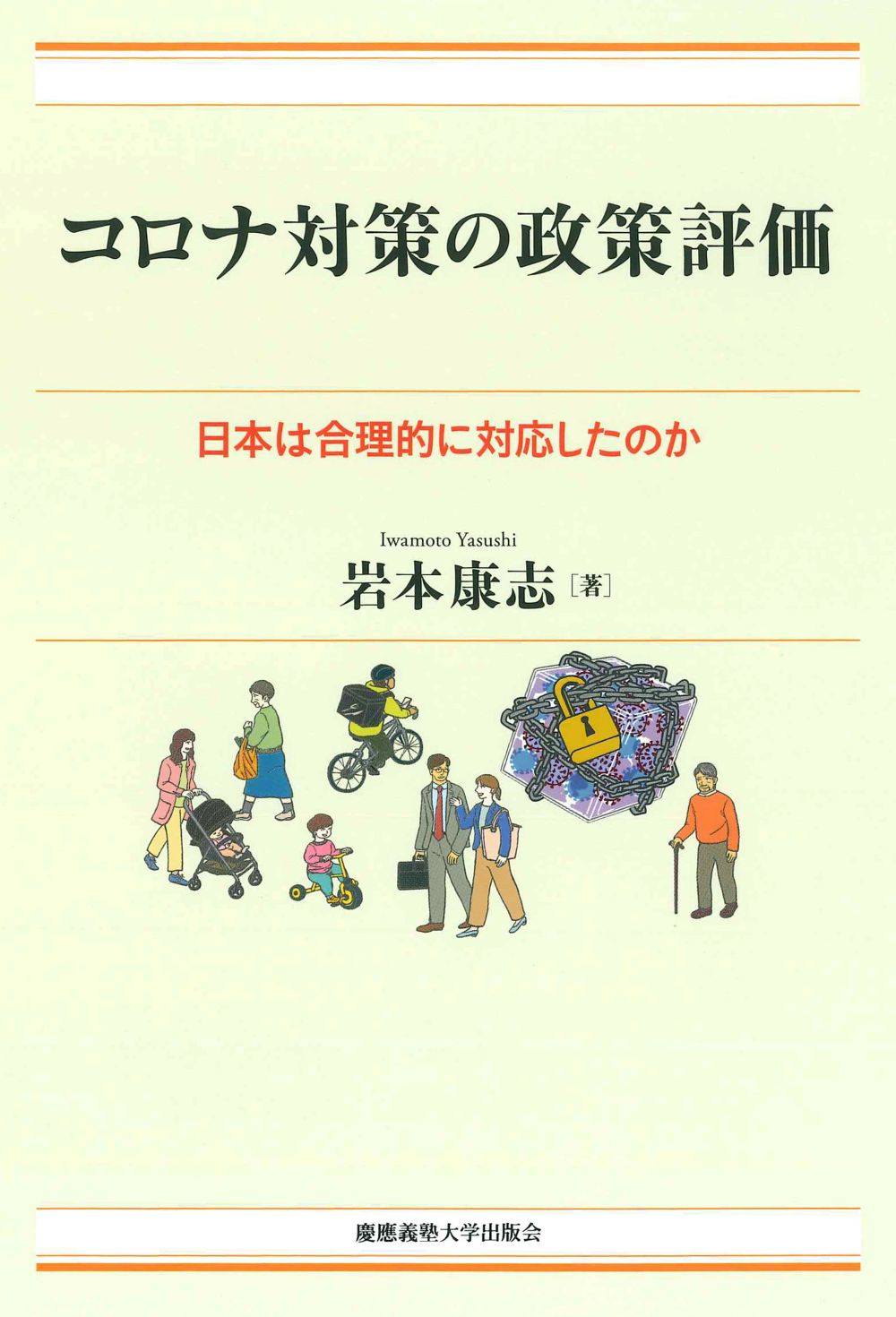
Title
Contemporary economy commentary series Corona taisaku no seisaku hyoka (Policy evaluation of COVID-19 countermeasures - Did Japan respond rationally to COVID-19?)
Size
280 pages, 127x188mm, hardcover
Language
Japanese
Released
June 25, 2025
ISBN
978-4-7664-3038-7
Published by
Keio University Press
Book Info
See Book Availability at Library
Japanese Page
 eBook
eBook
Did Japan respond rationally to COVID-19? This book addresses that question. It examines “rationality” from two angles: first, whether countermeasures were selected on the basis of sound evidence in line with evidence-based policymaking (EBPM); and second, whether effects and costs were appropriately weighed from an economic perspective. The emergency measures of spring 2020 are at the center of this analysis.
The widely cited target of reducing social contacts by 80 percent during that period was based on advice from infectious-disease experts using mathematical models. Yet the limited number of epidemiological modelers and the lack of critical review within academia left room for errors. Scholars from other fields with modeling expertise could have contributed more rigorously. Indeed, this book shows that the analysis contained serious flaws—so serious that, once corrected, the advice itself could not be sustained.
From the economic side, the author highlights two key contributions: understanding human behavior and clarifying the trade-offs between health and the economy so that measures can be implemented cost-effectively. Chapters 5 and 6, which form the core of the economic analysis, visualize the costs and effects of the first-wave countermeasures. They reveal that gains in life expectancy were modest compared with the enormous costs, and that the restrictions imposed at the time were not cost-effective. Moreover, the burden of selective activity restrictions fell heavily on certain individuals and businesses and, especially after the Omicron variant emerged, was shifted disproportionately onto younger generations. Policies that impose such asymmetric burdens without adequate compensation, the author argues, are indefensible.
A proper understanding of human behavior is also essential for achieving behavioral change through infectious-disease control. While epidemiological models tend to assume that people comply with instructions from policymakers and experts, economic models generally assume a free society in which individuals act according to their own preferences and rights. Even when the mathematical structure of models is similar, the behavioral assumptions are fundamentally different.
Japan’s COVID-19 measures lacked strong legal enforcement and instead relied on voluntary cooperation. From an economic perspective, as the costs of altruistic behavior rise, voluntary cooperation becomes harder to sustain, and introducing penalties may actually erode altruistic motivation. This helps explain why the effectiveness of repeated “state of emergency” declarations waned over time.
By emphasizing cost-effectiveness analysis and human behavior, this book fills an important gap in policy research on infectious-disease countermeasures. Moving beyond criticism, it offers the author’s own alternative proposals and constructive suggestions. It provides practical insights directly relevant to future pandemics, including how coercive measures and penalties can undermine cooperation and when compensation becomes necessary. It thus provides academically rigorous and socially relevant guidance for the design of evidence-based health policies.
(Written by IWAMOTO Yasushi, Professor, Graduate School of Economics, Graduate School of Public Policy / 2025)