

 Find a book


Title
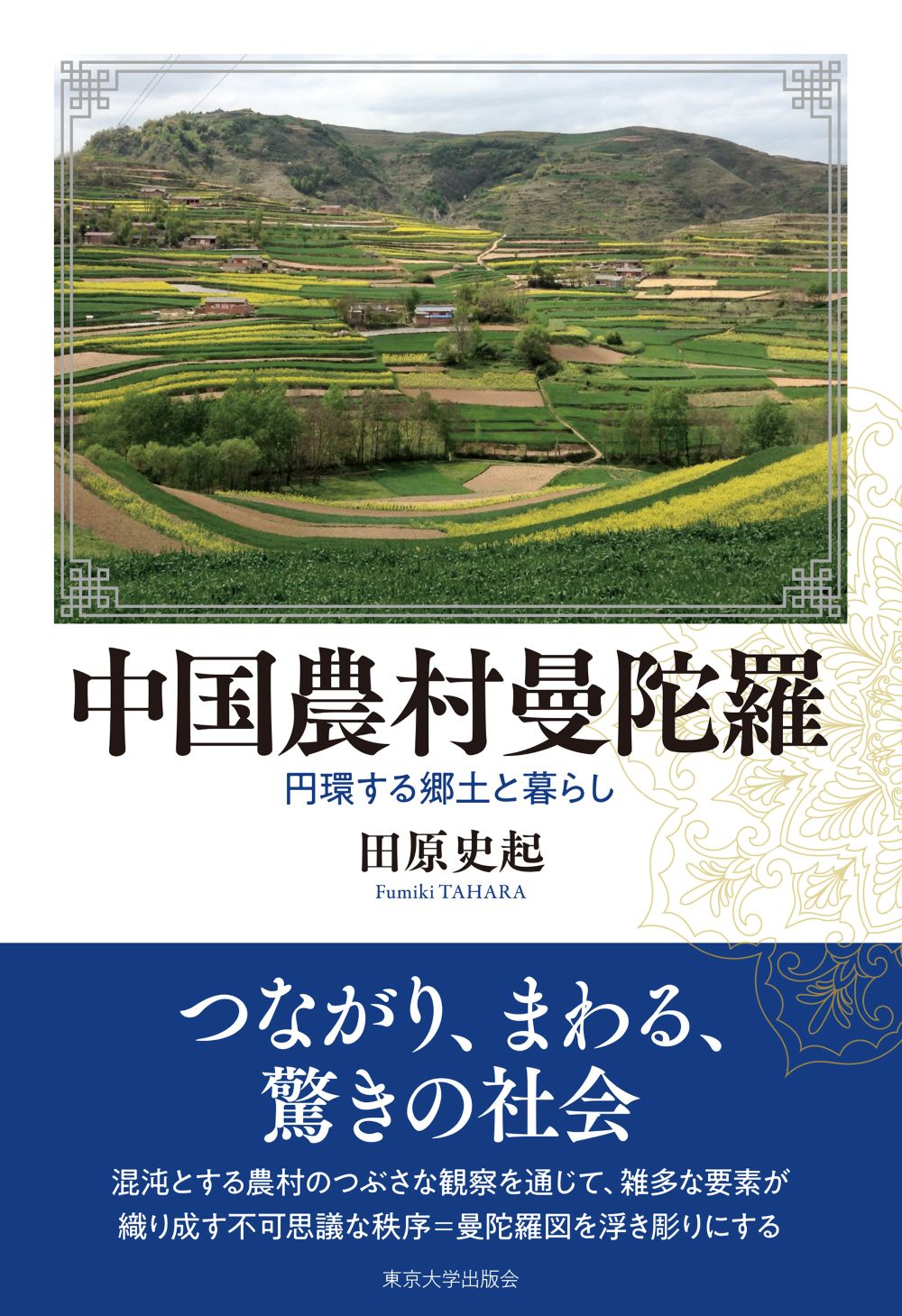
Chugoku Nouson Mandala (Rural China Mandala - Stories of Ever-Turning Living World)
Size
336 pages, 127x188mm
Language
Japanese
Released
July 02, 2025
ISBN
978-4-13-030222-7
Published by
The University of Tokyo Press
Book Info
See Book Availability at Library
Japanese Page
 eBook
eBook
This book is an experiment in area studies on China grounded firmly in rural society. I believe that beginning from the countryside and allowing the research to unfold outward has a double significance.
The first is what I call “the countryside as method.” We are, almost by habit, trained to view places and events through the lens of major cities—Tokyo, Beijing, Shanghai. This book resists that reflex, even if only a little. Whatever country or phenomenon we are looking at, we begin instead with a different question: “What does this look like in the village?” Rural life is both the base layer of society and, in many ways, its prototype. By momentarily setting aside the familiar mindset of the urban middle class—a mentality that contemporary Japanese readers, me included, tend to take for granted—we often begin to notice dimensions that would otherwise remain invisible.
The second is what I call “the countryside as a problem.” By this I mean asking what role the rural sector is expected — or allowed — to play within a nation. I do not see the countryside as a mere leftover, something that modernization forgot to absorb. If anything, the proof lies close at hand: even in contemporary Japan, where almost everyone appears to live with an urban sensibility, the countryside stubbornly persists. Why have farming, mountain, and fishing villages not disappeared? What work do they quietly perform for the nation? Perhaps the countryside functions — in moments of crisis — as a place of retreat, refuge, or belonging. Or perhaps, more interestingly, it is a site where new kinds of value can be created. If so, then we should be able to study the countryside not only as a survivor of the past, but as an active resource for the future. These questions matter for Japan, of course, but they become even more urgent — more fundamental, and more practical — in large states such as China, Russia, and India, where vast rural worlds still exist within the borders of a single country.
This book grows out of that way of thinking. It is a collection of twelve essays — some written in an academic mode, others closer to fieldwork-based narrative — that approach rural China from multiple angles. The range of topics is intentionally wide, almost like the multi-layered “mandala diagrams” of Esoteric Buddhism, in which countless figures coexist in a single sacred image. But beneath every chapter lies the same foundation: my experience doing fieldwork in the countryside. When you first enter a new field site, what you see is chaos — overlapping forces, social tensions, unspoken rules, small acts of care and conflict, all swirling at once. But as you return repeatedly, a focus gradually forms. What felt unordered begins to take on shape. A kind of “center” emerges from the clutter, and other elements start to connect themselves to that core. Even apparent disorder reveals its own logic. That is what I call “the countryside as mandala.”
The book is organized into three parts.
Part I, “Local Worlds of Rural Business,” gathers essays on what I call “rural business” in China — forms of economic activity rooted not just in markets, but in the moral logic and lived rhythm of village life. Many of these practices cannot be explained by the classic image of the “rational economic actor” pursuing individual profit. Especially in the Chinese countryside, business is inseparable from the ethos of the rural family: its obligations, loyalties, ambitions, and strategies of survival.
Part II, “Psychoculture of the County-Level Society,” turns to one of the core questions in China studies: the relationship between city and countryside. Here I approach it through the idea of the county (xian) as a social space — the layered zone where urban and rural life cross, collide, and negotiate with each other. I describe this space as an “intersectional zone,” and I am interested not only in its administrative form but in its emotional and cultural psychology. As part of this section, I also experiment with reading literary works that portray rural life as source material to understand peasants’ psychoculture.
Part III, “Rural China in Comparison,” collects essays written after I began fieldwork in rural Russia and rural India. Standing in villages outside China — talking with people, listening to worries, watching how households navigate power — forced me to see Chinese rural society again, but from the viewpoint of a world of large states. I consider this attempt to situate rural China alongside Russia and India, through grounded comparison rather than abstract theory, to be one of the rarer approaches within contemporary China studies.
(Written by TAHARA Fumiki, Professor, Graduate School of Arts and Sciences / 2025)