

 Find a book


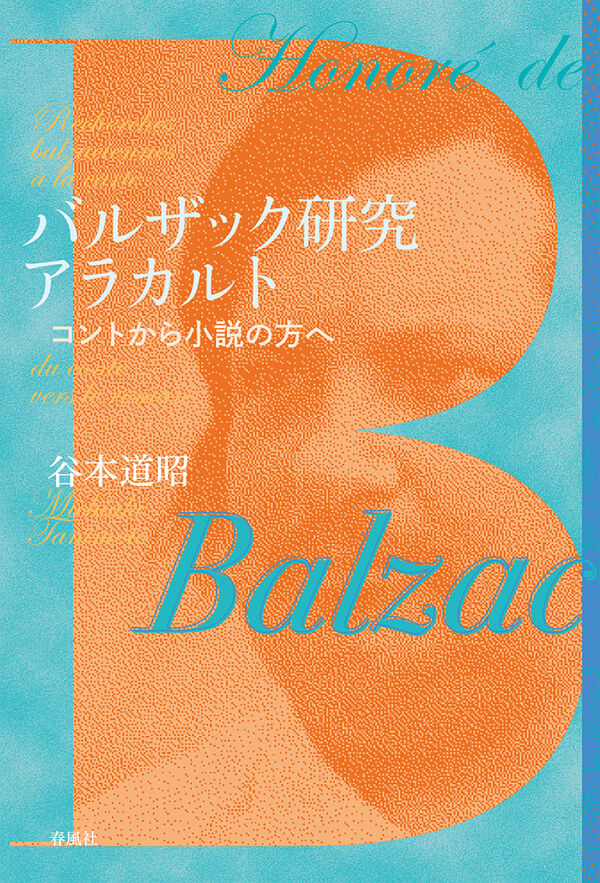
Title
Balzac Kenkyu à la carte (Balzac studies à la carte - From the conte to the roman)
Size
424 pages, 127x188mm, hardcover
Language
Japanese
Released
October, 2024
ISBN
9784861109676
Published by
Shumpusha Publishing
Book Info
See Book Availability at Library
Japanese Page
As an introduction to my own work, I wish I could write something like “The Philosophie of Composition” (by Poe), but that is hardly likely. Thus, I adopt a humble tone in writing this, as an À la carte par lui-même (by myself).
As the title indicates, this book is a “study” focusing on Honoré de Balzac, a French writer of the first half of the 19th century. The addition of “à la carte” after “studies” stems from the book’s structure: it comprises ten chapters, combining several selected chapters from my original French doctoral thesis with several chapters written later in Japanese as standalone pieces. Therefore, the expression “à la carte” carries a slightly meddlesome message from the author: you do not need to read it from start to finish; feel free to read each chapter as you like. Likewise, the overall title reflects a subtle personal preference: the desire to juxtapose the rigid term “studies” with the softer “à la carte” and to sandwich “studies” between “Balzac” and “à la carte”—two five-character katakana words both beginning with an “a” sound and followed by a “l” sound.
Regarding the content, as the subtitle indicates, the book explores “from the conte to the roman.” Rather than uncritically adopting the ideas and reading approaches tied to the literary genre of the “roman”—which gained legitimacy primarily after Balzac—it prioritizes the significance of Balzac’s choice of the genre of the “conte”—arguably the ancestor of the “roman”—and the distinctive narrative modes that characterize the “conte.” Guided by this approach, it traces Balzac’s creative trajectory through his works, focusing primarily on his writing from the 1830s and discussing everything from lesser-known pieces to famous works in chronological order.
If this book possesses any unique quality, it is that it undertakes research that has been neglected until now. This suggests a commonality between “research” and “creative writing.” To say that my research life to date has been far from smooth sailing would be an exaggeration, but I believe I was able to persist in this arduous journey of “research” without abandoning it, finding enjoyment along the way, precisely because over the years, I came to discover the joy of “creation” within “research.”
Finally, just between us, I recall one thing. While preparing this book, I considered including a “Dedication” at the beginning. Since acknowledgments to family are commonplace, I pondered boldly following Baudelaire’s example and adding “To the Reader/Au lecteur” instead. However, it felt too embarrassing, so I abandoned the idea. I believe that was for the best, yet my desire to dedicate this book above all to you, the readers, remains unchanged to this day.
(Written by TANIMOTO Michiaki, Associate Professor, Graduate School of Arts and Sciences / 2025)