

 Find a book


Title
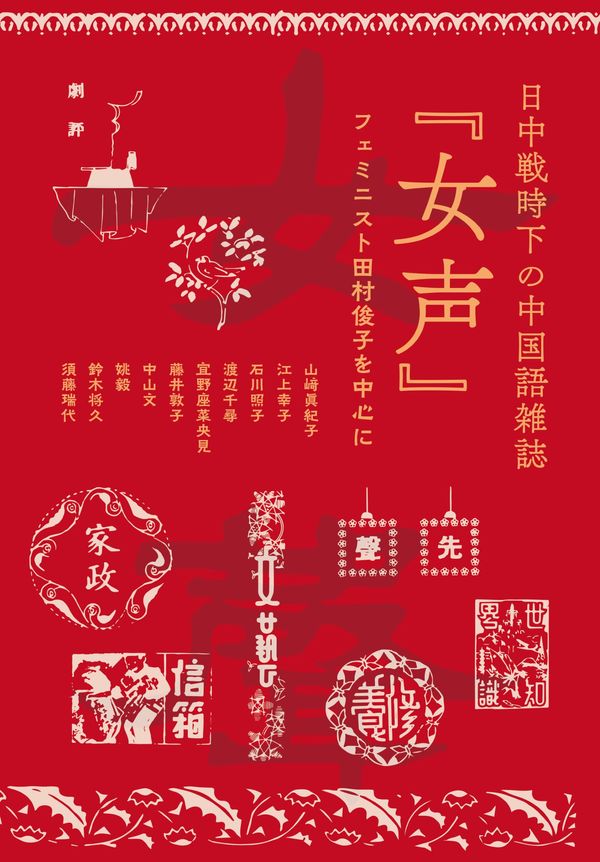
Nichu Senjika no Chugokugo Zashi “Nüsheng” (Chinese-language Magazine “Nüsheng” during the Sino-Japanese War – led by Tamura Toshiko as a feminist)
Size
408 pages, A5 format, hardcover
Language
Japanese
Released
December, 2023
ISBN
9784861109164
Published by
Shumpusha Publishing
Book Info
See Book Availability at Library
Japanese Page
Toward the end of the Sino-Japanese War, a Chinese-language magazine titled Nüsheng (Women's Voice) was published in Japanese-occupied Shanghai under the editorship of Tamura Toshiko, a Japanese woman. The magazine primarily aimed at Chinese female readers. Even this brief description suggests the complex entanglement of issues, such as wartime journalism, the cultural relationship between imperial Japan and China, and gender politics. Adding to this complexity, the actual editorial work was carried out by Guan Lu, a female Chinese writer who was a secret member of the Chinese Communist Party and remained in Shanghai as an underground operation.
Reflecting this intricate context, Nüsheng has drawn scholarly attention—not so much for its content, but for the circumstances surrounding its publication. In China, considerable research has focused on Guan Lu, who later led a tragic life. Because her underground affiliation could not be officially proven, she was stigmatized as a collaborator with the Japanese.
The central debate has revolved around whether Nüsheng should be viewed positively or negatively. The magazine embodied two conflicting aspects: On the one hand, it was a women’s magazine edited by Guan Lu and directed toward Chinese women; on the other, it was funded by the Japanese military and reflected Japanese interests. Many discussions have involved value judgments regarding its political stance.
One problem with this framing is the tendency to overlook the magazine’s actual content. Nüsheng was published over a span of three years (1942–1945), and reading all its issues is no easy task. However, without carefully examining what was written in the magazine, any assessment of its political nature would be unjustified.
Another problem is the tendency to isolate this period from a broader context. Tamura Toshiko, the editor-in-chief, was a novelist who had been active in the Japanese literary scene since the late Meiji era and was known for expressing a uniquely feminine sensibility in her works. From 1918 to 1936, she lived in Vancouver with her partner, who was involved in the labor movement. Given this background, it is necessary to interpret Nüsheng in relation to Tamura’s feminist perspective.
This book is based on a comprehensive reading of Nüsheng, as informed by Tamura Toshiko’s life and career. The magazine included sections on current affairs, films, fiction, domestic life, and reader submissions. Rather than being driven by a single unified vision, the magazine reflected a tension among multiple forces. Tamura likely held an ideal of amplifying women’s voices, but she was constantly forced to make compromises within the constraints of reality.
Through the analysis presented in this book, Nüsheng emerges as a medium shaped by competing relationships—between ideals and reality, China and Japan, male and female. This nuanced understanding was facilitated by the collaborative nature of the research. The collective effort allowed us to read every issue of the magazine, which was impossible for one person to cover alone. More importantly, the involvement of experts in Japanese literature, Chinese history, film studies, and theater studies enabled a multifaceted approach to the magazine. Such interdisciplinary collaboration allows us to grasp the full complexity of wartime issues without oversimplification, and it may be seen as a significant achievement in contemporary humanities research.
(Written by SUZUKI Masahisa, Professor, Graduate School of Humanities and Sociology / 2025)