


 Find a book


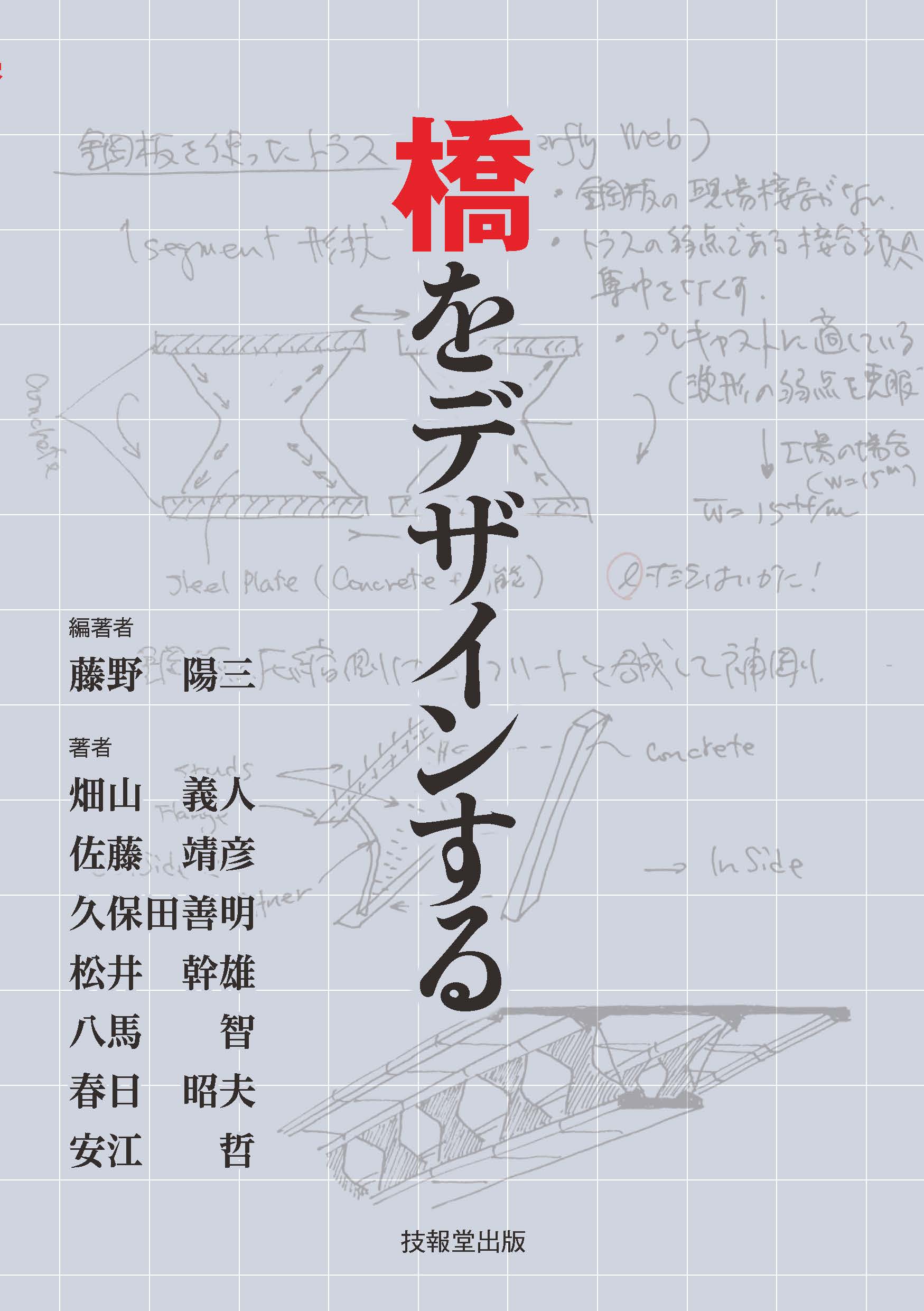
Title
Hashi wo dezain suru (Designing Bridges)
Size
210 pages, A5 format
Language
Japanese
Released
March, 2023
ISBN
978-4-7655-1887-1
Published by
GIHODO SHUPPAN Co.,Ltd.
Book Info
See Book Availability at Library
Japanese Page
The essential purpose of bridges is to allow people and vehicles to cross safely over natural obstacles—like rivers and valleys—or to span roads and railways in densely built areas. Although we use bridges every day without much thought, a closer look reveals an astonishing variety of shapes and materials, each tailored to a bridge’s size and setting. There are girder bridges, truss bridges, arch bridges, cable-stayed bridges, suspension bridges, and more. If you examine them even more closely, you’ll notice that, even within the same structural type, the profiles of the members and the ways they are joined can differ. Just as every person has a name and character, each bridge has its own name and its own subtle but distinct personality.
So, what do designers consider, and what processes do they go through when creating a bridge?
In this book, eight experts—both practitioners and researchers in bridge construction—speak in their own words about how bridges are conceived and built. While bridges must be strong and durable, functionality alone is not enough. As pieces of social infrastructure meant to serve for over a century, bridges must always feel safe and comfortable to cross and must blend harmoniously with their surroundings and landscapes. At the same time, they often need to reflect contemporary technological advances in both practicality and innovation. Over the years, as people continue to use a bridge, it can come to symbolize the very region it serves.
The heart of good bridge design lies in having a clear philosophy or conceptual framework. Unlike engineering standards, which ensure functionality, safety, and longevity, this framework defines “what kind of bridge it should be”—in other words, the bridge’s personality. Globally, this process is known as “conceptual design” and is a major topic in professional forums, though definitions vary subtly among engineers.
This collection uses an omnibus format: each author has their own definitions and style, but all share a common emphasis on the importance of developing concepts in the early stages of bridge design.
This book was written by eight bridge engineers who were close colleagues of Dr. Motoi Masubuchi, who passed away at a young age. After graduating from a Japanese university, Dr. Masubuchi studied in Sweden and Germany in search of the future of bridges, and worked on numerous bridges while employed at a German design firm. Just as he was preparing to return to Japan to apply his experience there, he died in an accident.
He often said, "Japan has many excellent bridges, but there are few books that explain their underlying design philosophy." Indeed, to achieve excellent bridges that harmonize utility, strength, and beauty, each engineer must articulate their values and thought processes, discuss how to shape space and form, and engage in broad dialogue. Therefore, with the desire to share his exploration of the "structural art of bridges" with the Japanese bridge community, especially young engineers and students of civil engineering and architecture, we compiled this book, "Designing Bridges."
Finally, we have received the following recommendation from Professor Hiroshi Naito, architect and professor emeritus at the University of Tokyo:
“Bridges are not only great technological achievements of civilization but also forms of culture. Beautiful bridges bring people joy. Beautiful bridges enrich lives. The methods for creating such bridges are written here.”
(Written by FUJINO Yozo, Professor Emeritus, School of Engineering / 2025)
Table of Contents
Chapter 1 Bridges create culture
Chapter 2 Fundamentals of mechanics and design
Chapter 3 Designing bridges from the construction process
Chapter 4 Towards bridge design that shapes the future
Chapter 5 Rediscovering value of bridges
Chapter 6 Conceptual design of bridges
Final Chapter