

 Find a book


Title
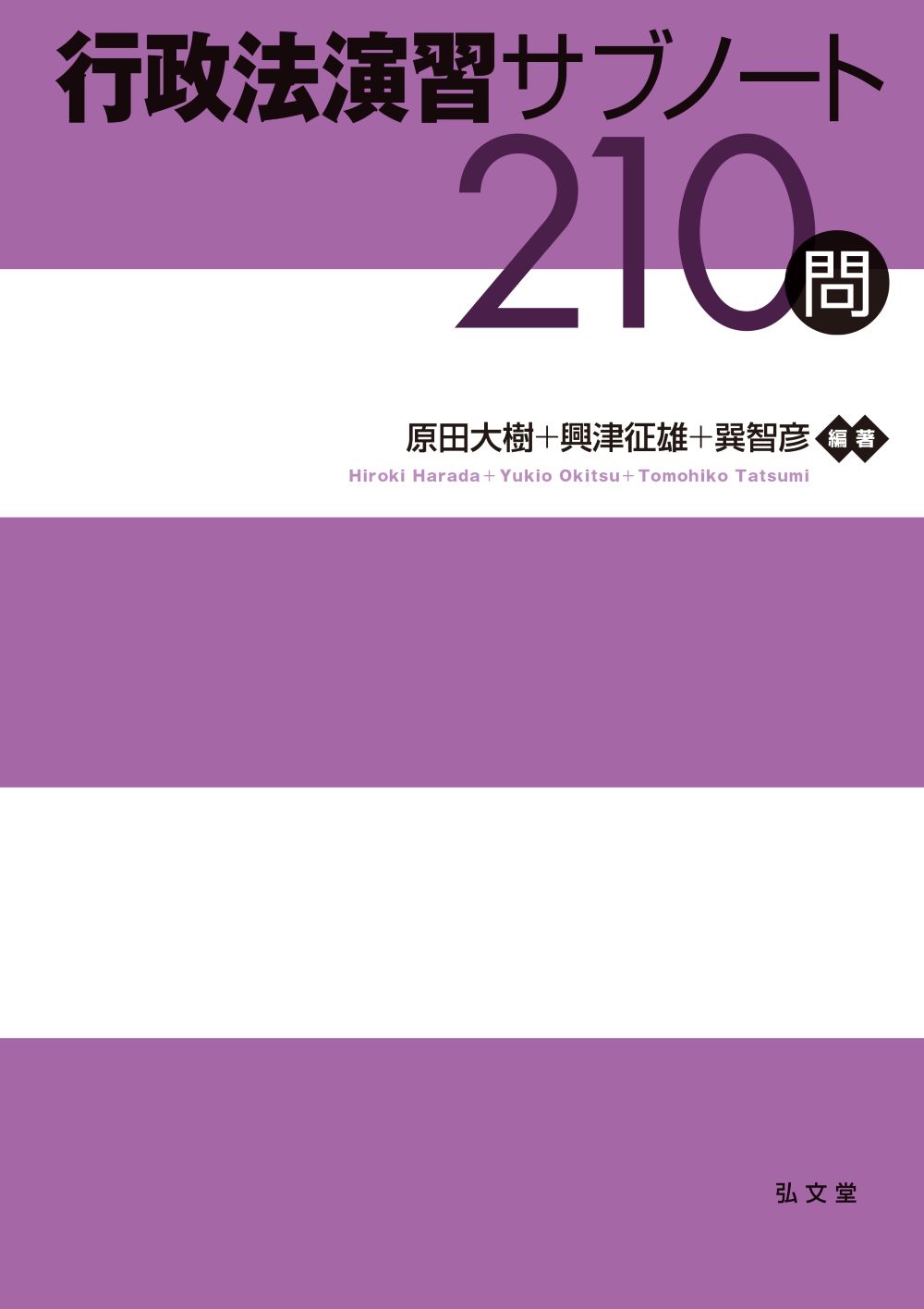
Exercise Subnotes 210 Questions Gyōsei-hō Enshū Sabunōto 210-mon (Administrative Law Exercise Subnotes 210 Questions)
Size
452 pages, A5 format, softcover
Language
Japanese
Released
September 26, 2024
ISBN
978-4-335-36001-5
Published by
KOUBUNDOU Publishers Inc.
Book Info
See Book Availability at Library
Japanese Page
This book is a study guide for Japanese administrative law. It is the fourth volume in the “Exercise Subnotes 210 Questions” series published by Kobundo, following the basic subjects of constitutional, civil, and criminal law. The series maintains a consistent format: each topic spans two pages, with the first page presenting a simple case and questions and the second page providing a concise explanation. The 210 topics follow the pattern of previous volumes in the series: 130 topics cover General Principles, Organization Law, and Procedural Law, while 80 topics address Remedial Law.
Concretely considering the direction for resolving problems based on specific cases is essential for studying positive laws. This necessity is particularly pronounced in administrative law. To provide legal solutions to administrative law cases, one must appropriately organize complex circumstances, identify relevant provisions from the myriad laws existing in each domain, interpret them in light of principles rooted in constitutional norms, distill them into concrete legal propositions, and then apply the law to the case. Although numerous exercise books have been published for this purpose, this book is particularly useful for learning, because its questions are compact and concrete. Administrative law textbooks, which are constrained by page limits, often present abstract arguments without elaborating on concrete cases. Conversely, focusing on case-based analysis risks excessive length and fragmentation of issues across fields, making it difficult to derive universal knowledge from case studies. In this context, the demand for “compactness and concreteness” presents an exceptionally challenging task. However, the author’s considerable expertise, honed through extensive teaching experience, is fully demonstrated, thus achieving this goal.
The book employs a layout that forces readers to think for themselves, presenting itself as a textbook. However, each section also presents the distilled essence of the research activities of the responsible author, who has studied the subject in depth. Consequently, even when read after some learning progress, or even later, when engaging with administrative law in practice or research, it remains rich with new discoveries. I also learned a great deal from the co-authors’ manuscripts and marveled at how the contributors intertwine research and education to advance both fields, while also reflecting on my own journey.
(Written by TATSUMI Tomohiko, Associate Professor, Graduate Schools for Law and Politics / 2025)