

 Find a book


Title
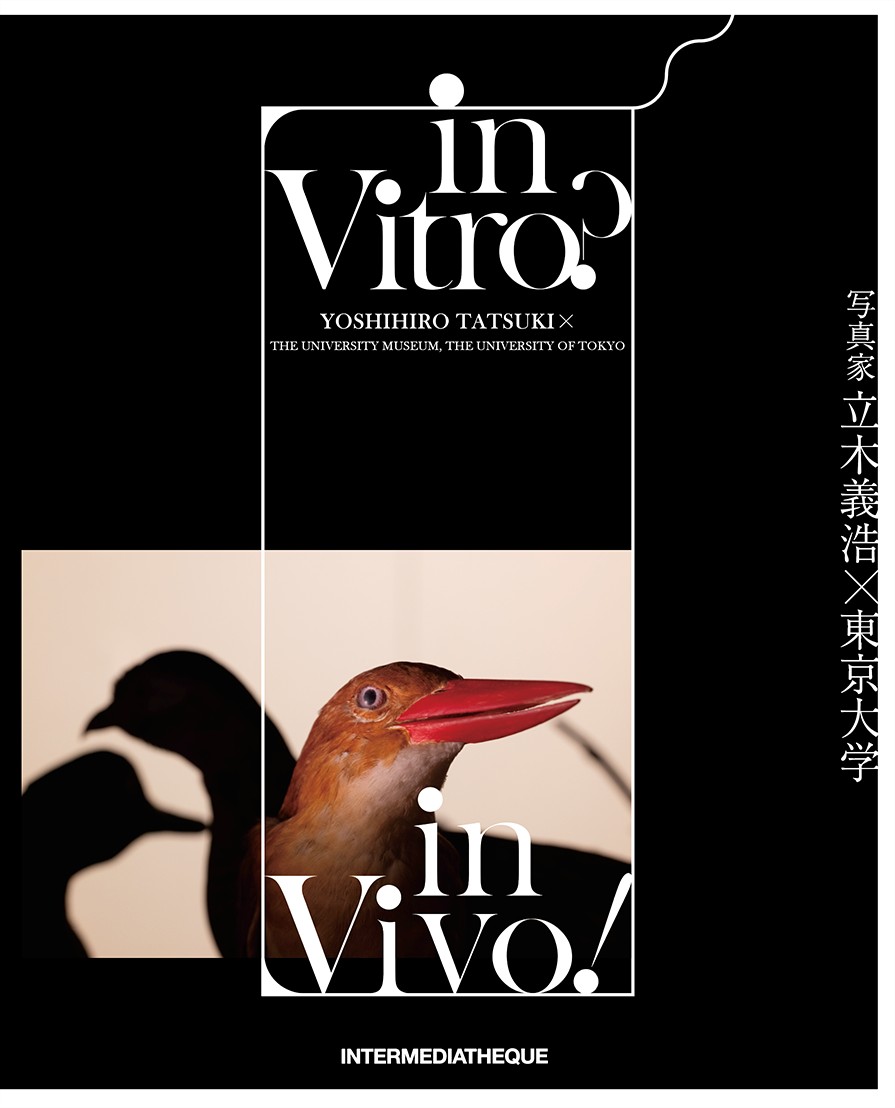
In Vitro? In Vivo! (YOSHIHIRO TATSUKI×THE UNIVERSITY MUSEUM, THE UNIVERSITY OF TOKYO)
Size
127 pages
Language
Japanese, English
Released
October 25, 2024
ISBN
9784910734064
Published by
The University Museum, the University of Tokyo
Book Info
See Book Availability at Library
Japanese Page
“In vitro” refers to a reaction inside a test tube, while the physiological term “in vivo” refers to a reaction inside a living organism.
The project began when photographer Yoshihiro Tatsuki contacted us to say, “I’d like to take some personal photos of the Intermediatheque.” Initially, he had planned to take all the photos within a few hours on a day when the museum was closed. However, the more he looked through his viewfinders, the stronger his desire to take pictures of everything. He took repeated photographs. He not only visited the Intermediatheque but also the main building in Hongo and, with the cooperation of researchers, even photographed the museum’s collection.
When the museum staff saw the photos he had taken, they exclaimed, “Really? Did we have this specimen?” These are the specimens that the museum stores or exhibits, so of course the staff should have seen them. However, when the angle and lighting are changed and the exhibits are captured by the photographer, they take on a completely different light. The specimens appeared so fresh through Tatsuki’s eyes and lenses.
The initial request was for personal photographs. We hoped to use one or two photos for PR purposes. However, when we saw the actual photograph, we became emboldened. What would happen if we exhibited this photo at the Intermediatheque? The plan then proceeded to the next stage.
If you think about it, exhibiting photos of actual specimens in a space where the specimens are actually located is a perverse plan. However, it is also an experimental expression that converts three-dimensional specimens into two dimensions. It offers an experience that would be impossible in real life—seeing scenery through someone else’s eyes. Visitors will be able to re-examine the exhibit after looking at the photos and see the specimens in a new way. Because most specimens in the Intermediatheque are photographable, visitors will be able to experiment by taking photos themselves.
Moreover, this project releases the specimens, usually from storage, into the exhibition space and lets them breathe among visitors. In other words, the specimens transition from an in vitro state to an in vivo state. Nakagawa, who was a coordinator at the photo shoot, later said that Tatsuki had the same expression on his face during the shoot as when he was taking portraits. This may have been the gaze of a photographer who had excelled at portrait photography when facing his subject.
Unlike archival photographs, this photograph captures the specimen in its exhibition space, or, in other words, its appearance as part of the museum’s collection. In that sense, it can be considered to capture the specimen as a living object. Similar to snapshots of people on the street, this has the effect of breathing new life into that specimen.
(Written by OSAWA Kei and MATSUBARA Hajime, Project Associate Professor, The University Museum / 2025)
Table of Contents
The Exhibits Don’t Speak, but They Tell a Story / Yoshihiro Tatsuki
To a Museum Exhibition called a Photo Exhibition / Hiroyuki Sekioka
To Yoshihiro Tatsuki since the days of “Nude” / Yoshiaki Nishino
From The Beginning to The End / Rico Nakagawa
Photography
Related Info
“in Vitro? in Vivo! YOSHIHIRO TATSUKI × THE UNIVERSITY MUSEUM, THE UNIVERSITY OF TOKYO”(The University Museum, The University of Tokyo (UMUT) Oct 26, 2024 – Jan 9, 2025)
https://www.intermediatheque.jp/en/schedule/view/id/IMT0280
“in Vitro? in Vivo! YOSHIHIRO TATSUKI × THE UNIVERSITY MUSEUM, THE UNIVERSITY OF TOKYO”
Tapei Edition (Museum of National Taipei University of Education (MoNTUE) Dec 20, 2025 – March 1, 2026)
https://www.intermediatheque.jp/en/schedule/view/id/IMT0296