


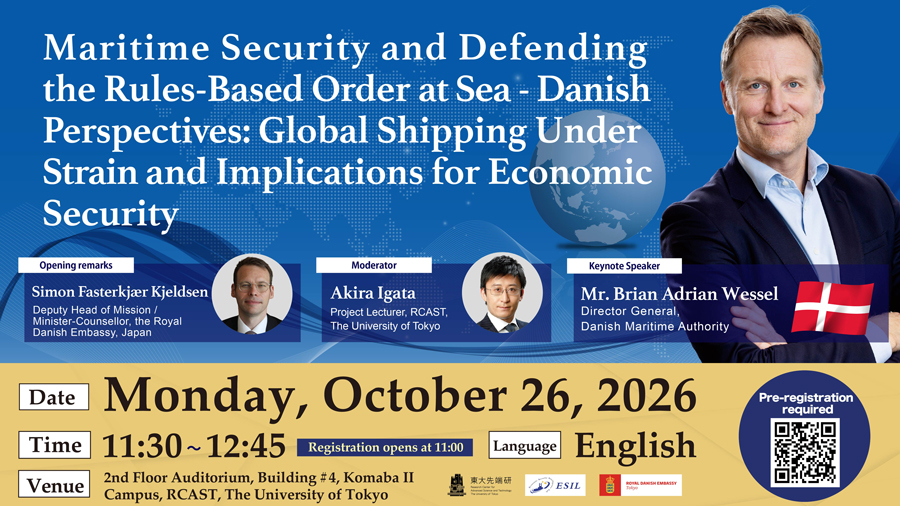
[Symposium] Maritime Security and Defending the Rules-Based Order at Sea - Danish Perspectives
Details
| Type | Lecture |
|---|---|
| Intended for | General public |
| Date(s) | October 26, 2026 11:30 — 12:45 |
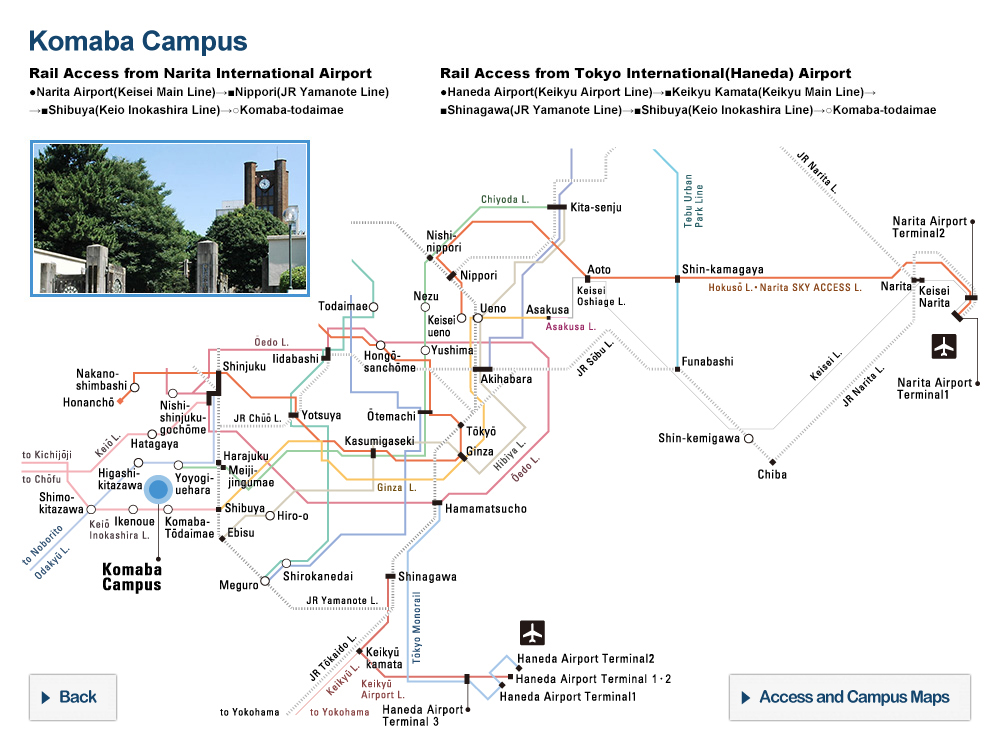
| Location | Komaba Area Campus |
| Venue | 2nd Floor Conference Hall, Building Number 4, Komaba II Research Campus |
| Capacity | 102 people |
| Entrance Fee | No charge |
| Registration Method | Advance registration required
Please register via Google form below https://forms.gle/8VoNTaMyxPUSSa3W9
|
| Registration Period | October 14, 2026 — October 25, 2026 |
| Contact | akira-igata@g.ecc.u-tokyo.ac.jp |
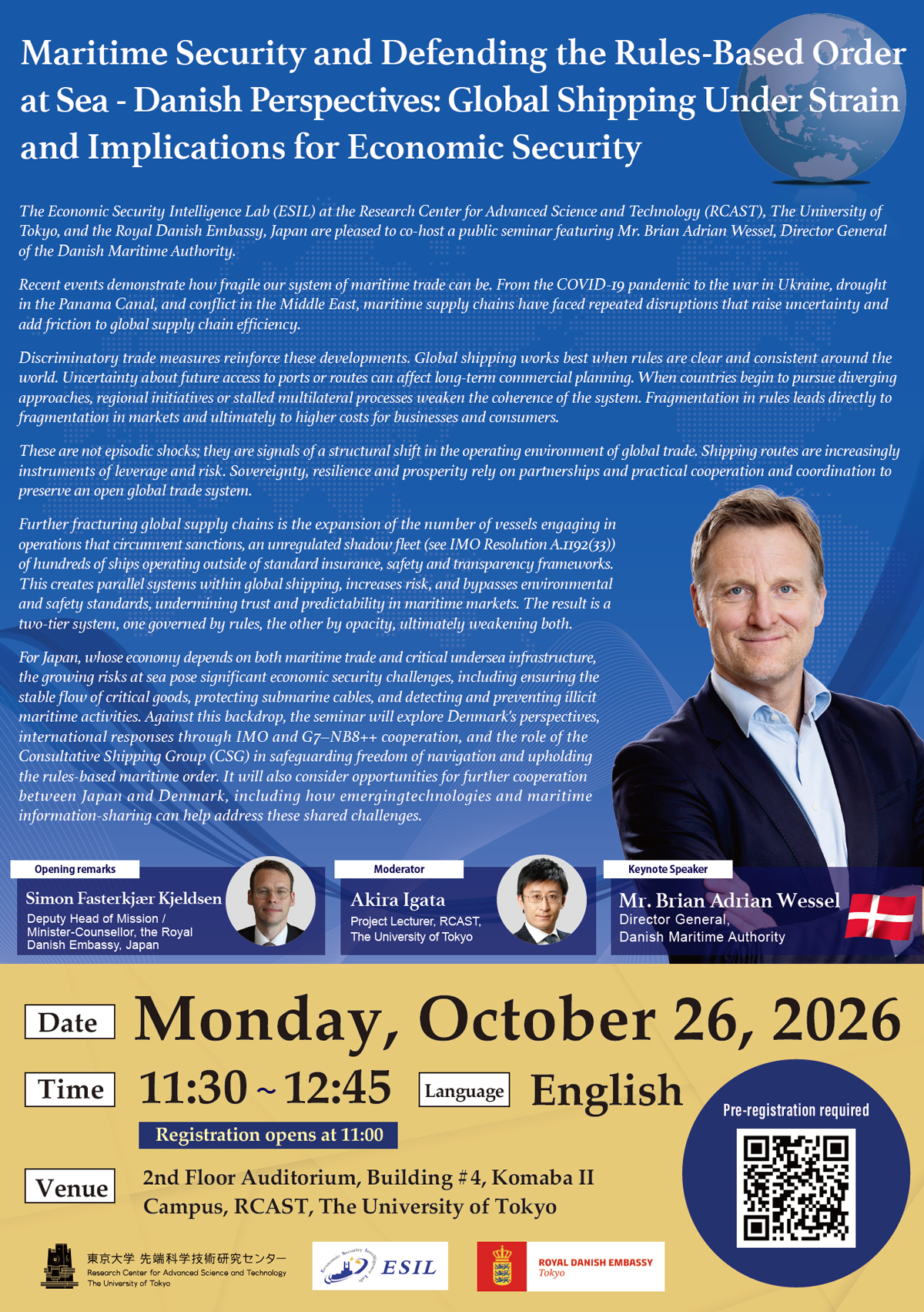
The Economic Security Intelligence Lab (ESIL) at the Research Center for Advanced Science and Technology (RCAST), The University of Tokyo and the Royal Danish Embassy, Japan are pleased to co-host a public symposium titled:
Maritime Security and Defending the Rules-Based Order at Sea - Danish Perspectives:
Global Shipping Under Strain and Implications for Economic Security
Recent events demonstrate how fragile our system of maritime trade can be. From the COVID-19 pandemic to the war in Ukraine, drought in the Panama Canal, and conflict in the Middle East, maritime supply chains have faced repeated disruptions that raise uncertainty and add friction to global supply chain efficiency.
Discriminatory trade measures reinforce these developments. Global shipping works best when rules are clear and consistent around the world. Uncertainty about future access to ports or routes can affect long-term commercial planning. When countries begin to pursue diverging approaches, regional initiatives or stalled multilateral processes weaken the coherence of the system. Fragmentation in rules leads directly to fragmentation in markets and ultimately to higher costs for businesses and consumers.
These are not episodic shocks; they are signals of a structural shift in the operating environment of global trade. Shipping routes are increasingly instruments of leverage and risk. Sovereignty, resilience and prosperity rely on partnerships and practical cooperation and coordination to preserve an open global trade system.
Further fracturing global supply chains is the expansion of the number of vessels engaging in operations that circumvent sanctions, an unregulated shadow fleet (see IMO Resolution A.1192(33)) of hundreds of ships operating outside of standard insurance, safety and transparency frameworks. This creates parallel systems within global shipping, increases risk, and bypasses environmental and safety standards, undermining trust and predictability in maritime markets. The result is a two-tier system, one governed by rules, the other by opacity, ultimately weakening both.
For Japan, whose economy depends on both maritime trade and critical undersea infrastructure, the growing risks at sea pose significant economic security challenges, including ensuring the stable flow of critical goods, protecting submarine cables, and detecting and preventing illicit maritime activities. Against this backdrop, the seminar will explore Denmark's perspectives, international responses through IMO and G7–NB8++ cooperation, and the role of the Consultative Shipping Group (CSG) in safeguarding freedom of navigation and upholding the rules-based maritime order. It will also consider opportunities for further cooperation between Japan and Denmark, including how emerging technologies and maritime information-sharing can help address these shared challenges.
Simon Fasterkjær Kjeldsen
Deputy Head of Mission / Minister-Counsellor, Royal Danish Embassy, Japan
Brian Adrian Wessel
Director General, Danish Maritime Authority
Brian Adrian Wessel has been serving as the Director General of the Danish Maritime Authority (DMA) since January 2025. The DMA is a government agency under the Ministry of Industry, Business, and Financial Affairs in Denmark.
Wessel had had a long career in public administration and international business affairs, having held various key positions, including Deputy Permanent Secretary for Legal and International Affairs at the Ministry of Industry, Business and Financial Affairs (2019–2024). Prior to this, he was Director at FSR – Danish Auditors (2015–2019). Wessel has extensive knowledge of the EU, including serving as a member of the EU's High-Level Group of Competitiveness from 2019 to 2024.
Wessel holds a Master Degree in Law from the University of Copenhagen and has completed executive leadership programs, including SPOT and the Executive Development Programme.
Wessel is also a board member of the Danish Maritime Foundation and has previously been part of the advisory board of DataEthics (2015–2022).
Akira Igata (Project Lecturer, RCAST, The University of Tokyo)
This seminar will be conducted in English.
Notes for participants
- For security reasons, no dangerous materials or food/beverages are allowed inside the venue. Please follow staff instructions during the event.
- Please present your valid photo ID (e.g., student ID or driver’s license) at the reception desk on the day of the event. For security reasons, participants who do not provide complete and accurate information regarding their identity, affiliation, and position may not be admitted.