


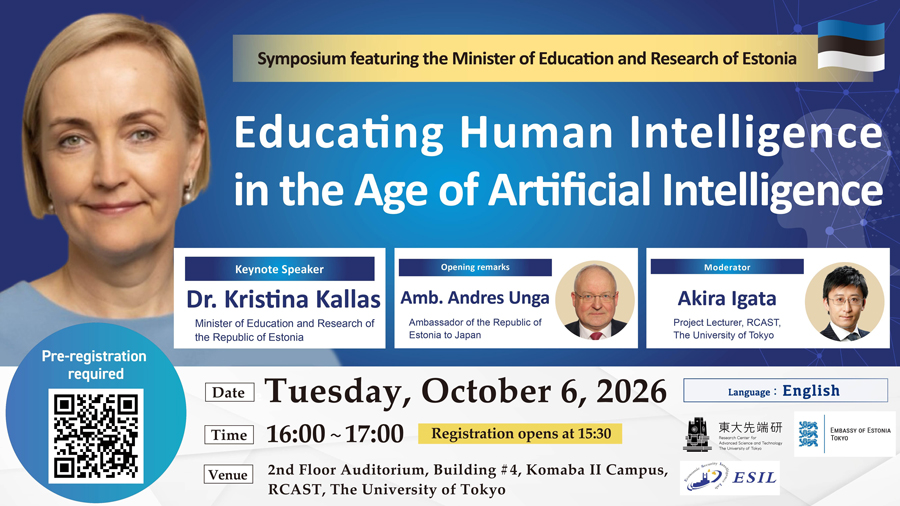
[Symposium featuring the Minister of Education and Research of Estonia] Educating Human Intelligence in the Age of Artificial Intelligence
Details
| Type | Lecture |
|---|---|
| Intended for | General public |
| Date(s) | October 6, 2026 16:00 — 17:00 |
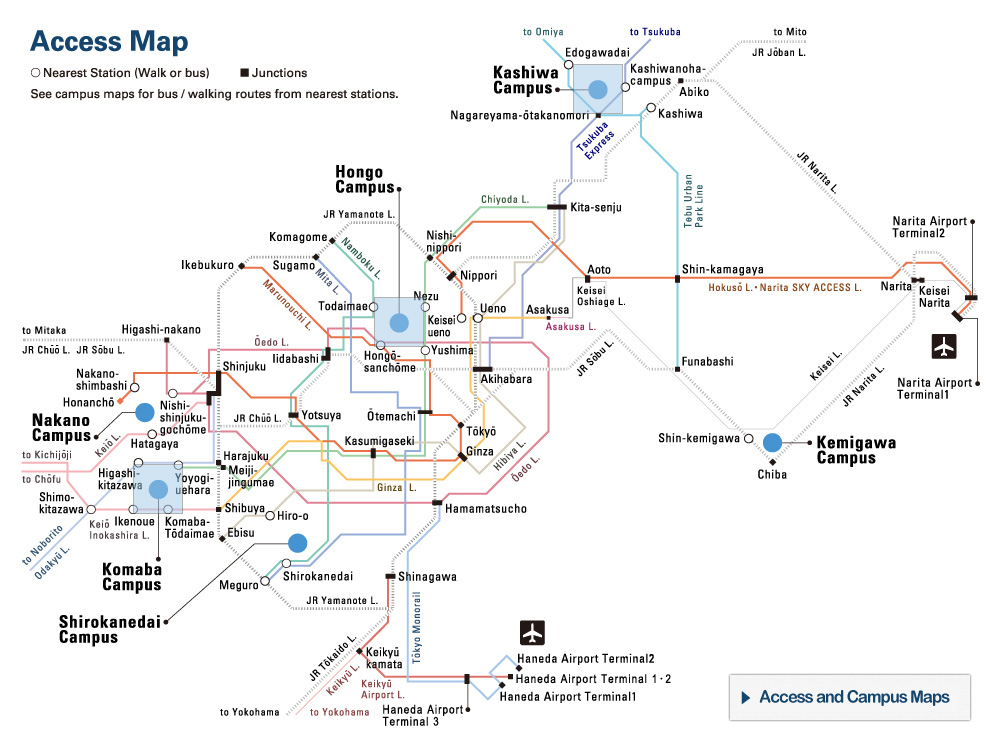
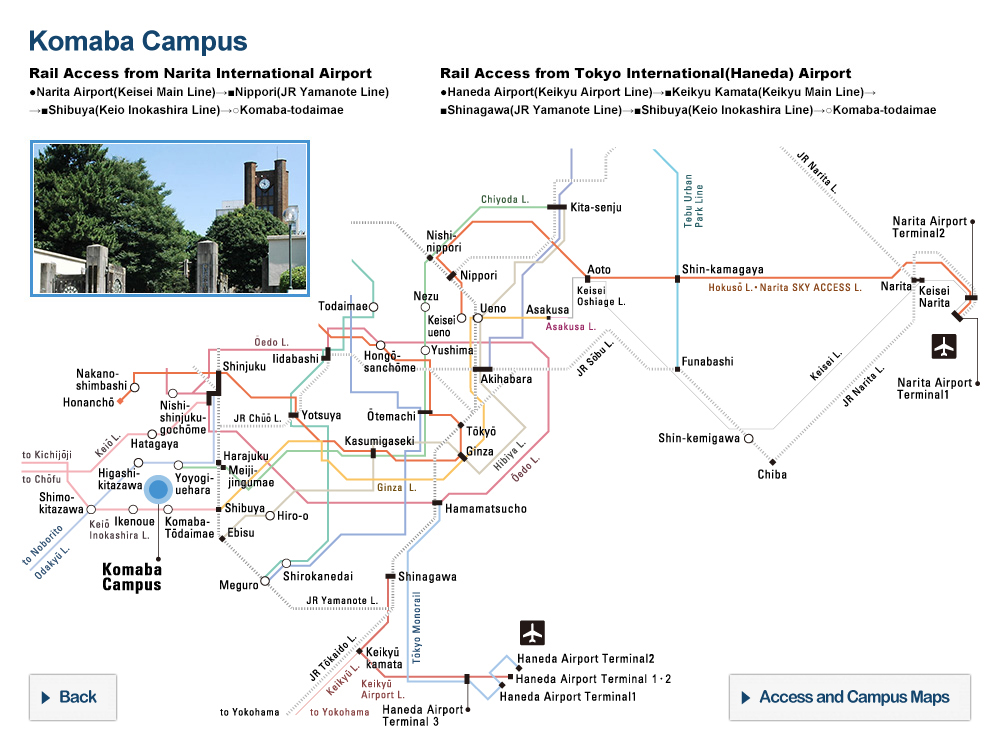
| Location | Komaba Area Campus |
| Venue | 2nd Floor Conference Hall, Building Number 4, Komaba II Research Campus |
| Capacity | 102 people |
| Entrance Fee | No charge |
| Registration Method | Advance registration required
Please register via Google form below https://forms.gle/FphmheeFtp3dxqLj8
|
| Registration Period | September 11, 2026 — October 5, 2026 |
| Contact | akira-igata@g.ecc.u-tokyo.ac.jp |
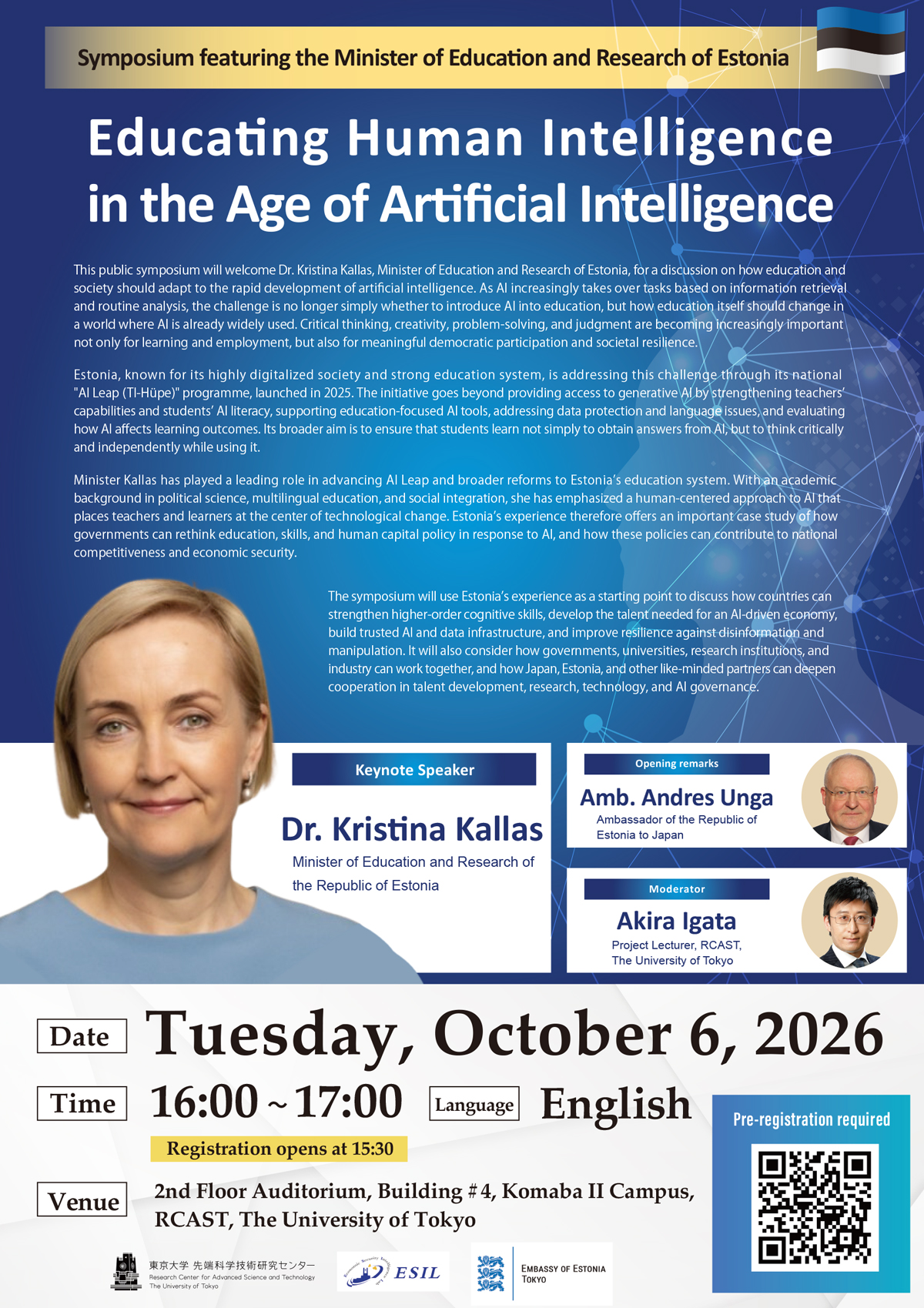
The Economic Security Intelligence Lab (ESIL) at the Research Center for Advanced Science and Technology (RCAST), The University of Tokyo and the Embassy of the Republic of Estonia in Tokyo are pleased to co-host a public symposium titled:
[Symposium featuring the Minister of Education and Research of Estonia]
Educating Human Intelligence in the Age of Artificial Intelligence
This public symposium will welcome Dr. Kristina Kallas, Minister of Education and Research of the Republic of Estonia, for a discussion on how education and society should adapt to the rapid development of artificial intelligence. As AI increasingly takes over tasks based on information retrieval and routine analysis, the challenge is no longer simply whether to introduce AI into education, but how education itself should change in a world where AI is already widely used. Critical thinking, creativity, problem-solving, and judgment are becoming increasingly important not only for learning and employment, but also for meaningful democratic participation and societal resilience.
Estonia, known for its highly digitalized society and strong education system, is addressing this challenge through its national "AI Leap (TI-Hüpe)" programme, launched in 2025. The initiative goes beyond providing access to generative AI by strengthening teachers’ capabilities and students’ AI literacy, supporting education-focused AI tools, addressing data protection and language issues, and evaluating how AI affects learning outcomes. Its broader aim is to ensure that students learn not simply to obtain answers from AI, but to think critically and independently while using it.
Minister Kallas has played a leading role in advancing AI Leap and broader reforms to Estonia’s education system. With an academic background in political science, multilingual education, and social integration, she has emphasized a human-centered approach to AI that places teachers and learners at the center of technological change. Estonia’s experience therefore offers an important case study of how governments can rethink education, skills, and human capital policy in response to AI, and how these policies can contribute to national competitiveness and economic security.
The symposium will use Estonia’s experience as a starting point to discuss how countries can strengthen higher-order cognitive skills, develop the talent needed for an AI-driven economy, build trusted AI and data infrastructure, and improve resilience against disinformation and manipulation. It will also consider how governments, universities, research institutions, and industry can work together, and how Japan, Estonia, and other like-minded partners can deepen cooperation in talent development, research, technology, and AI governance.
Dr. Kristina Kallas has served as Minister of Education and Research of the Republic of Estonia since 17 April 2023. Born in Kiviõli on 29 January 1976, she is a member of the Eesti 200 party, which she helped found, and currently serves as its Deputy Chairman. She was Chairman of Eesti 200 from 2018 to 2022 and has served as a member of the Tartu City Council since 2021.
Dr. Kallas has an extensive background in academia, education, integration policy, and public service. Since 2019, she has been a researcher at the University of Tartu, where she previously served as Director of Narva College from 2015 to 2019 and as an extraordinary research fellow from 2007 to 2008. From 2015 to 2019, she was also Chairman of the Supervisory Board of the Integration Foundation. She has advised the OSCE and national governments on multilingual education, integration, and ethnic policy, serving as a consultant in Georgia in 2020, Moldova in 2019, and Kyrgyzstan in 2016. She was a member of the board of the Estonian Refugee Council from 2011 to 2015 and of the Institute of Baltic Studies from 2007 to 2015. Earlier in her career, she worked as a senior consultant at Hill and Knowlton Estonia AS from 2002 to 2006 and, from 1998 to 2001, served as Estonia’s national contact person for the EU’s Fifth Framework Programme for Research and Innovation at the EU Innovation Centre of the Archimedes Foundation.
Dr. Kallas graduated from the University of Tartu in 2000 with a degree in history and received a master’s degree in history from Central European University in Hungary in 2002. She earned her PhD in political science from the University of Tartu in 2016. She speaks Estonian, English, Russian, and Polish. Outside her political and academic work, she also serves as President of the Estonian Handball Association.
The discussion will be moderated by Akira Igata (Project Lecturer, RCAST, University of Tokyo).
This seminar will be conducted in English.
Notes for participants
- For security reasons, no dangerous materials or food/beverages are allowed inside the venue. Please follow staff instructions during the event.
- Please present your valid photo ID (e.g., student ID or driver’s license) at the reception desk on the day of the event. For security reasons, participants who do not provide complete and accurate information regarding their identity, affiliation, and position may not be admitted.