



Event report on the SDGs Symposium 2026 AI and Sustainability: Opportunities and Challenges for a Sustainable Future

The University of Tokyo jointly with Springer Nature held a symposium on the interface of artificial intelligence and the Sustainable Development Goals (SDGs) on 17 February 2026. This was the seventh SDGs Symposium co-organized by the University of Tokyo and Springer Nature, following symposia in 2019, 2021, 2022, 2023, 2024 and 2025, each focusing on different aspects of the SDGs. The 2026 symposium focused on AI challenges and opportunities for sustainability, exploring both the opportunities that AI offers for accelerating progress toward the SDGs and the challenges it poses if not developed and governed responsibly. This theme reflected the consensus between the organizing teams that AI is rapidly reshaping societies, economies, and cultures in ways that carry profound implications for sustainable development across multiple sectors of society. In this context, there are growing calls to take a holistic, interdisciplinary, and inclusive approach to ensuring that AI serves the SDGs rather than undermines them.
To reflect these priorities, the 2026 SDGs Symposium brought together leading researchers and practitioners from academia, publishing, industry, and international organizations working at the intersection of AI, sustainability, and governance. Special attention was given to achieving a broad range of perspectives across disciplines, sectors, and geographies.
The Opening Remarks were delivered by Dr. Teruo Fujii, President of the University of Tokyo. He set the tone of the symposium by acknowledging that AI will impact the entire world, both positively and negatively, in areas such as sustainability and research and innovation, and that policies relating to AI will need to be individualized by each country to address these impacts.
In the first Keynote Presentation, Dr. Tshilidzi Marwala, Rector of the United Nations University (UNU) and Under-Secretary-General of the UN, addressed sustainable AI infrastructure and the digital divide. He emphasized that while AI holds significant potential for accelerating SDG progress, from agricultural pest detection in Africa to personalized learning and climate modeling, its benefits are unevenly distributed. He highlighted the self-reinforcing nature of the digital divide, pointing to the concentration of over 80% of global AI investment in just two countries, and the underrepresentation of languages and communities from the Global South in AI training data. He called for the democratization of AI as a shared societal resource, and underscored the need for sustainable material selection and responsible supply chains in AI hardware development. He also highlighted the UNU's new institute in Bologna dedicated to AI and big data, and the launch of the UNU artificial intelligence and sustainable development book series.
In the second Keynote, Dr. Magdalena Skipper, Editor-in-Chief of Nature and Chief Editorial Advisor for the Nature Portfolio, offered a dual perspective on AI and sustainability, examining AI both as a source of environmental risk and as a potential enabler of sustainable transformation. Drawing on recent publications from the Nature Portfolio, she outlined the significant environmental footprints associated with AI systems, including carbon and water footprints, noting that generative AI-based searches require four to five times more energy than conventional web searches, including the cumulative climate impact of AI data centers. At the same time, she highlighted research demonstrating how AI can contribute to climate modeling, early warning systems, behavioral change, and the advancement of multiple SDGs. She called for greater measurement and transparency—including energy ratings for AI tools analogous to those used for household appliances—and emphasized the need for closer collaboration between researchers and policymakers at a global level.
The four Plenary presentations addressed different critical dimensions of AI and sustainability. First, Dr. Ayyoob Sharifi, Professor at the IDEC Institute, Hiroshima University, examined AI-driven smart cities and their relationship to SDG progress. Second, Dr. Xin Zhou, Director of the AI and New Frontier Group at the Institute for Global Environmental Strategies, presented research on AI and the governance of SDG interlinkages. Dr. Hironobu Takagi, Executive Director of the National Museum of Emerging Science and Innovation (Miraikan) and Senior Member of the Accessibility Research Team at IBM Research Tokyo, presented a case study to demonstrate how physical AI can improve everyday life. Finally, Mr. Yuji Ogino, Global Head of Sustainability at Tokyo Electron, examined the relationship between AI and the semiconductor industry.
Professor Hiromi Yokoyama of the University of Tokyo coordinated a panel discussion with all speakers, which addressed the most critical aspects to achieve sustainable AI in the long term, and how inclusiveness in AI development and use can be achieved within and between countries. The discussion highlighted the need for well-calibrated regulations, the importance of standardized frameworks, and the value of understanding AI as infrastructure.
Dr. Antoine Bocquet, Managing Director of Springer Nature Japan, and Professor Kensuke Fukushi, Professor and Director of the Institute for Future Initiatives at the University of Tokyo, then presented the closing remarks of the Symposium. Dr. Bocquet commented that both the University of Tokyo and Springer Nature continue to champion the importance of collaboration in confronting the global challenges highlighted by the UN's sustainable development goals. He also highlighted Springer Nature's commitment to SDG-related research, as well as Springer Nature's recent membership in the UN Global Compact. He noted that 78% of policy-cited research originates solely from Global North authors, underscoring the importance of broadening participation in the global research landscape . Professor Fukushi emphasized that AI is not only merely a technical tool, it is embedded in the social, economic, and political systems, and that it is essential to integrate insights. He highlighted the value of interdisciplinarity and the role of universities as bridges. He also commented that AI was also a central topic at the Science and Technology in Society (STS) Forum in October 2025.
There were approximately 518 international participants who attended for the 2026 SDGs Symposium. Participants came from academic and research institutions, the private sector, government agencies, international organizations, and civil society, reflecting the broad transdisciplinary relevance of the event.
Following the Symposium, a networking and poster session was held, where undergraduate and postgraduate students from the University of Tokyo and other universities presented their work on SDG-related topics to the speakers and audience.
Photography:
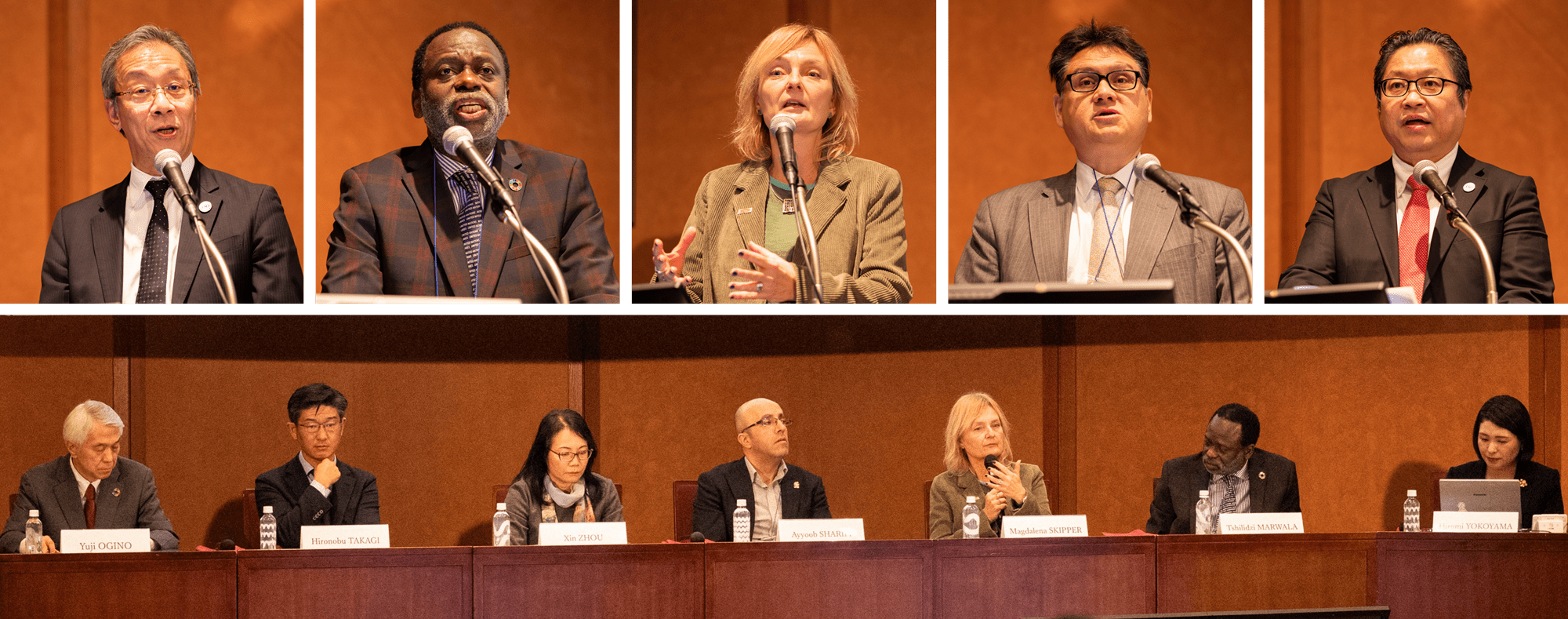
[TOP] From left, President Fujii, Dr. Marwala, Dr. Skipper, Dr. Bocquet, Director Fukushi
[Bottom] Panel Discussion (from left, Mr. Ogino, Dr. Takagi, Dr. Zhou, Dr. Sharifi, Dr. Skipper, Dr. Marwala, Prof. Yokoyama)
To reflect these priorities, the 2026 SDGs Symposium brought together leading researchers and practitioners from academia, publishing, industry, and international organizations working at the intersection of AI, sustainability, and governance. Special attention was given to achieving a broad range of perspectives across disciplines, sectors, and geographies.
The Opening Remarks were delivered by Dr. Teruo Fujii, President of the University of Tokyo. He set the tone of the symposium by acknowledging that AI will impact the entire world, both positively and negatively, in areas such as sustainability and research and innovation, and that policies relating to AI will need to be individualized by each country to address these impacts.
In the first Keynote Presentation, Dr. Tshilidzi Marwala, Rector of the United Nations University (UNU) and Under-Secretary-General of the UN, addressed sustainable AI infrastructure and the digital divide. He emphasized that while AI holds significant potential for accelerating SDG progress, from agricultural pest detection in Africa to personalized learning and climate modeling, its benefits are unevenly distributed. He highlighted the self-reinforcing nature of the digital divide, pointing to the concentration of over 80% of global AI investment in just two countries, and the underrepresentation of languages and communities from the Global South in AI training data. He called for the democratization of AI as a shared societal resource, and underscored the need for sustainable material selection and responsible supply chains in AI hardware development. He also highlighted the UNU's new institute in Bologna dedicated to AI and big data, and the launch of the UNU artificial intelligence and sustainable development book series.
In the second Keynote, Dr. Magdalena Skipper, Editor-in-Chief of Nature and Chief Editorial Advisor for the Nature Portfolio, offered a dual perspective on AI and sustainability, examining AI both as a source of environmental risk and as a potential enabler of sustainable transformation. Drawing on recent publications from the Nature Portfolio, she outlined the significant environmental footprints associated with AI systems, including carbon and water footprints, noting that generative AI-based searches require four to five times more energy than conventional web searches, including the cumulative climate impact of AI data centers. At the same time, she highlighted research demonstrating how AI can contribute to climate modeling, early warning systems, behavioral change, and the advancement of multiple SDGs. She called for greater measurement and transparency—including energy ratings for AI tools analogous to those used for household appliances—and emphasized the need for closer collaboration between researchers and policymakers at a global level.
The four Plenary presentations addressed different critical dimensions of AI and sustainability. First, Dr. Ayyoob Sharifi, Professor at the IDEC Institute, Hiroshima University, examined AI-driven smart cities and their relationship to SDG progress. Second, Dr. Xin Zhou, Director of the AI and New Frontier Group at the Institute for Global Environmental Strategies, presented research on AI and the governance of SDG interlinkages. Dr. Hironobu Takagi, Executive Director of the National Museum of Emerging Science and Innovation (Miraikan) and Senior Member of the Accessibility Research Team at IBM Research Tokyo, presented a case study to demonstrate how physical AI can improve everyday life. Finally, Mr. Yuji Ogino, Global Head of Sustainability at Tokyo Electron, examined the relationship between AI and the semiconductor industry.
Professor Hiromi Yokoyama of the University of Tokyo coordinated a panel discussion with all speakers, which addressed the most critical aspects to achieve sustainable AI in the long term, and how inclusiveness in AI development and use can be achieved within and between countries. The discussion highlighted the need for well-calibrated regulations, the importance of standardized frameworks, and the value of understanding AI as infrastructure.
Dr. Antoine Bocquet, Managing Director of Springer Nature Japan, and Professor Kensuke Fukushi, Professor and Director of the Institute for Future Initiatives at the University of Tokyo, then presented the closing remarks of the Symposium. Dr. Bocquet commented that both the University of Tokyo and Springer Nature continue to champion the importance of collaboration in confronting the global challenges highlighted by the UN's sustainable development goals. He also highlighted Springer Nature's commitment to SDG-related research, as well as Springer Nature's recent membership in the UN Global Compact. He noted that 78% of policy-cited research originates solely from Global North authors, underscoring the importance of broadening participation in the global research landscape . Professor Fukushi emphasized that AI is not only merely a technical tool, it is embedded in the social, economic, and political systems, and that it is essential to integrate insights. He highlighted the value of interdisciplinarity and the role of universities as bridges. He also commented that AI was also a central topic at the Science and Technology in Society (STS) Forum in October 2025.
There were approximately 518 international participants who attended for the 2026 SDGs Symposium. Participants came from academic and research institutions, the private sector, government agencies, international organizations, and civil society, reflecting the broad transdisciplinary relevance of the event.
Following the Symposium, a networking and poster session was held, where undergraduate and postgraduate students from the University of Tokyo and other universities presented their work on SDG-related topics to the speakers and audience.
Photography:
[TOP] From left, President Fujii, Dr. Marwala, Dr. Skipper, Dr. Bocquet, Director Fukushi
[Bottom] Panel Discussion (from left, Mr. Ogino, Dr. Takagi, Dr. Zhou, Dr. Sharifi, Dr. Skipper, Dr. Marwala, Prof. Yokoyama)