


 Find a book


Title
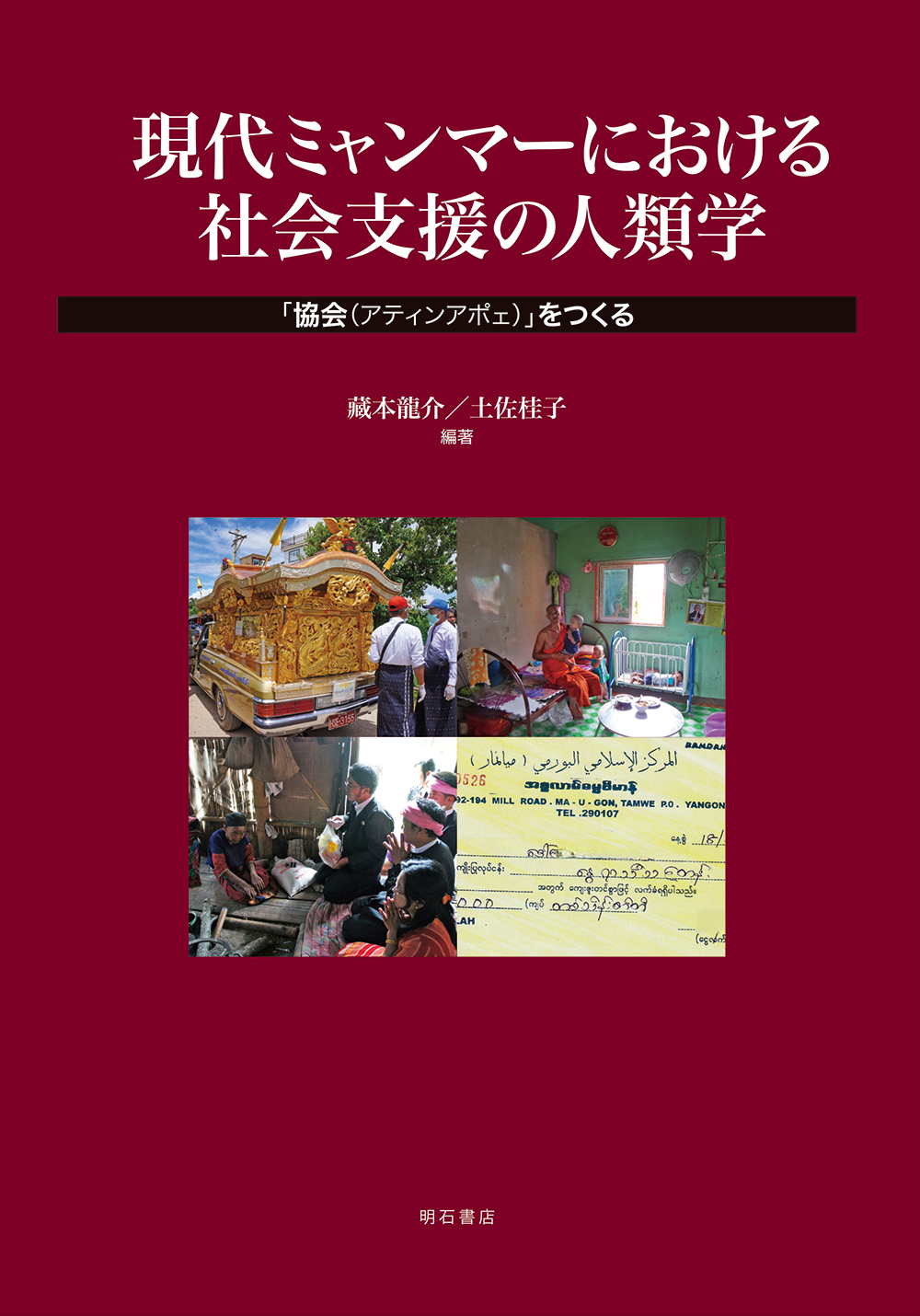
Gendai Myanmar ni okeru Shakai Shien no Jinruigaku (An Anthropology of Social Support in Contemporary Myanmar - Creating "Associations" [athin ahpwe])
Size
276 pages, A5 format
Language
Japanese
Released
March 31, 2026
ISBN
9784750360928
Published by
Akashi Shoten
Book Info
See Book Availability at Library
Japanese Page
When people think of Myanmar today, they often picture the military coup, civil war, and refugees. Yet amid these upheavals, how do ordinary people support one another and hold their society together day to day? This edited volume answers that question from the standpoint of cultural anthropology, showing how people in contemporary Myanmar have built mechanisms of mutual support with their own hands, rather than relying on the state or international NGOs.
Our focus is a form of organization found throughout Myanmar: the “association” (athin ahpwe). These associations’ activities are strikingly diverse—funeral assistance, medical care, educational support, disaster relief, and the preservation of religion and culture. At first glance these associations resemble Western NGOs, but they cannot be fully understood through the Western framework of “civil society” alone. The reason lies in a distinctive system, deeply rooted in the Theravada Buddhist world, that we call the “donation-based economy”: a mechanism for collecting donations from society, managing them, and redistributing them to those in need. Here, giving (dana) is not merely charity. It is at once a religious practice and the foundation that binds people together, sustains organizations, and makes social support possible.
The originality of this book lies in approaching these associations from multiple angles at once. Part I examines the historical development of Buddhist associations, the nationwide distribution of registered associations based on administrative records, and the reality of the so-called “government-organized NGOs.” Part II presents a range of cases that cut across religious and ethnic boundaries—funeral-assistance associations, a meditation center, Muslim social-support organizations, and the associations of ethnic minorities such as the Shan and the Ta’ang—each drawn from the authors’ long-term fieldwork. What emerges is that “support” is not simply the act of helping those in difficulty, but a practice deeply entangled with merit, ethics, communal ties, and the social order of local communities.
The book also speaks directly to Myanmar’s present situation. Since the 2021 coup, some associations have been suppressed for aiding those injured in protests, while others have been forced to halt or scale back their activities. Even so, the practice of mutual support and the impulse to take responsibility for a shared “public” have not disappeared. If anything, the associations reveal anew the solidarity that runs beneath the surface of Myanmar society.
What we most wish to convey is the distinctive appeal of cultural anthropology—and of the humanities and social sciences more broadly: the capacity to immerse oneself in the lived world of people on the ground and, from there, to fundamentally rethink seemingly self-evident concepts such as “civil society,” “NGO,” and “support.” Coming to know the distant “associations” of Myanmar can also become an occasion to reconsider the forms that mutual support might take in our own society. We hope this book will serve as a starting point for that inquiry.
(Written by KURAOTO Ryosuke, Professor, Institute for Advanced Studies on Asia / 2026)


