

 Find a book


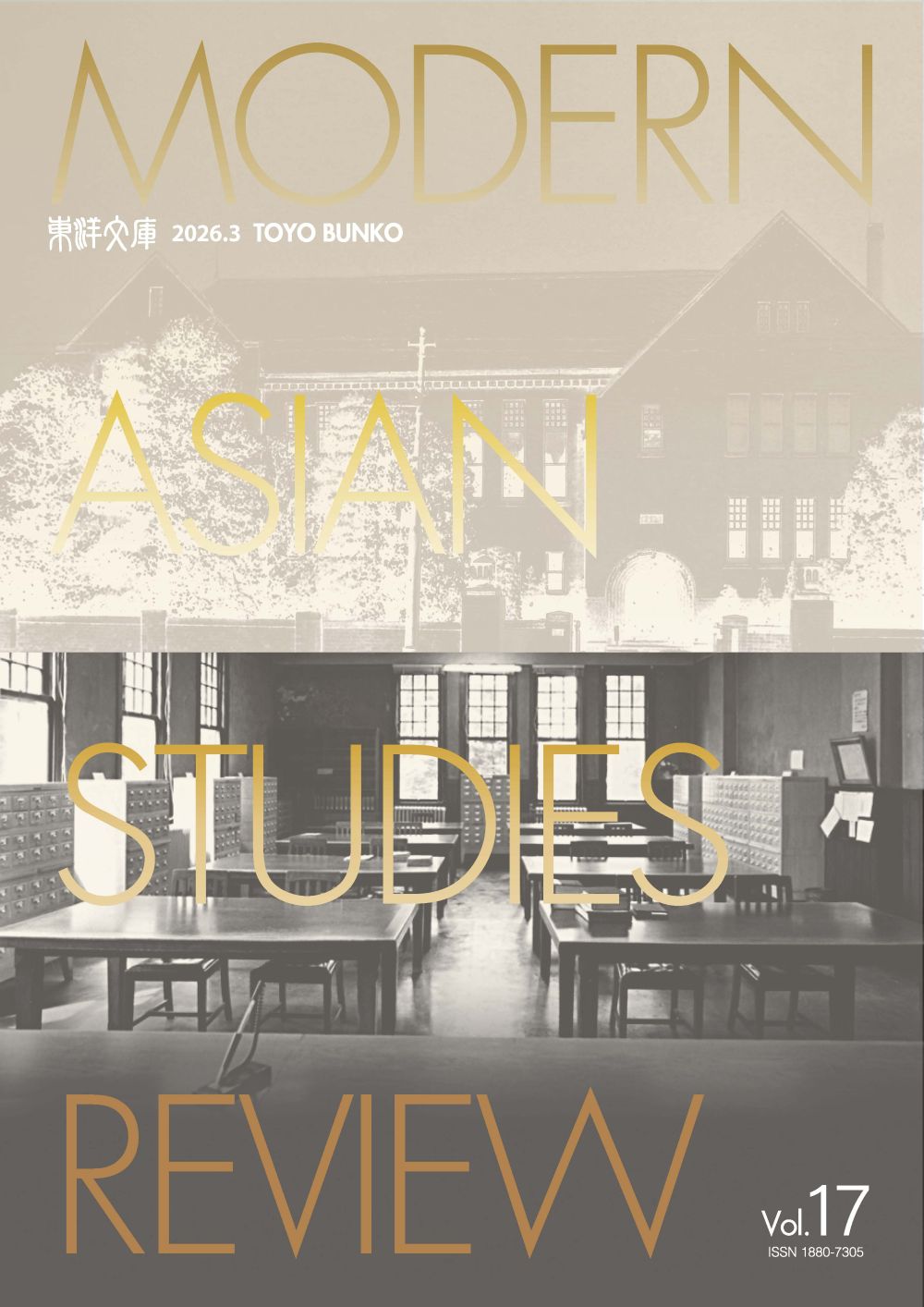
Title
Modern Asian Studies Review Vol. 17 Special Feature: Historicizing China’s Reform and Opening-Up
Size
Online journal
Language
English
Released
March 23, 2026
ISSN
1880-7305
Published by
Toyo Bunko
Book Info
See Book Availability at Library
Japanese Page
 eBook
The period in China commonly known as the Reform and Opening-Up period spanned approximately 50 years. A critical question arises for scholars of Chinese studies: How should this period be examined?
Drawing on major recent studies in both English and Japanese, the significance of research on this period can be summarized as follows.
The forces that propelled China from the turmoil of the Cultural Revolution to its current status as a global power were generated in large part by the policies pursued during the Reform and Opening-Up period. Therefore, understanding the transformative processes of this period is essential for gaining a deeper understanding of contemporary China.
In this context, China scholars in Western countries and in Japan have focused on two key issues.
First, scholars have sought to identify the similarities and differences between China and the Soviet Union, exploring why China avoided the major systemic collapse that occurred in the Soviet Union around 1990.
Second, they have examined how the political tolerance and social diversity that emerged during the nascent phase of Reform and Opening-Up, from the late 1970s through 1992, shaped Chinese politics and society from the 1990s onward. Particular attention has been paid to the period following the 1989 Tiananmen Incident and to Deng Xiaoping’s Southern Tour in 1992 as a turning point in the reform process. To what extent have human agency and institutional factors contributed to the consolidation of the current political power structure?
However, the current state of research on the history of the Reform and Opening-Up periods in Western countries and Japan is not entirely consistent. One distinguishing feature of Western research compared with that of Japan is the relatively robust body of comparative studies between China and the Soviet Union. Japanese scholars of China should acknowledge that this area has certain disadvantages. However, in contrast to Western countries, a key feature of Japanese research is its effort to situate the Reform and Opening-Up period within the broader context of modern and contemporary Chinese history. Japanese historians and political scientists have collaborated to identify key aspects of modern and contemporary Chinese history that influenced the Reform and Opening-Up period.
Nonetheless, certain deficiencies are common to both Western and Japanese studies on the history of the Reform and Opening-Up period.
First, there is a lack of research perspectives that reposition the nascent phase of Reform and Opening-Up―a turning point from the Cultural Revolution to the present―compared with the Soviet Union and the former Eastern European countries. This perspective should also incorporate Taiwan’s (Republic of China) experience, as Taiwan achieved economic and social development earlier than the People’ s Republic of China. Such a perspective would place the nascent phase of Reform and Opening-Up within the global currents of modernization and democratization, which spanned the 20th century and included various reactions against modernity.
Second, scholarly works have not sufficiently reassessed the various phenomena that emerged during the nascent phase of Reform and Opening-Up within the framework of universality and particularity.
Third, there is a need for research methods that empirically clarify the political conditions of the nascent phase of Reform and Opening-Up to support these research perspectives and ambitions.
The articles included in this special feature provide new insights into one or more of three major challenges faced by the global community of China scholars. The record of roundtable discussions with political scientists and European studies scholars appended at the end will likely prove highly beneficial in advancing future research on the history of this period. We hope that this special feature will serve as a catalyst for further development in the global study of the history of the Reform and Opening-Up period.
(Written by NAKAMURA Motoya, Professor, Graduate School of Arts and Sciences / 2026)
Table of Contents
Nakamura, Motoya
Background
Reform and Opening-Up in the Context of Modern and Contemporary Chinese History
Kaneko, Hajime
The Development and Transformation of the Parliamentary System: in Modern and Contemporary China (1900s-1980s)
Kamo, Tomoki
Continuity and Discontinuity in Reform: CCP Proposals for Social Consultation and Dialogue and for Consultative Democracy
Yoshimi, Takashi
The Political and Judicial Exploration in China during the Budding Period of Reform and Opening-Up
Kawai, Reika
Political reform during the 1980s: Hu Yaobang's Perspective
Yokoyama, Yuta
Hungary and Poland as Models for China's Political and Economic System Reforms in the 1980: From the Perspective of the Future International Relations Scholar, Wang Yizhou
Higo, Haruka
Scientification of Decision-Making: Knowledge that Supported an Enduring Political Reform
Ienaga, Masaki
The Issue of Multi-Party System in Discourses on National Unification in Early Reform-Era China
Amiya, Ryosuke and Nakada, Mizuho
Roundtable