


 Find a book


Title
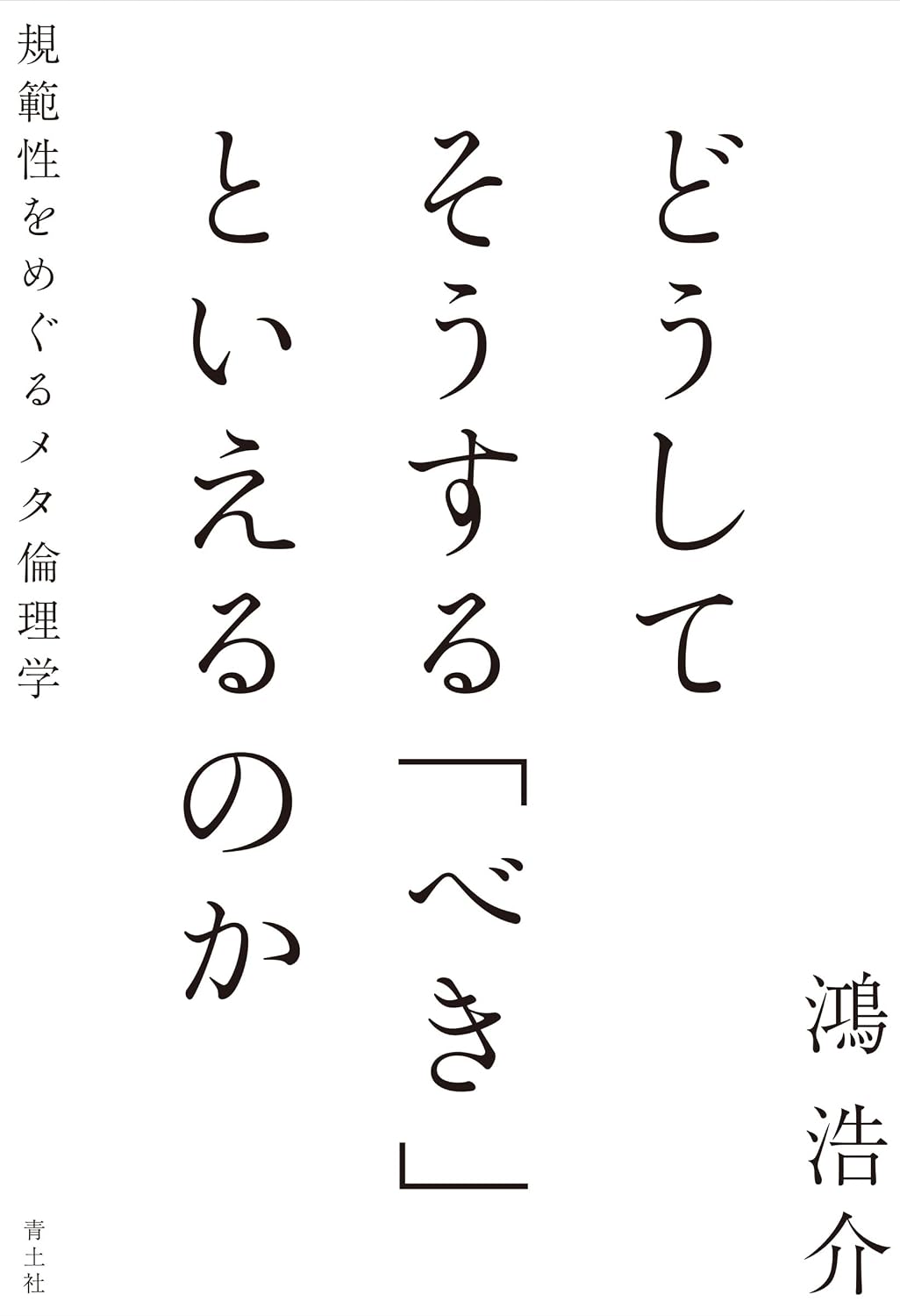
Dōshite Sō Suru 'Beki' to Ieru no ka (Why Can We Say We "Ought" to Do It? - A Metaethical Inquiry into Normativity)
Size
373 pages
Language
Japanese
Released
December 25, 2025
ISBN
978-4-7917-7759-4
Published by
青土社
Book Info
See Book Availability at Library
Japanese Page
 eBook
Claims to the effect that someone ought to do something, or that something ought to be a certain way, are called "normative" claims. Normative claims are distinguished from "descriptive" claims, which state facts: that someone is doing something, or that something is a certain way. Anyone who has studied even a little philosophy will have been taught this distinction; yet the question of how exactly the normative differs from the descriptive is in fact one of the major problems on which philosophers remain far from agreement. This book takes up that problem and attempts, from a particular vantage point, to shed light on the nature of the normativity. Ethics in the ordinary sense—"normative ethics"—engages in ethical thinking itself; the enterprise of examining that thinking from a meta-level standpoint, as this book does, is called "metaethics."
This book adopts the "expressivist" hypothesis that normative claims are not attempts to state facts, but rather expressions of the speaker's attitudes. Attitudes, of course, come in many kinds. The difference the book focuses on is that between directing an attitude toward someone in the second-personal manner of "you...," and directing it third-personally, as in "that person...." Anger, for example, may be regarded as a second-personal attitude, since it anticipates a response from the other party and carries the intention of remaining in engagement with them. Once we judge that no appropriate response can be expected at all, we lose any motive for anger toward that person. In its place arise third-personal attitudes such as disgust and contempt, which involve neither the anticipation of a response nor any intention of engagement. Our expressions of disgust are directed less at the object of disgust than at some third party.
If this is right, then normative claims that employ words like "ought" likewise divide into second-personal and third-personal varieties. When we blame someone—"Why did you do that? You ought not to have!" —and what is being expressed is a second-personal attitude such as anger, the aptness of that expression depends on the other party's capacity to respond. Where the attitude is a third-personal one such as disgust, by contrast, the same does not hold. The details must be left to the book itself, but the author contends that taking this distinction into account in fact points the way to dissolving a fundamental problem running through the history of ethics and metaethics—one the book calls "the dilemma of practicality and objectivity." The argument also bears directly on the practical question of just how far the class of beings we can hold responsible extends, and what hangs on that. Is it rational, for instance, to hold people who have no concern for morality at all ("amoralists") morally responsible? Is it irrational to retaliate against a bear that has harmed a human being? The book closes with considerations such as these.
(Written by BISHAGO Kosuke, Assistant Professor, Graduate School of Humanities and Sociology / 2026)
Related Info
Reviewed by Shigeki Noya (Asahi Shimbun January 31, 2026
https://book.asahi.com/article/16320060