

 Find a book


Title
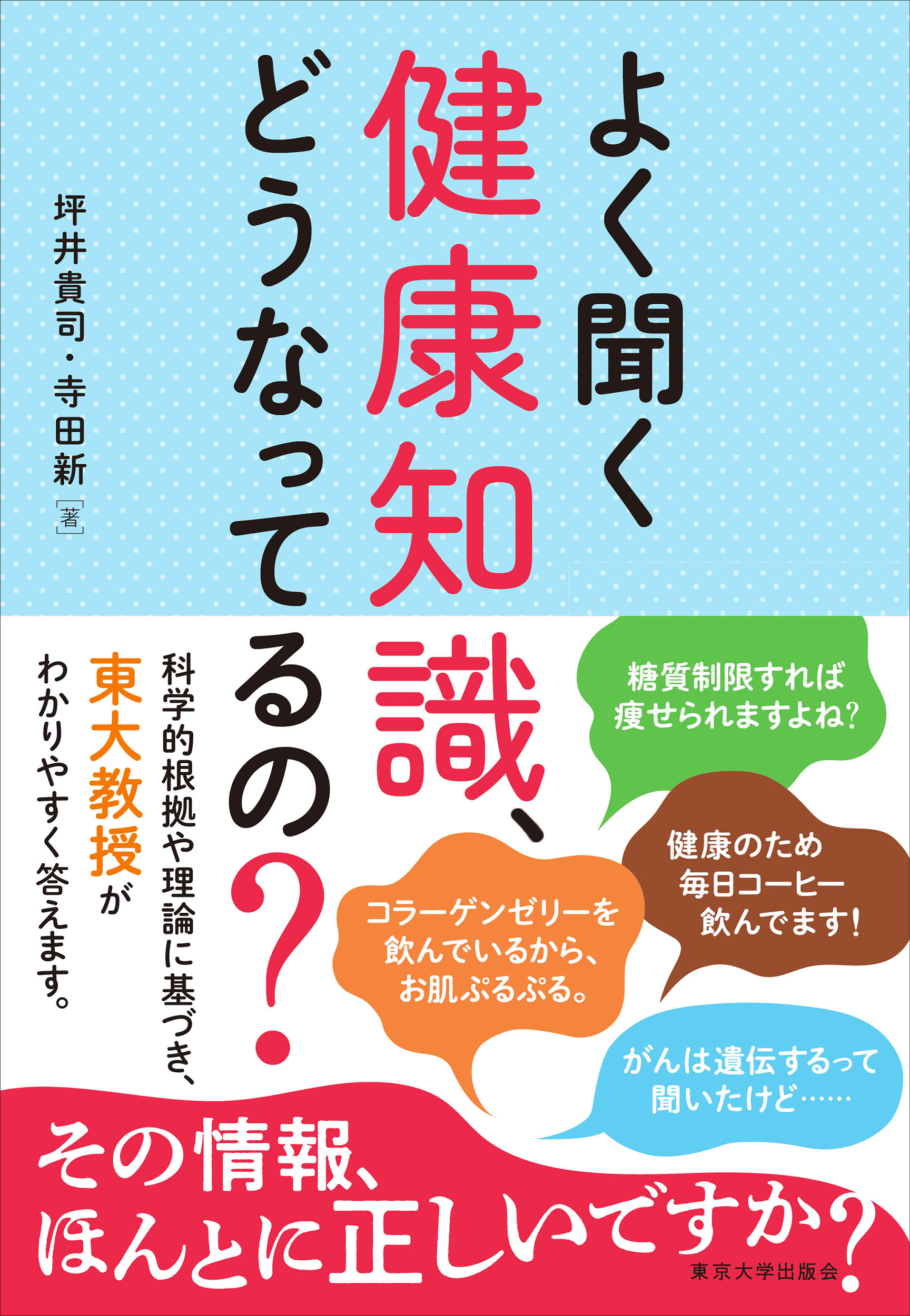
Yoku Kiku Kenko Chishiki Donatteruno? (Your Guide to Scientific Health Literacy)
Size
292 pages, 127x188mm
Language
Japanese
Released
March 28, 2025
ISBN
978-4-13-063411-3
Published by
University of Tokyo Press
Book Info
See Book Availability at Library
Japanese Page
 eBook
eBook
Walk into any convenience store, scroll through social media, or turn on the TV, and you’ll see it: health advice everywhere. “Burn belly fat with this drink!” “Avoid these foods if you want to live longer!” The promises sound tempting—but are they true? That’s the real question. And it’s not just a matter of curiosity; it’s about how we live, age, and stay healthy.
Japan is famous for its longevity. People here live some of the longest lives in the world. But there’s a catch: our healthy life expectancy—the years we spend free from major health problems—is much shorter than our overall lifespan. For men, the gap is about nine years; for women, it’s twelve. That means many people spend their final years needing care, living what’s called “Nen-nen Korori” instead of the ideal “Pin-pin Korori.” It is no wonder that health advice feels so urgent. We all want to stay active and independent for as long as possible. Bridging this gap isn’t just about living longer—it’s about adding life to those years.
Here’s the problem: the flood of health tips we see every day isn’t always backed by science. Some claims are exaggerated. Others are just plain wrong. So how can we separate fact from fiction? The answer lies in scientific literacy—not memorizing facts, but learning how to think critically. It’s about asking: “Where’s the evidence?” “Who’s making this claim?” “Does the science actually support it?” With this mindset, we stop being passive consumers of health advice and start making informed choices.
This is exactly how scientists approach such claims. When they hear something like “This food reduces visceral fat,” they don’t go straight to the laboratory. First, they dig into research papers, check data, and look for solid evidence. You don’t need a PhD to do the same. A little skepticism and curiosity go a long way.
That’s exactly what this book is about. Based on a popular series from the University of Tokyo Press magazine UP, it takes common health myths and puts them under the microscope. Is a low-carbohydrate diet truly effective? Are coffee and tea good for you? Does the so-called “golden time” after exercise actually exist? Each chapter breaks down the science in plain language—no jargon, no hype—so you can see what’s real and what’s not. You’ll learn to spot the difference between a genuine medical breakthrough and a clever marketing gimmick, giving you the clarity to navigate today’s health landscape.
The goal isn’t just knowledge-it’s empowerment. In a world overflowing with health advice, scientific literacy is your shield. It helps you protect your health, your family, and your peace of mind. More than that, it’s a life skill—a way of thinking that shapes your future. It transforms anxiety into confidence, ensuring you’re no longer swayed by every fleeting trend. This book is your first step. So dive in, and discover how fascinating—and practical—scientific thinking can be.
(Written by TSUBOI Takashi and TERADA Shin, Professors, Graduate School of Arts and Sciences / 2025)