

 Find a book


Title
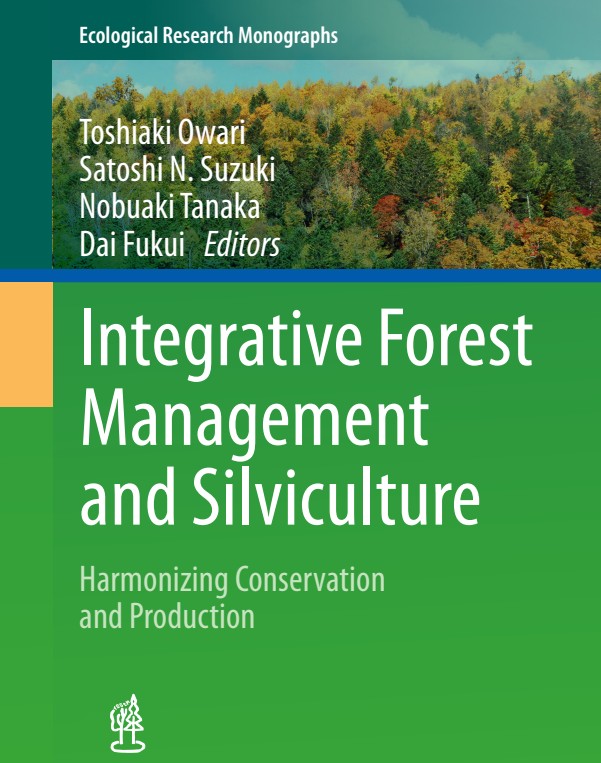
Ecological Research Monographs Integrative Forest Management and Silviculture Harmonizing Conservation and Production
Size
292 pages
Language
English
Released
October 02, 2025
ISBN
978-981-95-1016-0
Published by
Springer Singapore
Book Info
See Book Availability at Library
Japanese Page
 eBook
eBook
This monograph presents a comprehensive account of the scientific and practical achievements of the University of Tokyo Hokkaido Forest (UTHF), over more than six decades. At its core is the Stand-based Silvicultural Management System (SSMS), an innovative and adaptive framework developed to address the growing challenges posed by climate change. The SSMS reconciles two objectives that have often been viewed as conflicting: sustainable timber production and the conservation of forest ecosystems.
The SSMS is grounded in six fundamental principles that emphasize minimal and well-targeted intervention, careful adaptation to site-specific conditions, and the maintenance of structurally and compositionally diverse, multi-layered forests. These principles reflect a long-term commitment to ecological integrity and resilience rather than short-term optimization. The academic strength of the UTHF is further demonstrated by its extensive Long-Term Ecological Research (LTER) program and the systematic integration of advanced digital technologies. Tools such as GIS, airborne LiDAR, UAV photogrammetry, and GNSS are employed to support precise forest type classification, detailed inventories, and single-tree selection harvesting. This data-driven and spatially explicit approach underpins sustainable forest management across the UTHF’s approximately 23,000-hectare, hemi-boreal forest landscape.
Beyond silvicultural techniques, this book highlights the multiple ecosystem functions being fulfilled by the UTHF. It has dedicated chapters examining the role of the UTHF in climate change mitigation through carbon sequestration and the stable provision of drinking and agricultural water for local communities. It also covers the UTHF’s efforts in a wide range of cultural ecosystem services including the conservation of habitats for emblematic species, such as the Black Woodpecker and the Northern Pika, as well as support for the cultural traditions of the indigenous Ainu people through the provision of materials for traditional dugout canoe construction.
Importantly, the monograph does not shy away from unresolved challenges. It addresses the increasing frequency and intensity of climate-related disturbances, such as windthrow and snow damage, and critically examines ongoing biological threats, including insect pests, and the ecological impacts of expanding sika deer populations and non-native species. By presenting both achievements and limitations, the book underscores that integrated forest management is an evolving process that requires continual learning and adaptation.
A Message to Students:
This book offers a compelling case study of interdisciplinary practice in action, for students aspiring to pursue careers in humanities and social sciences. The SSMS demonstrates how rigorous natural science combined with historical insight and long-term empirical data can inform policies and management strategies that reconcile economic activity with ecological responsibility. The experience of the UTHF illustrates that sustainable governance of human–nature systems does not depend on abstract ideals alone, but on continuous observation, adaptation, and ethical engagement with real-world complexity. Engaging with this framework will equip students to better understand, and ultimately help address, the global sustainability challenges they will face in their future research and professional lives.
(Written by OWARI Toshiaki, Professor, Graduate School of Agricultural and Life Sciences / 2026)
Table of Contents
1 Outline of This Book
Toshiaki Owari, Satoshi N. Suzuki, Nobuaki Tanaka, and Dai Fukui
2 Management History of the University of Tokyo Hokkaido Forest
Toshiaki Owari and Satoshi N. Suzuki
Part II Forest Ecosystem
3 Location, Topography, Geology, and Soil
Nobuaki Tanaka
4 Climate and Hydrology
Nobuaki Tanaka
5 Forest Vegetation and Ecological Studies
Satoshi N. Suzuki and Susumu Goto
6 Fauna and Their Biology
Dai Fukui and Naoto Kamata
Part III Forest Management and Silviculture
7 The Stand-Based Silvicultural Management System: An Introduction
Toshiaki Owari
8 Implementing the Stand-Based Silvicultural Management System
Toshiaki Owari
9 Harvesting, Timber Marketing, and Forest Roads
Toshiaki Owari
10 Management Practices for Natural Regeneration and Plantations
Satoshi N. Suzuki, Daisuke Sakaue, Susumu Goto, and Toshiaki Owari
11 Seedling Production
Daisuke Sakaue, Susumu Goto, and Satoshi N. Suzuki
Part IV Management and Conservation of Multiple Ecosystem Functions
12 Effects of Forest Management on Ecosystem Processes
Satoshi N. Suzuki
13 Forest Recovery Process and Restoration After Large-Scale Disturbances
Satoshi N. Suzuki and Toshiaki Owari
14 Biological Threats: Insect Pests, Diseases, and Mammal Damage
Dai Fukui, Naoto Kamata, and Daisuke Sakaue
15 Biodiversity Conservation
Dai Fukui and Satoshi N. Suzuki
16 Ecosystem Services in the UTHF
Satoshi N. Suzuki, Nobuaki Tanaka, and Toshiaki Owari
Part V The Future
17 Future Challenges and Opportunities for Integrative Forest Management and Silviculture
Toshiaki Owari, Satoshi N. Suzuki, Nobuaki Tanaka, and Dai Fukui