


 Find a book


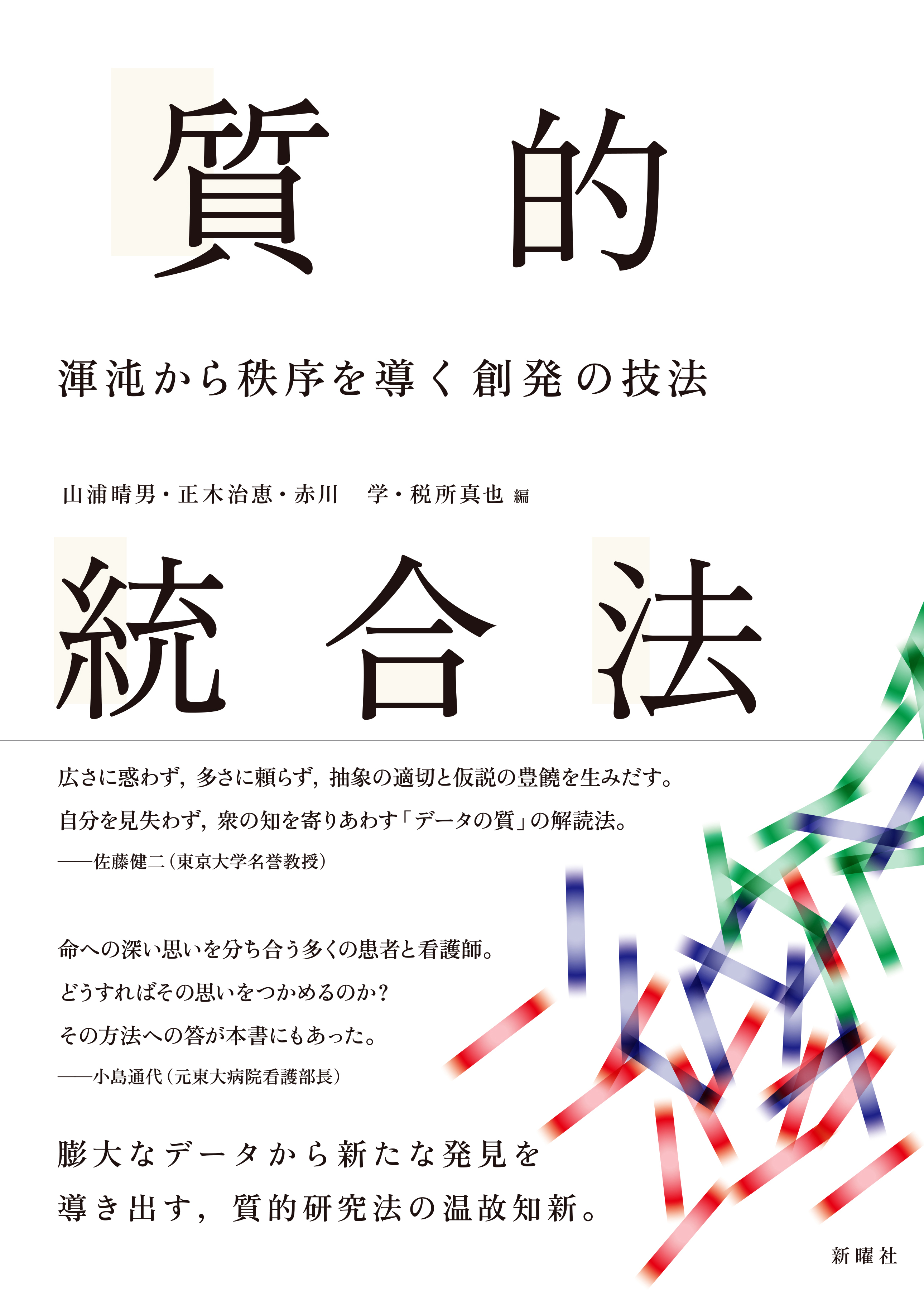
Title
Shitsuteki Togoho (The Qualitative Synthesis Method - An Emergent Technique for Deriving Order from Chaos)
Size
544 pages, B5 format
Language
Japanese
Released
October 19, 2025
ISBN
978-4788518988
Published by
Shinyosha
Book Info
See Book Availability at Library
Japanese Page
Researchers who work with qualitative data often find themselves at a loss. Interview transcripts, field notes, open-ended responses -- how can this accumulated "chaos" be grasped as a whole and turned into genuine discovery, without arbitrary selection and interpretation? How can qualitative research secure scientific rigor and objectivity at all? This book confronts these long-standing questions head-on.
The Qualitative Synthesis Method (shitsuteki togoho) integrates qualitative data in faithful accordance with the principles and techniques of the KJ Method, devised by the cultural anthropologist Jiro Kawakita. Its developer, Haruo Yamaura (Director of Joho Kobo; Project Professor, Graduate School of Nursing, Chiba University), spent twenty years under Kawakita studying and disseminating the KJ Method, and has spent the three decades since refining it through teaching and research support -- above all in nursing science -- and through practice in local communities.
The book opens with a systematic exposition by the developer himself (Parts 1-4), which covers i) the "W-shaped problem-solving model"; ii) the procedure that leads from unitizing data to diagramming and narration; iii) the epistemology of exercising the researcher's subjectivity while securing objectivity; iv) two dedicated techniques for interpretation; v) the method's intellectual debts to Kitaro Nishida and Kinji Imanishi and its affinities with pragmatism and Michael Polanyi; and vi) the "Yoriai Workshop" for consensus building in community revitalization. With applications by researchers in nursing (Part 5), sociology (Part 6), and anthropology, architecture, and education (Part 7), the book consists of a total of twenty-eight chapters in 544 pages.
The immediate impetus for the book was the method's introduction into the Department of Sociology in the Faculty of Letters at the University of Tokyo. Teaching the undergraduate social research practicum, the present writer (Shinya Saisho) confronted the hollowed-out "pseudo-KJ" that is employed as if writing labels were all there is to it. Together with Professor Yasushi Sukenari, he invited Professor Yamaura to lead a training workshop on the Hongo campus in autumn 2022, and the method was formally adopted into the practicum from the 2023 academic year. Chapter 20 (Saisho) records this process, while Chapter 19 (Chizuko Ueno) traces the KJ Method's "cultural diffusion" from Kyoto University -- Kawakita's own alma mater -- to the University of Tokyo.
The sociology chapters show the method at work. Chapter 23 (Manabu Akagawa) takes interview data from his "sociology of cats" -- on the experience of seeing a companion cat through the end of its life -- and sets a self-taught, KJ-style analysis against a re-analysis with the Qualitative Synthesis Method, allowing readers to experience for themselves where the method's formidable power lies. Chapter 22 (Yasushi Sukenari) "re-reads" interviews from a survey of an aging public housing estate in three successive ways, until a hidden theme -- variations on the motif that "people can change" -- emerges from a single resident's narrative. Chapter 21 (Takashi Iguchi) candidly records the difficulties of applying the method to an interdisciplinary study of women in families affected by hemophilia: if training data are an "artificial pool," one's own data are the "open sea."
The book's reach extends beyond sociology. In Chapter 24, Shoko Konishi (human ecology) applies the method to focus group interviews on sexual behavior as a determinant of fecundity, finding it useful for discovering research themes, understanding quantitative data, and designing questionnaires. Chapter 26 (Toshio Otsuki) connects participatory community planning (machizukuri), the "wisdom-gathering" techniques he witnessed in a Cambodian slum-improvement project, and Participatory Rural Appraisal (PRA) with the KJ Method, revealing it as a philosophy of participation and consensus formation rather than a mere data-sorting technique. Further chapters come from nursing science, where the method first took root (Part 5, Harue Masaki and others), demographic anthropology, and higher education.
From companion cats to housing estates, hemophilia families, sexual behavior, and Cambodian villages, the cases attest that the method is not the property of any discipline but a transferable scholarly skill, honed through training just as experimental skill is honed in the laboratory sciences. Let chaos speak for itself: at the end of a thorough engagement with one's data comes a moment of deep joy, as a structure that no existing concept could capture rises into view. In an age when generative AI dominates information processing, the human techniques of conception and synthesis matter more, not less. This is a book for every student and researcher who wishes to know how scientific rigor can be brought to qualitative research.
Messages from the Contributors (University of Tokyo Faculty)
Yasushi Sukenari, Professor, Graduate School of Humanities and Sociology, The University of Tokyo
Listeners tend to direct their attention to what they had set out to learn in advance. The Qualitative Synthesis Method has built-in devices to restrain this filtering of information, so that even the small but important messages a narrator sends are not missed. It is, in the true sense of the word, a technique that fosters dialogical communication.
Takashi Iguchi, Professor, Graduate School of Humanities and Sociology, The University of Tokyo
My chapter describes my trial and error at the stage just before actually carrying out the Qualitative Synthesis Method, wondering how on earth to make it work. Even after the training, doing turns out to be far harder than saying -- and yet, once you have experienced the method, a hope begins to emerge that you can somehow find your way through a vast body of data. Still very much a beginner, I am in no position to lecture anyone, but I invite you all to dive with us into the sea of the Qualitative Synthesis Method and swim on together.
Toshio Otsuki, Professor, Graduate School of Engineering, The University of Tokyo
I am, unusually among the contributors, from engineering. Within engineering, however, lies the field of planning, whose mission is to solve the problems before us by reconciling the knowledge and mechanisms of the natural sciences with the endlessly complex mechanisms of human beings. Seen in this light, the Qualitative Synthesis Method has the character of a technique for finding common ground between the natural and social sciences, and it is a methodology that can bring new insight to any academic field.
Shoko Konishi, Associate Professor, Graduate School of Medicine, The University of Tokyo
I warmly recommend this book to anyone interested in the study of human beings. Collecting data by talking with people and observing them is enjoyable, but pulling it all together is often a struggle. This is a book that helps at exactly such moments.
Manabu Akagawa, Professor, Graduate School of Humanities and Sociology, The University of Tokyo
The Qualitative Synthesis Method offers intellectual excitement and a sense of liberation all at once. In gathering the captions and arranging them in space, you experience "emptying yourself and letting the data speak." In writing the captions and drafting the overview map, you become so absorbed that you lose track of time, and when the final diagram is complete, a flash of insight -- "now I see!" -- arrives together with the exhilaration of having seen it through. I hope that many more people will come to know this extremely rewarding research method.
(Written by SAISHO Shinya, Assistant Professor, Graduate School of Humanities and Sociology / 2026)