


 Find a book


Title
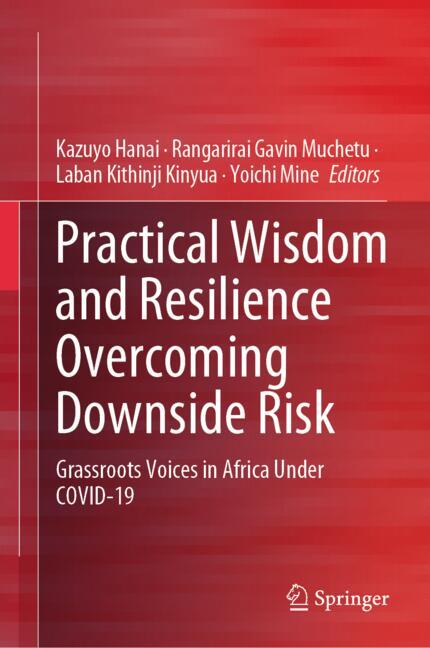
Practical Wisdom and Resilience Overcoming Downside Risk Grassroots Voices in Africa Under COVID-19
Size
175 pages, hardcover
Language
English
Released
May 25, 2025
ISBN
978-981-96-4454-4
Published by
Springer Singapore
Book Info
Japanese Page
 eBook
eBook
How have Africans perceived and overcome the global COVID-19 pandemic?
This book presents the research results of the three-year project “Exploration of Practical Wisdom and Resilience Overcoming Downside Risk – Collecting Grassroots Voices in Africa under COVID-19,” which was initiated in 2021.
This research project collected grassroots voices from Sub-Saharan Africa and explored how local people perceived and coped with the impact of the COVID-19 pandemic and government prevention policies on their daily lives.
This project covered seven countries: Uganda, Ethiopia, Kenya, the Democratic Republic of the Congo, Zimbabwe, Tanzania, and South Africa.
Through in-depth field research conducted in collaboration with local researchers, we gathered the voices of local residents, which foreign studies often find difficult to obtain, and dynamically observed the process by which people recognize and overcome risks.
Chapter 1 sets the research questions, while Chapter 2 presents the findings from a common online questionnaire survey conducted in seven countries, revealing that economic distress is perceived as a greater risk factor than COVID-19. The case studies in Chapters 3 through 8 explore such diverse aspects as differences in risk perception between urban and rural areas (Zimbabwe), the politicization of infectious disease countermeasures (Uganda), youth “hustling” to overcome risks (Kenya, Tanzania), the role of the middle class in supporting societal resilience (South Africa), the impact of misinformation on vaccination practices (Ethiopia), and the impact of the pandemic and countermeasures on women’s self-esteem in conflict-affected areas (Congo).
This study contributes significantly to the literature by revealing that the effectiveness of government policies can be hindered by government politicization of COVID-19 prevention measures combined with people’s distrust of the government. In several countries, politicians have faced criticism for using government prevention measures to garner votes and favor the governing party in elections. Such biased policies decrease popular trust in government and can hinder preventive measures and vaccine dissemination. While rapid implementation of these measures is vital for preventing pandemics, policymakers should carefully consider them from the perspective of protecting vulnerable populations and guaranteeing human rights.
However, our survey revealed that people’s perceptions of the government and its policies are complex and multifaceted, often depending on the passage of time and the outcome of the policy. Moreover, ordinary people, seeking to survive, have improvised creative activities to maintain their livelihoods while navigating the containment measures. It is also essential to understand the sources of people’s resilience in times of hardship and to empower them with public assistance during regular times.
We highly recommend reading the manuscript.
(Written by HANAI Kazuyo, Project Assistant Professor, Institute for Future Initiatives / 2025)
Table of Contents
Kazuyo Hanai, Rangarirai Gavin Muchetu, Laban Kithinji Kinyua, and Yoichi Mine
2. Risk Perceptions of COVID-19 in Seven African Countries
Christian Samen Otchia and Kazuyo Hanai
3. Risk Perceptions, Resilience and Evaluation of Government Policies During the COVID-19 Pandemic in South Africa: A Study of the Middle Class
Chizuko Sato, Scarlett Cornelissen, and Tomohiro Hosoi
4. Peasants Survive Again: Risk Perception and Implications for COVID-19 Resilience in Urban and Rural Areas of Zimbabwe
Rangarirai Gavin Muchetu and Walter Chambati
5. Politicization of COVID-19 in Uganda: A Critical Reflection on Government Interventions and Citizens’ Perceptions
Vick Lukwago Ssali, Wakiko Ohira, Denis Musinguzi, and Nakabuye Juliet Musoke
6. We Hustled, We Emerged Stronger: Students’ Resilience in Countering the Risks of the COVID-19 Pandemic in Kenya and Tanzania
Laban Kithinji Kinyua, Odomaro Mubangizi, and Maureen Obare
7. Establishing Misinformation as a Key Downside Risk in COVID-19 Vaccination: Evidence from Ethiopia
Christian Samen Otchia
8. Resilience Under Pressure: The Impact of COVID-19 on Self-Esteem Among Vulnerable Women in Eastern Democratic Republic of Congo
Christian Samen Otchia, Kazuyo Hanai, Jean-Claude Maswana, and Akemi Ishikawa
9 Conclusion
Kazuyo Hanai
Related Info
Exploration of Practical Wisdom and Resilience Overcoming Downside Risk
Collecting grassroots voices in Africa under COVID-19
https://ifi.u-tokyo.ac.jp/en/projects/africa-under-covid19/
Events:
The 2nd Symposium of “Exploration of Practical Wisdom and Resilience Overcoming Downside Risk” (SDGs Collaborative Research Unit, Institute for Future Initiatives (IFI), the University of Tokyo Feb 9, 2024)
https://ifi.u-tokyo.ac.jp/en/event/12316/
The 1st Symposium of “Exploration of Practical Wisdom and Resilience Overcoming Downside Risk” (SDGs Collaborative Research Unit, Institute for Future Initiatives (IFI), the University of Tokyo Feb 21, 2023)
https://ifi.u-tokyo.ac.jp/en/event/10978/