

 Find a book


Title
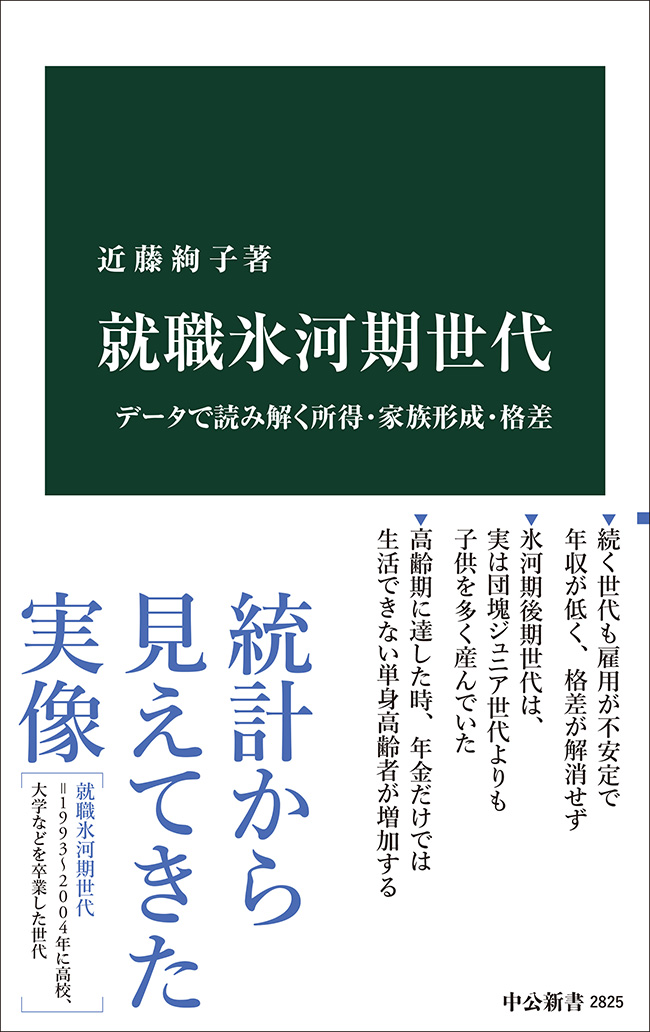
Chuko Shinsho 2825 Shushoku Hyogaki Sedai (The Job Market “Ice-age” Generation - Understanding Income, Family Formation, and Inequality Through Data)
Size
192 pages, paperback pocket edition
Language
Japanese
Released
October 21, 2024
ISBN
978-4-12-102825-9
Published by
CHUOKORON-SHINSHA. INC.
Book Info
See Book Availability at Library
Japanese Page
This book attempts to objectively understand the reality of “Shushoku Hyogaki Sedai (Job market “ice age” generation),” the cohorts who graduated from high school or university and entered the workforce during the recession following the collapse of the bubble economy (specifically between 1993 and 2004) based on statistical data. This generation has often been perceived as disadvantaged, with the effects of poor economic conditions during their youth—such as difficulty securing regular employment—lingering well into adulthood. This book takes the stance of rigorously examining how much of such popular perception is true, using data to verify it.
The introduction reveals that the job market situation for new graduates differed significantly between the early and late phases of the “ice age”, and that conditions did not improve substantially even after the mid-2000s, when the “ice age” is generally considered to have ended. While the term “Shushoku Hyogaki Sedai” often conjures images of those who graduated from university in the late 1990s when the phrase became popular, the job market was even worse for younger cohorts. Building on this, Chapter 1 then presents the post-graduation employment status and income trends for each cohort. It reveals that, while the income gap between the cohort that entered the labor market before the “ice age” began and the “ice age” cohort has been slow to narrow, there is little difference in income trajectories between the “ice age” cohort and the younger cohorts.
It is commonly perceived that the worsening economic situation of young people caused by the economic stagnation starting from the 1990s accelerated the declining birthrate. However, this book shows that, for the cohort entering the workforce around 2000 (the bottom of the recession), the birthrate stopped falling and even recovered slightly. On the other hand, some aspects confirmed the conventional wisdom. For instance, data confirmed that since the “ice age” cohorts, the proportion of those in particularly difficult situations—such as NEETs, isolated non-workers, or unmarried individuals living with parents for economic reasons—has increased.
Based on these findings, the final chapter proposed the need to expand the social security safety net to prevent poverty in old age and to provide continuous employment support not just for the ice age cohort but especially for the younger cohorts. It specifically highlighted the need for support for those who are working but whose income is insufficient.
The October 2024 release of this book coincided with the House of Representatives election, where measures for the “ice age” cohort began to gain political attention. By July 2025, it had become one of the key issues in the House of Councillors election. While the book was referenced in various places and I myself gave several interviews, I still feel a simplistic view persists that “this poor generation is simply unfortunate.” I sincerely hope that those who pick up this book will grasp the importance of objectively understanding the more complex reality through statistical data.
(Written by KONDO Ayako, Professor, Institute of Social Science / 2025)
Related Info
The 47th (2025) Suntory Prize for Social Sciences and Humanities (Political Science and Economics) (
(Suntory Foundation Nov 10, 2025)
https://www.suntory.com/sfnd/prize_ssah/
Shinsho Award 2025 (CHUOKORON.jp March 31 2025)
https://chuokoron.jp/shinsho_award/
TOYOKEIZAI 2024 Best Economics books (TOYOKEIZAI online Jan 3rd, 2025)
https://toyokeizai.net/articles/-/847722?page=3
Related Article:
Retirement Crisis Facing Graduates of Japan’s Lost Decades (nippon.com Sep 9, 2025)
https://www.nippon.com/en/in-depth/d01155/retirement-crisis-facing-graduates-of-japan%E2%80%99s-lost-decades.html
‘Employment ice age generation’ returns to spotlight ahead of Upper House election (The Japan Times April 25, 2025)
https://www.japantimes.co.jp/news/2025/04/25/japan/politics/employment-ice-age-measures/