

 Find a book


Title
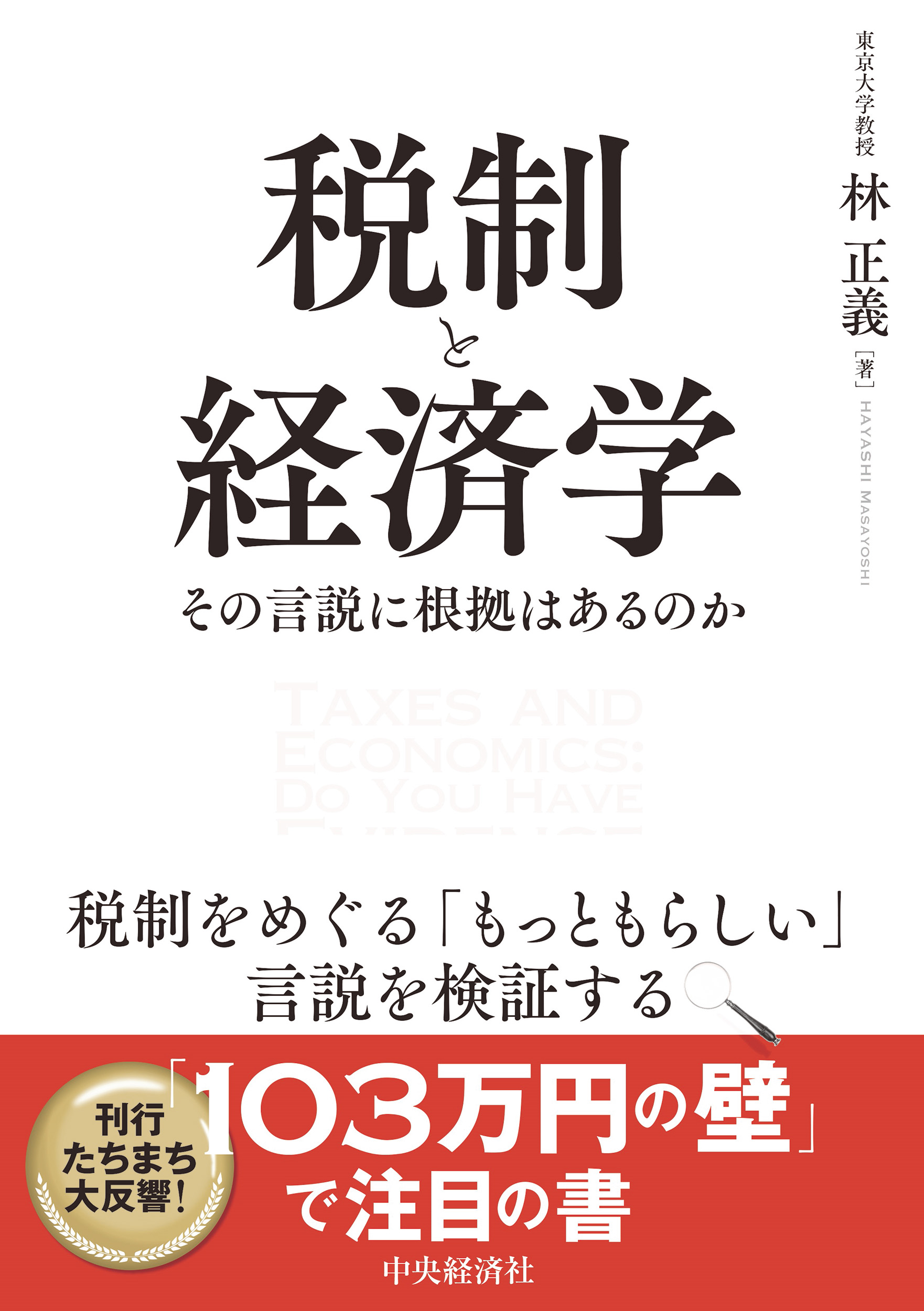
Zeisei to Keizaigaku (Taxes and Economics - Do You Have Evidence on Your Claims?)
Size
208 pages, A5 format
Language
Japanese
Released
July 29, 2024
ISBN
978-4-502-48911-2
Published by
Chuokeizai-sha Holdings, Inc.
Book Info
See Book Availability at Library
Japanese Page
 eBook
eBook
A wide range of claims and opinions about taxation have circulated through various media. You may have encountered arguments such as the following:
-- High labor income taxes undermine work incentives.
-- Raising the top marginal tax rate does not lead to higher tax revenues.
-- Strongly progressive taxation drives high-income earners abroad and reduces tax revenue.
-- The spousal exemption discourages women’s participation in the labor force.
-- The inheritance tax hinders business succession and harms the Japanese economy.
-- Corporate taxation has negative effects on economic growth.
-- Reduced tax rates help low-income earners.
These claims may sound plausible at first glance, but some of them may stem from the speaker’s “personal experiences and assumptions.” Others may be rooted in particular ideologies or value systems, or may arise from vested interests and practical benefits. Tax reforms that satisfy everyone are rare. Organized groups acting on the basis of specific beliefs or interests are likely to exert influence to prevent policies that work against them and to promote those that serve their advantage.
Indeed, whenever momentum builds for tax reform, such arguments tend to resurface repeatedly. Combined with widespread dissatisfaction over taxation, they tend to attract public attention. Moreover, if a particular claim aligns with one’s self-interest, people may accept it uncritically, even when it lacks solid evidence. As a result, unreliable arguments may spread and potentially shape the course of actual tax reform. Ultimately, tax policy is determined through political decision-making, and such decisions inevitably leave some parties dissatisfied. This is an unavoidable aspect of policymaking within Japan’s democratic system. Nevertheless, even if political outcomes themselves cannot satisfy everyone, the policymaking process leading up to those outcomes should not be swayed away by misconceptions or unfounded claims.
This book was written with such concerns in mind. It examines the extent to which various claims about taxation are supported by evidence, by reviewing existing economic research. However, in many areas, studies based on Japanese data remain limited. For those topics, the book mainly introduces findings from international research. Of course, it is not always clear whether studies based on data from countries with different institutions and social structures can serve as valid evidence for evaluating Japan’s tax system. Even so, given the scarcity of Japan-specific empirical research, results from studies conducted abroad remain an indispensable source of information that should be consulted first.
The final chapter summarizes key points that readers should bear in mind when assessing economic research. In particular, it discusses the recent emphasis on evidence-based policy making (EBPM), highlights the limitations of both existing empirical analyses and my own arguments presented in this volume, and underscores the importance of readers themselves “thinking critically” about the evidence and interpretations offered.
(Written by HAYASHI Masayoshi, Professor, Graduate School of Economics / 2025)
Related Info
The 34th (2025) The Institute of Tax Research and Literature Prize (The Institute of Tax Research and Literature 2025)
https://www.sozeishiryokan.or.jp/034-04/
Japan Association of Applied Economics Prize (Japan Association of Applied Economics June 2025)
https://www.jaae.org/prizes.html