

 Find a book


Title
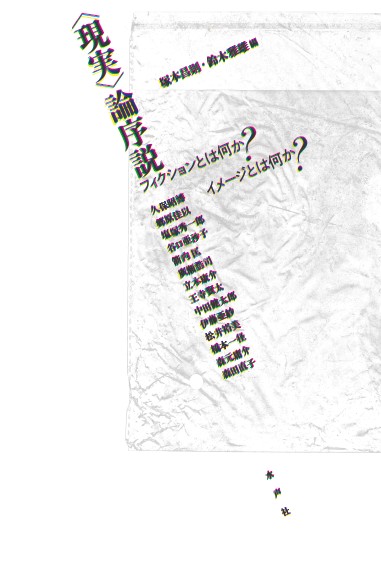
Genjitsu-Ron Josetsu (Prolegomena to a Theory of “Reality” - What Is Fiction? What Is an Image?)
Size
506 pages, A5 format, hardcover
Language
Japanese
Released
December, 2024
ISBN
9784801008366
Published by
Suiseisha
Book Info
See Book Availability at Library
Japanese Page
Scholars and educators working in literature departments share profound concerns. Since the end of the twentieth century, it has become commonplace to hear that literature is “finished.” When one is absorbed in one’s own research, this claim may not seem particularly troubling. Even if only a single specialist remains in a given field, research will no doubt continue. However, when faced with the young people living at present, many find themselves at a loss as to how they should convey the significance of their work.
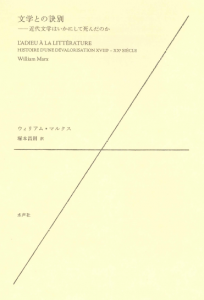
This volume, An Introduction to the Theory of “Reality”, begins by re-examining whether such claims about the “end of literature” are truly justified. According to this line of argument, the role of literature as a means of understanding the age in which we live has been taken over by the human sciences—history, sociology, anthropology, psychoanalysis, art history, image theory, and fiction theory—all of which developed dramatically in the twentieth century. Consequently, literature is said to have been reduced to little more than a form of entertainment that appeals to sensibility alone (see, for example, William Marx’s Farewell to Literature and Karatani Kōjin’s The End of Modern Literature). Since 2019, the editors of this volume have engaged in sustained dialogue with scholars of literature and the human sciences to assess the extent to which this argument can be upheld. What emerged from these discussions was not a simple opposition between literature and the human sciences, but a more fundamental question: How have both fields, in their own ways, confronted what we call “reality”?
This led us to ask anew, “What is reality?” However, once a question is posed, it becomes clear that this is not straightforward. Reality is neither something with a clearly defined outline that can be observed from the outside, nor is it an object possessing a fixed essence that can be neatly defined. On the contrary, what we call reality may be precisely that which cannot be held at a distance and is contemplated as an object. When we encounter something that overturns the assumptions of a subject who believes that understanding is simply a matter of thinking things through, we experience the inexpressible force of reality. More concretely, reality shatters the protective membrane of everyday life in which we ordinarily live without reflection, leaving us unsure of what kind of world we inhabit.
The essays in this volume can be broadly divided into two attitudes toward approaching reality. One is the attitude of attentive waiting: although one does not know what is happening, one concentrates on attention and remains alert. Sensing that something is present without knowing what it is, one listens intently and sharpens one’s gaze. This stance is shared by anthropological fieldwork and testimonial literature, which seek to give words about experiences that resist language. It is impossible to predict where, in such waiting, reality may even reveal a fragment of itself; yet, this posture of patience appears to draw forth wide-ranging realities.
Another attitude involves actively engaging with things that are known from the outset, but are not real. One lingers with fiction, with images that are materially present before one’s eyes, while knowing that they are not in reality. At times, something unreal suddenly reverses and transforms into reality. Truth can only be approached through falsehood.
This book is divided into four sections: literature, human sciences, image theory, and manga studies. However, what unites them is a shared concern with the dynamism inherent in what we call reality. Even when we do not know what kind of world we are confronting, the attempt to approach and interpret the unknown domain testifies to the enduring power of literature as a form of inquiry.
(Written by TSUKAMOTO Masanori, Professor Emeritus, Graduate School of Humanities and Sociology / 2025)
Table of Contents
Masanori Tsukamoto
Part I: Fiction
Knowledge of Fiction, Knowledge of Literature
Akihiro Kubo
1. What Is “Reality” for Literature?
For Impersonal Singularity: Maurice Blanchot’s “What Is Literature?”
Kai Gohara
Investigative Literature and the Apparatus of the Housing Complex:
On the Nodal Points of Contemporary Literature
Shūichirō Shiotsuka
Witnesses of Witnesses: On the Poetics of Oral Testimony (“Kikigaki”)
Asako Taniguchi
Plastic Reality: On Paul Valéry’s Lectures on Poetics
Masanori Tsukamoto
2. What Is “Reality” for the Human Sciences?
The Death of Ambrosio: On the “Literary” in Anthropology
Tadashi Yanai
Words Arising from the Cracks of Institutions:
From Merleau-Ponty’s Literary Theory
Kōji Hirose
“Reality” in Psychoanalysis: Freud, Winnicott, Lacan
Kôsuke Tsuiki
The Politics of the First Person:
A Scene from Rousseau’s Discourse on Inequality and The Social Contract
Kenta Ōji
Fiction as Experience:
Jean-Marie Schaeffer’s Theory of Fiction and Aesthetics
Akihiro Kubo
Part II: Images
Image Expression and Reality
Kentaro Nakata
3. The Intersection Between Images and “Reality”
Hidden Hands, Floating Hands, Emerging Hands
Asa Itō
An Anatomy of the Mimetic Body:
Playing with Origins in André Masson’s Anatomy of My Universe
Hiromi Matsui
From the Society of Bees to a Society with Bees:
An Intellectual History of Social Images
Kazumichi Hashimoto
Quotation, Image, and Wandering:
Anna, Bossuet, Gainsbourg
Yōsuke Morimoto
4. What Is “Reality” for Manga?
The Character Looks Back at Me:
What Is “Reality” for Manga?
Masao Suzuki
Can Manga Depict Violence Seriously?
A Tentative Essay on Meta-Perspectives in Manga
Naoko Morita
Literature in Manga, or Literature as Manga:
On That Which Keeps Rushing Forward
Kentaro Nakata
Epilogue: On “Narrating” Truth
Masao Suzuki