

 Find a book


Title
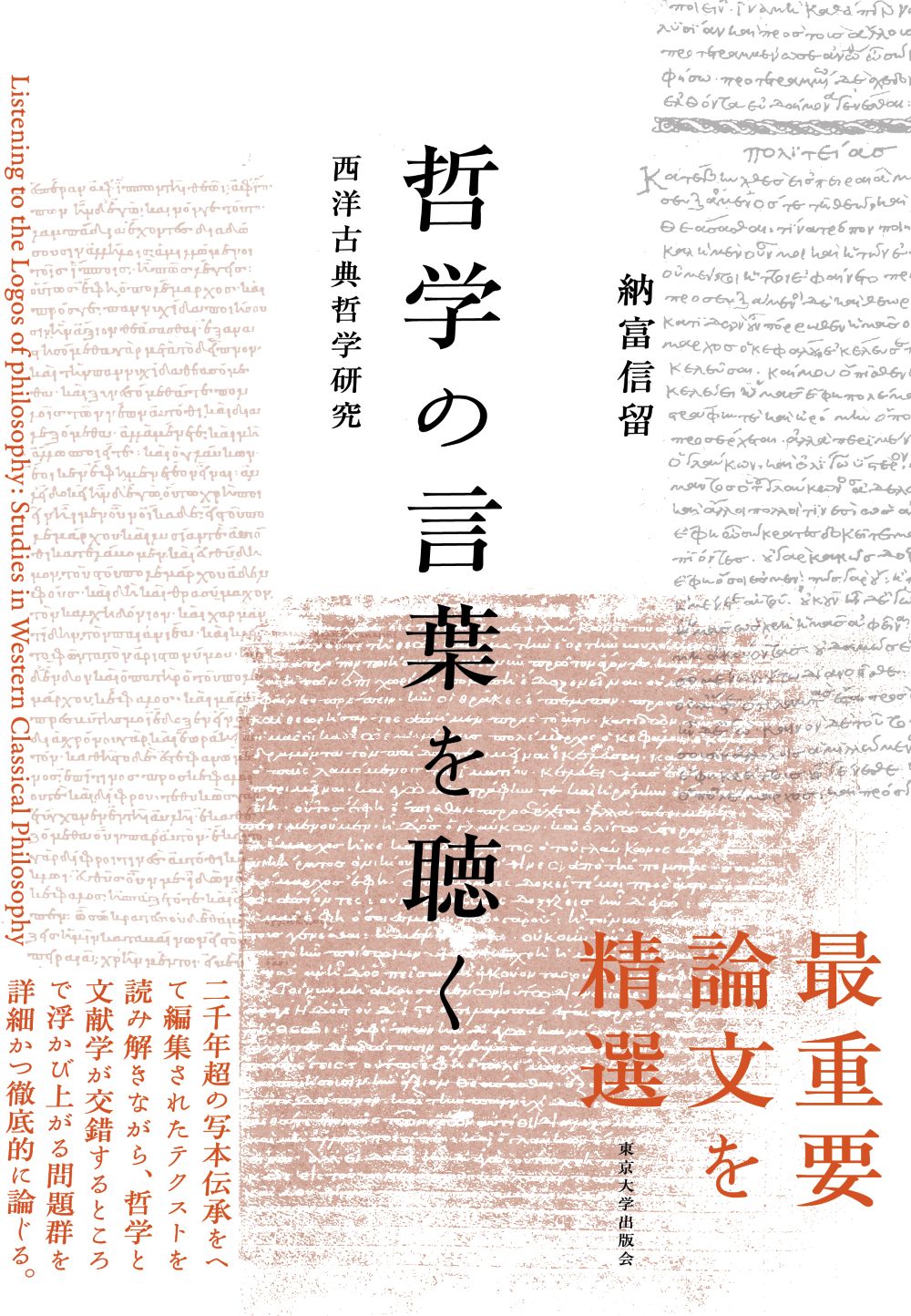
Tetsugaku no kotoba wo kiku (Listening to the Logos of Philosophy - Studies in Classical Western Philosophy)
Size
408 pages, A5 format
Language
Japanese
Released
June 03, 2025
ISBN
978-4-13-010163-9
Published by
University of Tokyo Press
Book Info
See Book Availability at Library
Japanese Page
 eBook
eBook
Ancient Greek philosophy has exerted a profound influence down to the present day. Yet the works that have been transmitted to us are extremely limited, and much of what we know has come down in the form of fragmentary testimonies. For this reason, their interpretation involves distinctive methodological difficulties. Insofar as they require an approach that integrates classical philology with the history of philosophy, ancient philosophical texts differ fundamentally from philosophical works of the modern and contemporary periods.
The writings of Plato and Aristotle, composed some 2,400 years ago, were transmitted from ancient papyrus rolls through medieval manuscripts. Modern scholars critically edited these handwritten texts and published them as printed editions, through which they came to be widely disseminated. In classical philology, which examines these texts in detail, there are many scholarly controversies over how key passages should be read, and new proposals continue to be advanced. Moreover, for philosophers whose works have not survived, testimonies and fragments preserved in quotations and references in texts written in late antiquity are carefully compared in order to reconstruct the original sources—this is the work of doxography and fragment studies. In some cases, the interpretation of ancient papyri that have miraculously resurfaced across the centuries is also brought to bear. By employing this wide range of philological methods, the present book seeks to reconstruct classical Western philosophy through close and detailed analysis of the surviving texts.
The book consists of nineteen essays and a general introduction, organized into five parts. Part I comprises four chapters on early Greek philosophy and the Sophistic movement. Parts II through IV contain thirteen chapters on Plato’s philosophy, ranging from his early to late works. Part V consists of two chapters devoted to Aristotle. At the core of the volume are five essays on the Politeia (Republic), which was the theme of an international Plato conference organized by the author in 2010. Although some of the essays were originally written in the late 1990s, the arguments and bibliographies have been revised as far as possible to reflect the most recent scholarship, and each chapter is accompanied by an editorial note that traces its publication history. These notes assess the significance of the research at the time it was conducted and the influence it has exerted since. In addition to chapters originally published in Japanese, the volume includes three chapters translated from English articles and eight chapters presented in Japanese in parallel with their English versions. The book is intended to serve as a bridge between international scholarship and research conducted in Japan.
Among the essays are studies that examine how differing readings of a single word or even a single letter across medieval manuscripts can give rise to radically different interpretations, and which of these readings should be regarded as most plausible. Other chapters explore the cultural and political contexts in which the works were written, as well as their reception and treatment in modern and contemporary thought. Taken together, these diverse approaches bring into relief, in a comprehensive way, the language and thought of ancient Greek philosophy.
(Written by NOTOMI Noburu, Professor, Graduate School of Humanities and Sociology / 2025)
Table of Contents
Chapter 1
The Ideals and Methods of Classical Western Philosophy
Part I: Early Greek Philosophy and Sophistic Movement
Chapter 2
Speaking Beyond Perspective: Xenophanes, Fragment 34 DK
Chapter 3
Bearing Witness to the Words and Deeds of the Sophists: Diogenes Laertius, Lives of Eminent Philosophers, Book 9, “Life of Protagoras”
Chapter 4
Speaking on the Existence of the Gods: Protagoras, On the Gods, Fragment 4 DK
Chapter 5
Comedy’s Satire of the Sophists: Aristophanes, Birds 689–691
Part II: Plato (I): From the Early to the Middle Dialogues
Chapter 6
The Provocation of the Opening Words: Plato, Apology 17a
Chapter 7
The Failure of the Ideal of Philosophical Politics: The Background to Plato’s Charmides
Chapter 8
Quoting the Words of the Ancients: Plato, Symposium 178b–c
Chapter 9
Under What Conditions Is Suicide Permissible?: Plato, Phaedo 62a
Part III: Plato (II): A Reading of the Republic
Chapter 10
Who Are Friends and Enemies in Matters of Justice?: Plato, Republic Book I, 334d–e
Chapter 11
Challenging Justice: Plato, Republic Book II, 357a–362c
Chapter 12
What Is True Falsehood?: Plato, Republic Book II, 382a–e
Chapter 13
How Do Philosophy and Politics Converge?: Plato, Republic Book V, 473c–e
Chapter 14
The Republic Set Up in Heaven: Plato, Republic Book IX, 592a–b
Part IV: Plato (III): Later Philosophy
Chapter 15
How the Elements of All Things Are Combined: The Vocabulary of Plato’s Sophist
Chapter 16
How Should the Good Be Discussed?: Plato, Philebus 11a–12b
Chapter 17
How Does Eternity Become Time?: Timaeus 37c–38c
Chapter 18
Did Plato Write in the First Person?: The Question of the Authenticity of the Seventh Letter Attributed to Plato
Part V: Aristotle
Chapter 19
How Does Dialectic Relate to Examination?: Aristotle, On Sophistical Refutations 34, 183a37–b8
Chapter 20
Sharing the Same Name as the Forms: Aristotle, Metaphysics A6, 987b7–10
Afterword
Index of Sources
Index of Names