

 Find a book


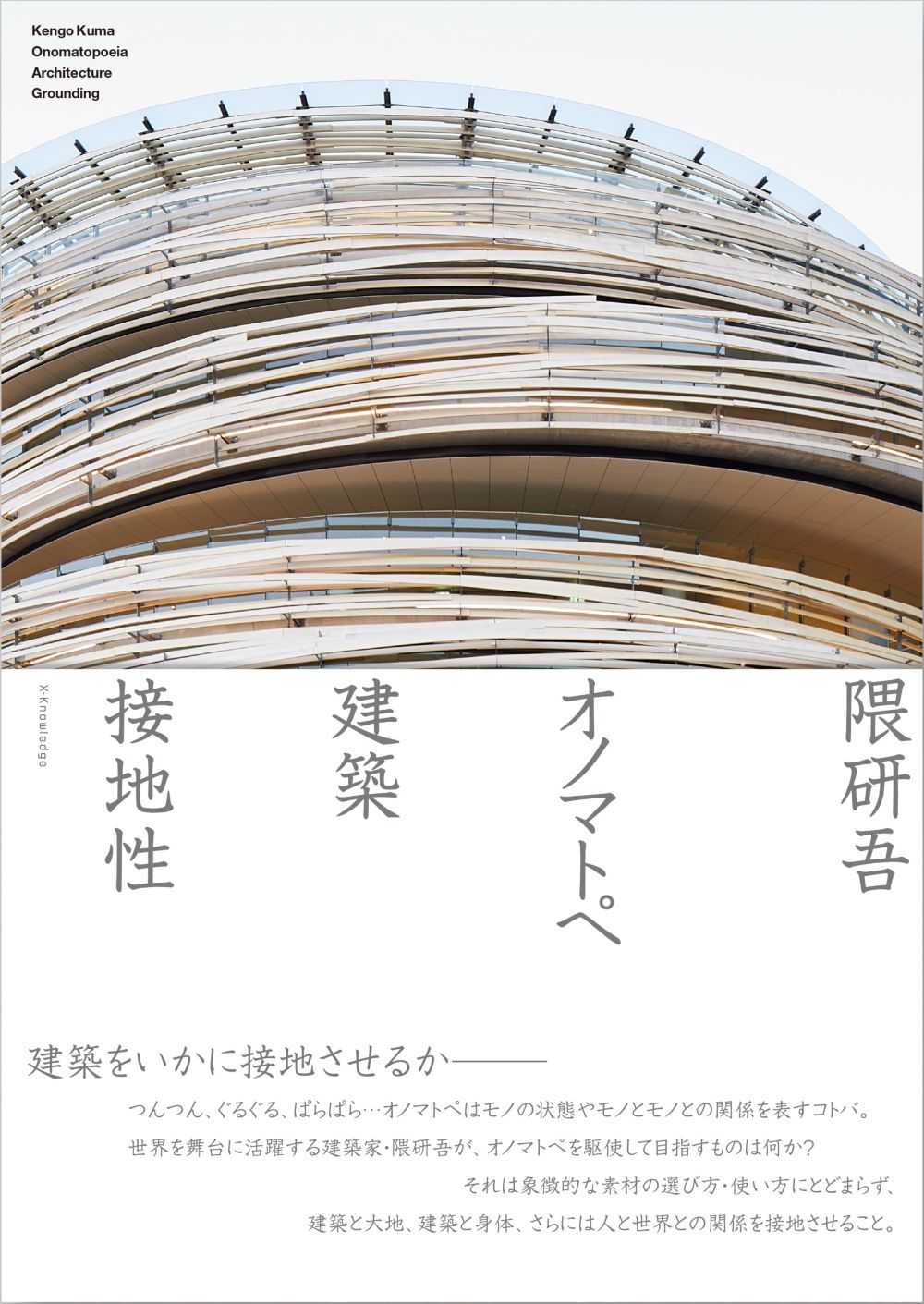
Title
Kuma Kengo Onomatopoeia Kenchiku Setchisei (Kengo Kuma Onomatopoeia Architecture Grounding)
Size
256 pages, B5 format
Language
Japanese
Released
August 01, 2024
ISBN
9784767833217
Published by
X-Knowledge Co., Ltd.
Book Info
See Book Availability at Library
Japanese Page
As I have increasingly participated in discussions regarding AI, I recently collaborated with Professor Yutaka Matsuo to present a project titled “Domino 3.0” at the Venice Biennale International Architecture Exhibition, the world's largest architectural event. Through our dialogues, I encountered the term "Symbol Grounding Problem." This led to the discovery that what I have been striving for is, in essence, the "grounding" of architecture, reclaiming structures that have become floating, detached symbols and firmly re-establishing their connection to reality.
Looking back at architectural history, 20th-century Modernism can be summarized as a movement, or a revolution, to treat architecture as a symbol severed from the earth, allowing it to be sold freely on the market. The technique of the pilotis—using slender columns to lift a building off the ground—is a confession that the essence of Modernism lies in this act of "severance."
The extent to which this severance has impoverished human life becomes clear when comparing cities built after Modernism with those that came before. The question then arises: how should we "re-ground" architecture?
While it goes without saying that we need physical methods to reconnect buildings to the earth through landscape design, I believe the concept of "grounding" must also encompass the effort to reconnect the human body with architecture—which has evolved in a distorted manner by pursuing only visual, symbolic impact.
Currently, however, our vocabulary for this reconnection with the body is woefully meager. I believe the primary cause is that, prior to Modernism, this role was entrusted almost entirely to the realm of "ornament." Carrying various narratives, ornament served to firmly bind the heart, the body, and the architecture together. But because Modernism viewed ornament as an enemy and systematically eliminated it, we completely lost the means and the opportunity for that integration. In its place, Modernism provided a mathematical vocabulary—verticality, horizontality, rectangular parallelepipeds, and spheres—which was too sparse, leaving architecture and the body in a state of lonely fragmentation.
To transcend these impoverished mathematical and engineering tools, I began to focus on the ambiguous linguistic system of onomatopoeia.
At first glance, onomatopoeia may seem vague and subjective. However, by comparing and delving into the onomatopoeia of various languages, I discovered a surprisingly rich scientific nature and a universality that transcends nations and cultures, approaching the very essence of humanity. If you observe our architecture—designed with hints taken from onomatopoeia—alongside these concepts, I am certain you will feel that onomatopoeia is, indeed, a linguistic system for the future.
(Written by KUMA Kengo, University Professor / Professor Emeritus, Office of University Professor, School of Engineering / 2026)