

 Find a book


Title
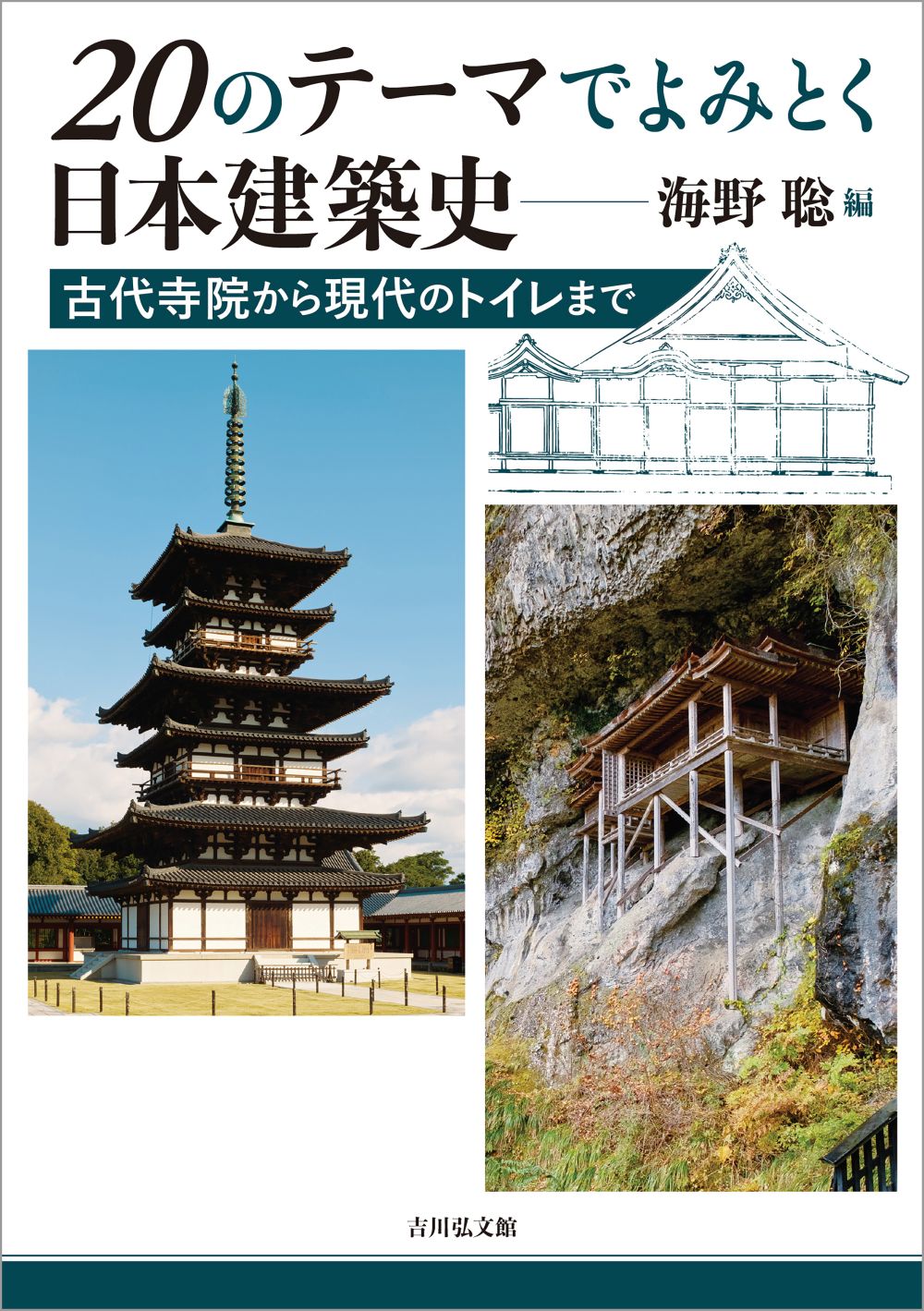
20 no theme de yomitoku Nihon Kenchiku-shi (The History of Japanese Architecture through 20 Topics: From Ancient Temples to Modern Toilets)
Size
248 pages, A5 format
Language
Japanese
Released
March 24, 2025
ISBN
9784642084741
Published by
Yoshikawa Kobunkan
Book Info
See Book Availability at Library
Japanese Page
 eBook
eBook
This book is an attempt to present diverse issues concerning architectural culture as an “accumulation of individual studies” while delineating a single, cohesive intellectual horizon. As I descired in the preface, the idea behind this work was to bring together research that does not fit within the traditional frameworks of chronological narrative or stylistic history and to consider architecture from various angles as a cultural endeavour. The contributors are primarily young academics, centred on current and former graduate students, and the book is built upon individual research findings accumulated in the course of their education and research. Consequently, this volume is not merely a collection of academic articles, and it has the character of a record of collective knowledge existing as an extension of graduate-level education.
The preface begins by clearly showing a critical awareness of the current state of the study of architectural history. That is to say, it recognizes that conventional methods, which describe architecture in terms of the development of form or technology, fail to fully capture underlying aspects such as religious beliefs, intellectual thought, social structure, function, and human endeavour. This book was compiled with the aim of surmounting these limitations and situating architecture within the context of cultural history. The topics of the individual chapters range from ancient temple architecture and the spatial configuration of Buddhist halls to pilgrimages and the pleasures of freak shows and red-light districts in the early modern period and also to the protection of cultural properties in the modern period. While these studies may appear at first glance to be wide-ranging, they are all linked by a perspective that views architecture as a “history of relations between people and their environment.”
Furthermore, the preface emphasizes that while each contributor possesses an independent critical focus, the work as a whole has an organic structure. During the editing stage, rather than simply placing the contributions side-by-side, the chapters were arranged with consideration for chronological flow and thematic commonalities so as to create a structure in which the chapters resonate with each other. As a result, the entire book has been designed so as to constitute a “stratum of architectural culture.”
Meanwhile, in the afterword the circumstances leading to the book’s compilation and its significance are discussed. Many of the contributors are graduates who entered society after completing their graduate studies, and the accumulated discussions and joint research conducted during their time at university form the basis of this book. The afterword aims to show how such educational and collective practices function not only to deepen individual research but also as a locus for the transmission and renewal of scholarship. I would like to stress the fact that, through discussions held in staff offices, contributors from different disciplines gained new perspectives by referencing each other’s findings, thereby fostering interdisciplinary dialogue.
Underlying both the preface and the afterword is an awareness of the communality of knowledge and its transmission. By bringing together individual studies, this work gives them the weight of a book and presents the shape of an intellectual community built by young academics. This book is the fruit of an intersection of graduate educational praxis and academic inquiry, and it is hoped that it will serve as an achievement instructive for the future development of research on architectural history.
(Written by UNNO Satoshi, Associate Professor, School of Engineering / 2026)