

 Find a book


Title
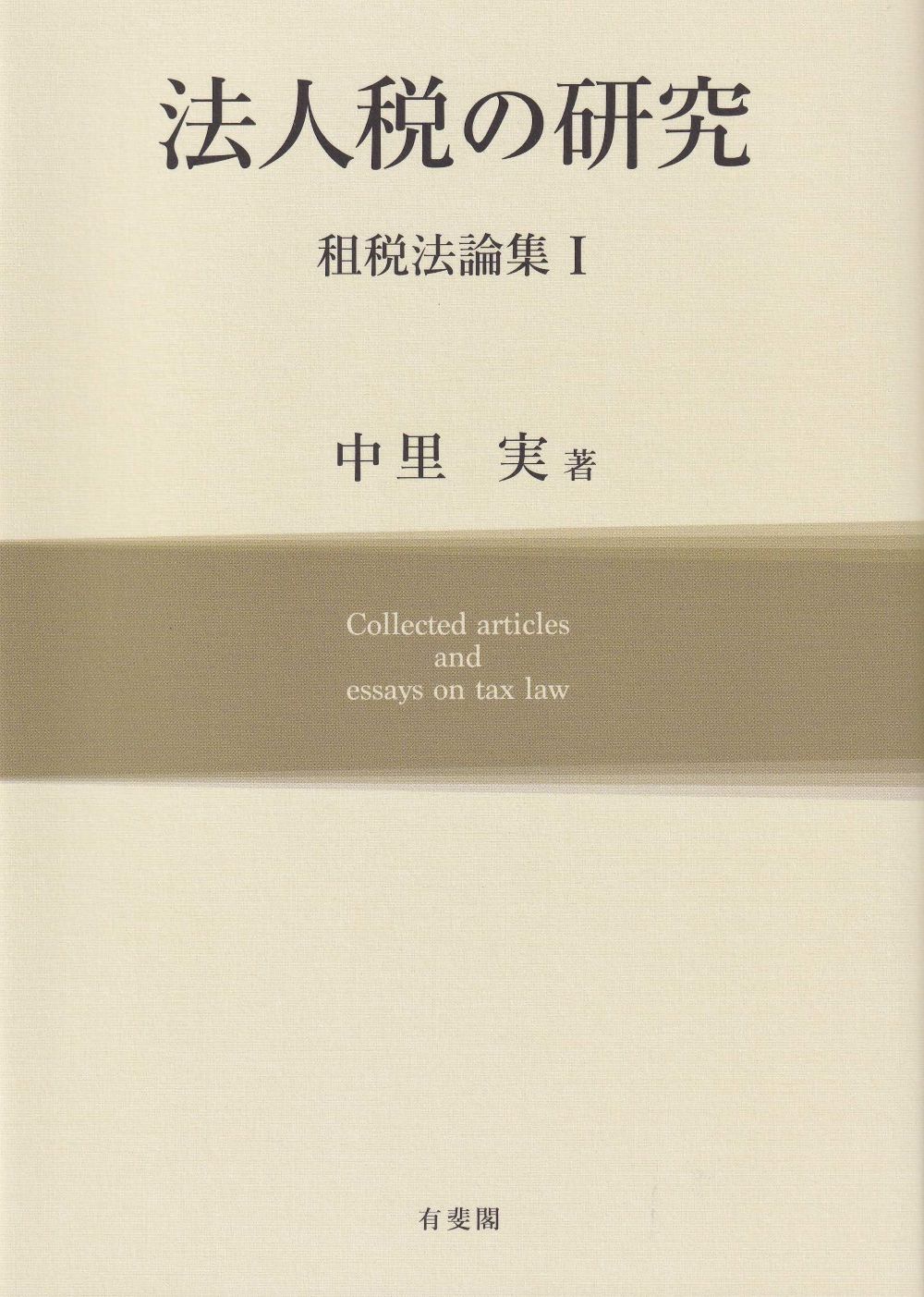
Collected Articles and Essays on Tax Law, vol.1 Hojin-zei no Kenkyu (Studies in Corporate Income Taxation)
Size
582 pages, A5 format, hardcover
Language
Japanese
Released
December 15, 2021
ISBN
9784641228054
Published by
Yuhikaku Publishing Co., Ltd.
Book Info
See Book Availability at Library
Japanese Page
 eBook
eBook
Volume 1: Studies in Corporate Taxation
――The Legal Structure and Theoretical Foundations of Corporate Income Tax
Volume 1 serves as the point of departure for this comprehensive collection on tax law theory. Its primary objective is to reconceptualize corporate income tax—not merely as a subcategory of general income taxation, but as an institutional framework with its own autonomous theoretical structure. The central inquiry governing this volume is: What is the legal nature of "income" as defined and taxed under the corporate tax system?
Part I: Financial Accounting and Tax Accounting
Part I examines the computation of taxable corporate income in its nexus with financial accounting. The core issue addressed is whether taxable income simply mirrors accounting profit, or whether it is a normative construct independently established by tax law. Through a comparative analysis of German, U.S., French, and Japanese law, this section explores the interplay between accounting regulations under commercial and securities laws and the methodologies of income calculation in tax law. Specifically, the discourse on fair value accounting clarifies that taxable income does not merely reflect "economic reality"; rather, it is the product of legal determinations shaped by the specific objectives and structural logic of the tax system. Rather than subordinating tax accounting to financial accounting or asserting its absolute autonomy, this part highlights the theoretical significance of the inherent tension between the two.
Part II: Fundamental Theory of Corporate Taxation
Part II addresses the underlying abstract theoretical issues of corporate taxation. Key themes include tax neutrality, the conceptualization of the corporation as a taxable entity, and the theoretical justification of tax rates. The analysis explores how corporate taxation influences organizational and transactional choices, and examines the implications of treating the corporation as a tax subject in relation to the temporal dimension (timing of taxation) and transactional frameworks. Using insurance and derivative transactions as case studies, this volume interrogates the scope and limits of corporate taxation—specifically, where the boundaries of "corporate income" should be drawn. Throughout this section, corporate tax is treated not merely as a revenue-raising tool, but as an institutional framework that integrates transaction structures, risk allocation, and time.
Part III: Corporate Taxation in France
Part III provides a comparative legal study focusing on French corporate taxation. Topics such as the structure of taxable income calculation, the taxation of small and medium-sized enterprises (SMEs), and anti-tax avoidance rules are analyzed within the French legal context. This comparative analysis transcends descriptive institutional comparison; it serves as a tool to relativize the assumptions underlying Japanese corporate tax theory, illuminating both the universal and specific aspects of corporate tax doctrine.
The Significance of Volume 1
Volume 1 reconceptualizes corporate taxation not as a purely pragmatic regime, but as a theoretically rigorous system intersecting accounting, economics, and comparative law. It establishes the foundational framework for subsequent volumes addressing income taxation, tax theory, and international taxation.
(Written by NAKAZATO Minoru, Professor Emeritus, Graduate Schools for Law and Politics / 2026)