


 Find a book


Title
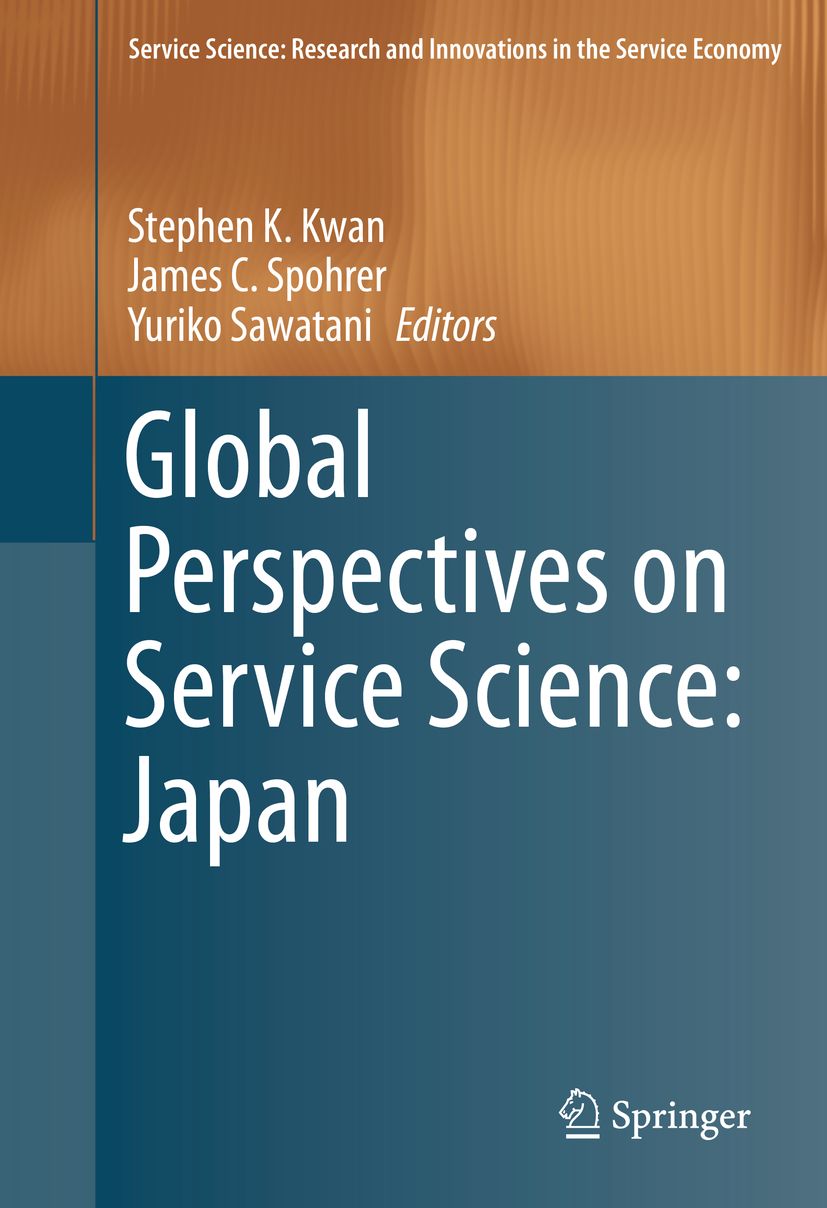
Service Science: Research and Innovations in the Service Economy Global Perspectives on Service Science: Japan
Size
349 pages, hardcover
Language
English
Released
May 26, 2016
ISBN
978-1-4939-3592-5
Published by
Springer New York
Book Info
See Book Availability at Library
Japanese Page
 eBook
eBook
The service industry accounts for approximately 75% of Japan's GDP. However, the service sector has long relied on experience and intuition for its operations, delaying the adoption of scientific, systematic approaches. This book is a collection of papers presenting Japanese service science research that addresses this global challenge directly. It consists of 21 chapters. The content covers eight domains: theoretical foundations, methodology, engineering, design, technology, industrial applications, education, and future prospects.
The book's primary academic significance lies in its reinterpretation of the Service-Dominant Logic (SDL) theoretical framework within a Japanese context. SDL views all economic activities as exchanges of services and positions customers as "co-creators" of value, not merely as consumers.
The book features an impressive case study of the conveyor-belt sushi chain Kura Sushi. Kura Sushi uses a "Time-Limited Freshness Management System," in which each plate is labeled with a QR code and the sushi is discarded automatically after 55 minutes. The company also analyzes five years of customer attribute data to determine the optimal combination of sushi to send to the conveyor belt, taking into account visit time and customer demographics.
The long-established ryokan Kagaya has introduced robots along its hundreds of meters of food delivery routes to improve efficiency and enable employees to focus on providing "omotenashi," or high-level hospitality. These examples embody the fusion of scientific methods and the Japanese spirit of service.
Methodologically, the book is unique in that it systematizes service engineering R&D into four stages: "Observation," "Analysis," "Design," and "Application," and specifies concrete technologies for each stage. The "observation" stage uses sensing technologies and IC tags to visualize behavior; the "analysis" stage uses Bayesian networks and data mining; the "design" stage uses agent-based simulation; and the "application" stage uses IT technologies.
The ground operations simulation at Haneda Airport, covered in Chapter 8, exemplifies the effectiveness of this framework.
Another notable aspect of the book is its contribution to education and human resource development. The MBA program at the University of Tsukuba has developed a method of learning about service system interactions through manga-based case studies. This method provides a concrete pathway for cultivating the next generation of leaders responsible for service innovation.
In terms of social significance, the book is important because it presents a perspective on applying service science to solve societal challenges in the aftermath of the Great East Japan Earthquake. The book also explicitly outlines technology adoption guidelines, which are particularly beneficial for enhancing the productivity of small and medium-sized enterprises (SMEs) via the Ministry of Economy, Trade and Industry's Service Engineering Roadmap. The book envisions a "Service Innovation Community," formed through collaboration between industry, academia, and government, to support the societal implementation of research outcomes.
This book is an excellent introductory text for examining the services present in every aspect of daily life through a scientific lens. Additionally, it provides a valuable opportunity to recognize that service science lies at the intersection of diverse academic fields, including engineering, information science, management, and psychology, and to cultivate interdisciplinary thinking skills.
(Written by AOYAMA Kazuhiro, Professor, School of Engineering / 2026)
Table of Contents
Chapter 1: Introduction
Authors: Jim Spohrer, Stephen K. Kwan, Yuriko Sawatani
Part II: Foundations
Chapter 2: Service Innovation in Japan and the Service-Dominant Logic
Authors: Teruyasu Murakami
Chapter 3: Context Management Approach to Value Co-creation: Toward Dynamic Process Model of Customer as Value Co-creator
Authors: Yoshinori Fujikawa, Satoshi Akutsu, Joji Ono
Chapter 4: Human Behavior Observation for Service Science
Authors: Haruhito Matsunami, Aya Kubosumi, Kanako Matsumoto
Part III: Methods
Chapter 5: Community-Based Participatory Service Engineering: Case Studies and Technologies
Authors: Yoichi Motomura, Takeshi Kurata, Yoshinobu Yamamoto
Chapter 6: Methodology of Workshop-Based Innovative System Design Grounded in Systems Engineering and Design Thinking
Authors: Toshiyuki Yasui, Seiko Shirasaka, Takashi Maeno
Chapter 7: Wants Chain Analysis
Authors: Takashi Maeno, Seiko Shirasaka, Toshiyuki Yasui
Chapter 8: Interactive Service Design Method: Application to Aircraft Operations at Haneda Airport
Authors: Kazuo Furuta, Takanori Kaneko, Taro Kanno, Shigeki Yoshihara, Takamichi Mase
Part IV: Engineering and Design
Chapter 9: Service Design in Tourism: Encouraging a Cooperative Relationship Between Professional Design and Non-professional Design
Authors: Tatsunori Hara, Kazuhiro Aoyama, Yohei Kurata, Naoto Yabe
Chapter 10: Value Co-creation Process and Value Orchestration Platform
Authors: Kyoichi Kijima, Yusuke Arai
Part V: Technology
Chapter 11: Formalizing Expert Knowledge Through Machine Learning
Authors: Tsuyoshi Idé
Chapter 12: Agent-Based Simulation for Service Science
Authors: Hideyuki Mizuta
Chapter 13: Temporal–Spatial Collaboration Support for Nursing and Caregiving Services
Authors: Naoshi Uchihira, Kentaro Torii, Tetsuro Chino, Kunihiko Hiraishi, Sunseong Choe, Yuji Hirabayashi, Taro Sugihara
Chapter 14: Quest for Equation of Life: Scientific Constraints on How We Spend Our Time
Authors: Kazuo Yano
Part VI: Industry
Chapter 15: The Spread of Services and Consumer Value Co-Creation
Authors: Makoto Usui
Chapter 16: Sustainability and Scalability in Japanese Creative Services
Authors: Yoshinori Hara, Yoshikazu Maegawa, Yutaka Yamauchi
Chapter 17: Knowledge Structuring Tools for Decision Support Service: An Overview of Citation-Based Approach
Authors: Ichiro Sakata
Chapter 18: R&D Servitization in the Manufacturing Industry
Authors: Yuriko Sawatani, Yuko Fujigaki
Part VII: Education
Chapter 19: MANGA-Case Training for Global Service Science
Authors: Akiko Orita, Atsushi Yoshikawa, Takao Terano
Chapter 20: Creation of Service Science Curriculum for Customer-Oriented Business Innovation
Authors: Hideaki Takagi, Yukihiko Okada, Akiko Yoshise, Maiko Shigeno
Part VIII: Future
Chapter 21: Service Engineering Road Map of Ministry of Economy Trade and Industry in Japan
Authors: Takafumi Kinoshita, Kazuaki Ibe, Mitsuru Kawamoto, Kitayoshi Tsumita, Yasuhiro Maeda