


令和8年度 東京大学秋季入学式 農学生命科学研究科長式辞
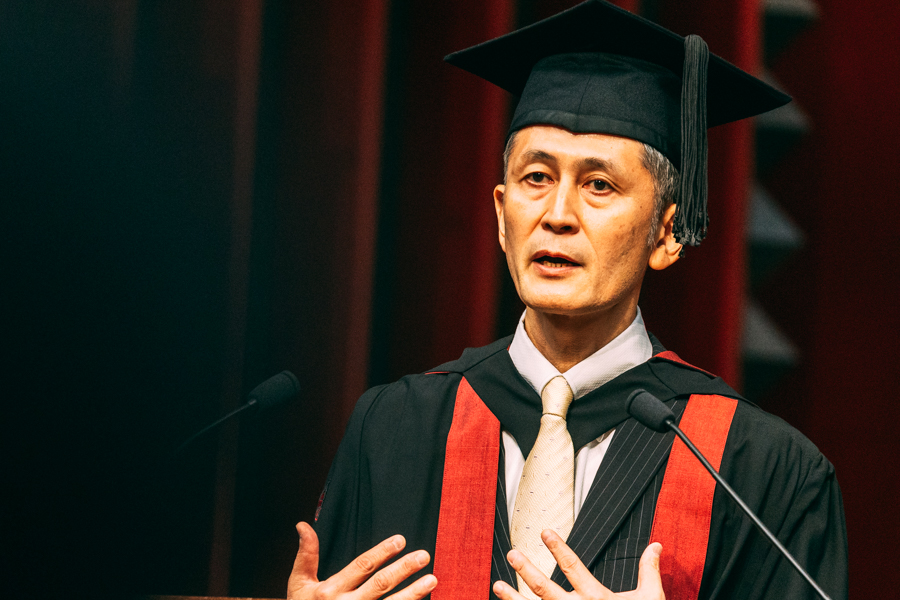
Dean’s Address at the 2026 Autumn Semester Matriculation Ceremony
Congratulations, everyone, and welcome to the University of Tokyo.
And a big congratulations to your families and friends who are here today. I’m told that about eighty percent of you are international students, so I want to talk about something you will certainly experience: the walls you’ll encounter and the freedom you’ll gain in academic life. These two forces, walls and freedom, are closely connected and will shape your growth more than you might expect.
Thirty-seven years ago, I was in the same position as you. I went to the United States as an international graduate student. Back then, there were no smartphones, no internet, and no easy way to call home. With just a one-way ticket, I crossed the Pacific to start graduate school. I still remember the moment the plane took off from Narita—my chest tightened, and my eyes felt warm. I was leaving Japan, a place surrounded by cultural and geographic “walls,” and stepping into the wide, open world.
Japan at that time was in the bubble economy, and lifetime employment was the standard path. Once you got a job, life became stable and predictable—almost like reaching the final square of a board game. But to me, that felt too predetermined. I didn’t want my time or choices to be restricted. I wanted to see a world I had never seen and test my own potential in the freedom that academic life offers.
When I arrived in the U.S., I quickly sensed many walls around me and realized just how different the world could be. Japan is a very homogeneous society, but the U.S. is incredibly diverse. Languages, cultures, values, ways of thinking—everything was different. You could see this even in the newspapers. In 1989, when I went abroad, major events like Tiananmen Square and the Berlin Wall fell were happening. The same event was described completely differently depending on the country. For example, the Berlin Wall was called a “protective barrier” in socialist countries, but a “symbol of lost freedom” in the West. Same wall, totally different meaning. That’s not a cultural wall—it’s an ideological wall. And as international students, you will encounter these differences everywhere—in conversations, in classrooms, and in daily life.
You will face cultural walls, language walls, and value-based walls. But I encourage you to look beyond them. Listen. Observe. Try to understand what’s on the other side. You don’t have to agree with everything. But if you can respect that other perspectives exist, you will grow—and you will become true global citizens. This mindset is essential not only in daily life but also in research. Science is not a single straight road. It is a field where diverse ways of thinking lead us toward truth.
So does academia have “walls”? A famous 19th-century scientist, Louis Pasteur, once said, “Science has no borders, but scientists have a homeland.” I felt exactly that. Japan is my homeland, and I love its culture deeply. But the science I learned—the logic, the methods, the way of thinking—was universal. At the same time, discussing science with people from different backgrounds brought out new ideas. Differences didn’t divide us; they expanded our thinking.
In this sense, research has no walls. It transcends national, cultural, and ideological boundaries. And because of that, it offers freedom. Academic freedom is one of the most important principles of the university, and it is one of the most attractive to us. The freedom to research, to publish, and to teach—these are protected by our Constitution. I want you to enjoy that freedom. Use it to explore ideas, challenge assumptions, and discover new possibilities.
But freedom also comes with risks. Too much freedom can lead to low-quality research, irreproducible results, or even misconduct. Issues like dual-use concerns, personal data protection, and animal ethics must always be kept in mind. When freedom is not accompanied by responsibility, research environments can become closed and isolated, drifting away from common sense. Please avoid that. Practice a balanced kind of freedom. Because you are free, you must manage yourself, take responsibility, and plan your work carefully.
By now, you may have realized that what I’ve talked about today applies not only to international students, but also to Japanese students. Facing different “walls” helps you develop the ability to adapt—an ability valuable to anyone, anywhere. And understanding how to use “freedom” wisely is essential for all of you as you begin your academic journey.
So let me end with my take-home message to all of you.
Your time in graduate school is when you will begin to form your identity. In that process, please let many walls become transparent. Transparent walls mean that while you need certain boundaries to keep your identity from being easily swayed by trends, their transparency allows you to see the world beyond. If you keep looking beyond the wall, your perspective will widen, your research will flourish, and you will be able to enjoy and use the academic freedom to its fullest. And regarding freedom, please remember this: Don’t be defeated by freedom. Master your freedom. Stay disciplined in your freedom.
All of us on the faculty look forward to seeing you grow into such individuals. And we will support you with all our strength. Let’s work hard together.
Once again, congratulations.
TOUHARA Kazushige
Dean of the Graduate School of Agricultural and Life Sciences
The University of Tokyo
October 1, 2026
関連リンク
- カテゴリナビ