




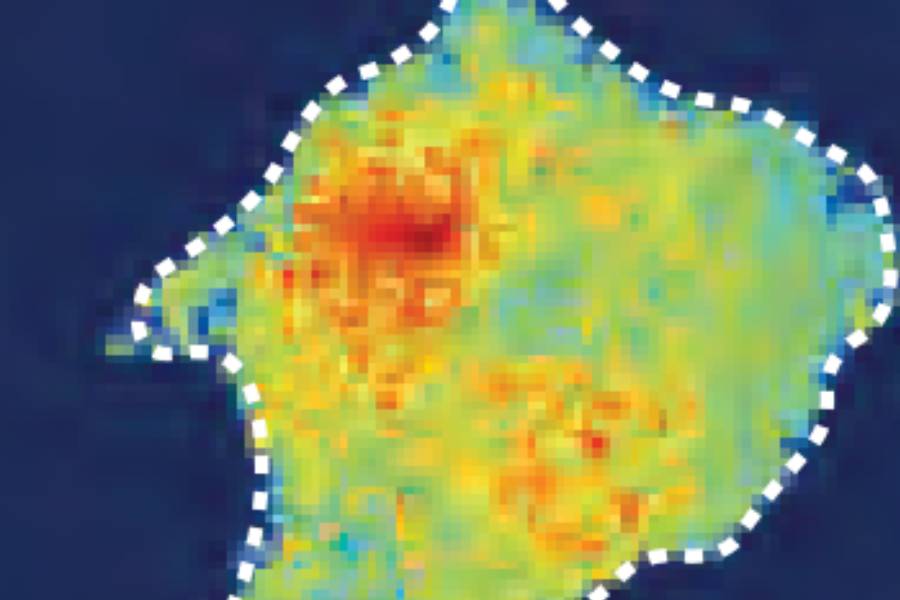
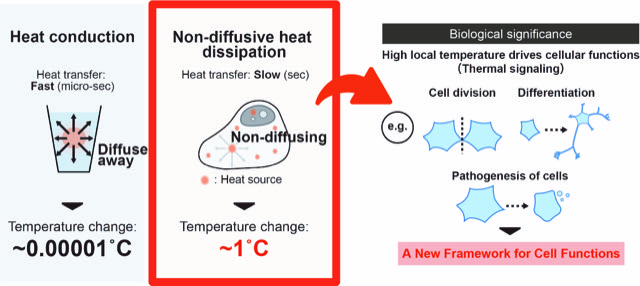
Living cells cool much slower than our current understanding of heat conduction can explain, according to new research from the University of Tokyo. Researchers used two techniques — high-speed temperature mapping and artificial heating — to observe how heat dissipated from living cells and similar-sized artificial, fluid-filled sacs (liposomes). While heat dispersed quickly from the artificial liposomes as expected, cells cooled significantly more slowly due to other biomolecules within the cell. Understanding the process behind slower heat dissipation within cells could affect how we treat conditions linked to changes in body temperature, such as epilepsy, inflammation and cancer.
Do you tend to run a little hot or are you cool as a cucumber? Your internal body temperature is the byproduct of all the work your cells do to keep you living, moving and thriving. More recently, researchers have found that spontaneous heat generation in our cells, which can change by as much as 1-2 degrees Celsius, appears to play an important role in driving some key cell-based activities and functions. So far, this includes changing neural stem cells into neurons and the heat shock response, which protects stressed cells from damage.
As our cells are sacs of mostly jellylike fluid, it is not unreasonable to think that the heat they generate would behave according to the typical laws of physics which apply to all fluids. However, a paper published in 2012 provided the world’s first map of temperature distribution within a cell, along with a surprising revelation.
“Our results showed a massive gap between the ‘laws of physics’ and the ‘reality of life’ in terms of how temperature changes within a cell,” explained Project Associate Professor Kohki Okabe from the Graduate School of Pharmaceutical Sciences, co-author on this latest research and lead author of the 2012 paper. “We felt driven to solve this contradiction ourselves and have now found that cells are highly specialized environments that handle heat in a very unique way.”
The team used an ultrasensitive microscope (called a high-speed fluorescence lifetime imaging microscope), along with a custom-made thermometer to map temperature changes in detail in real time. After heating part of a cell with an infrared laser, they monitored the cooling process with millisecond precision. The team performed the same tests on artificial, cell-like sacs of fluid (liposomes). They then compared the temperature changes inside the cells and the liposomes with their model-based predictions.
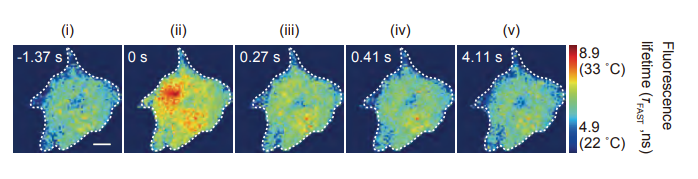
According to conventional physics, heat should spread out (diffuse) from a fluid very rapidly, which the team saw happen with the liposomes. However, they found that inside a cell, heat tended to “stay put.” Diffusion was not only slow, but it also depended on where within the cell was heated and the surrounding molecules. From their observations, they concluded that the slow rate of change was an intrinsic property of the cells, and not due to a side effect of the research method.
“The phenomenon of ‘nonspreading heat’ is so unprecedented we could not rely on existing textbooks to decipher the physical mechanism behind what we saw. This phenomenon completely flips our conventional understanding on its head,” said Okabe.
Next, the researchers want to delve deeper into the mechanisms behind this slow heat transfer. “We believe that this trapped heat is not just waste; it acts as a concentrated energy source that powers cellular functions,” explained Okabe. “By redefining heat as an ‘active signal’ that cells use to control themselves — rather than just a byproduct — we hope to unlock new ways to understand life and develop innovative medical treatments.”